Vote: Over 10 MW | 2026 Project of the Year Awards

Here are the Over 10 MW finalists for the 2026 Solar Builder Project of the Year awards.
The form is at the bottom of the page. You are allowed to vote once per day from now until Friday, Oct. 16 at midnight (ET). (FYI: Our voting widget will let you vote more than once a day, but we filter these out in the back-end. Sorry, ballot stuffers.) Winners will be announced and prominently featured in the Q4 issue of Solar Builder magazine and online in December.
Thanks to Aurora Solar for sponsoring the 2026 Project of the Year Awards.
Be sure to vote in every category!
Bellefield Solar Project 1
Mojave, California | 641 MWdc
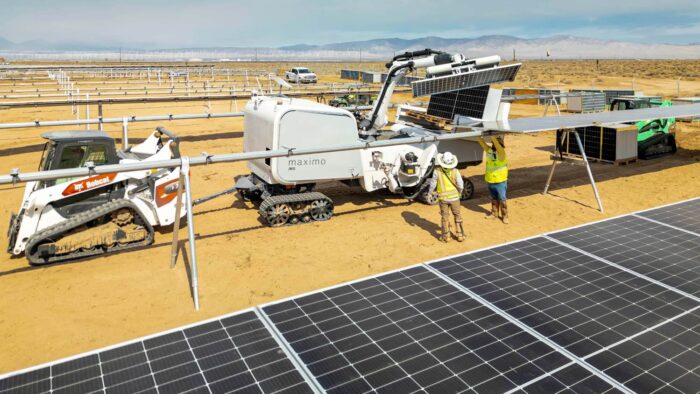
Bellefield Solar is a landmark project supporting California’s transition to a carbon-free energy future. Owned by AES, the project combines utility-scale solar generation with battery energy storage to deliver reliable renewable energy while enhancing grid resiliency during periods of peak demand. The first phase of the development, Bellefield 1, included 641 MWdc of solar generation with an equally sized phase two in progress. Phase one also included 500 MW of battery storage, with an equally sized phase two in progress. Primoris Renewable Energy, served as the engineering, procurement, and construction (EPC) contractor for the solar installation in phase one, and is serving as the solar and battery storage EPC contractor in phase two.
Bellefield 1’s included more than 1,187,000 Canadian Solar 540W modules and 160 Sungrow 3,600kW inverters, with a 14-mile transmission line connecting the facility to Southern California Edison’s Windhub Substation. But, what makes Bellefield 1 particularly notable is how the project team approached the challenge of building at that scale and the ways the project has helped shape the future of solar construction.
AES’s Maximo AI-enabled robotic solar installation system was integrated directly into active construction, working alongside field crews to assist with the lifting, positioning and installation of solar modules, and isone of the earliest large-scale deployments of AI-enabled solar installation technology on a project of this magnitude.
Rather than replacing conventional installation methods, Maximo functioned as a force multiplier for field crews, becoming part of the daily construction process. Bellefield provided a real-world environment to test and refine the technology under actual field conditions, with the field team providing feedback as the system evolved. That work helped advance the technology, with the latest Maximo systems surpassing installation rates of one module per minute under optimized conditions.
Behind the project’s scale and magnitude was a coordinated effort across engineering, procurement, construction, logistics, and field operations. The team successfully managed the installation of more than one million modules and miles of supporting electrical infrastructure while adapting to evolving project conditions and maintaining a strong focus on safety, quality and productivity. The result is a major new energy resource for California – one that pairs renewable generation with large-scale storage to provide clean power when it is needed most.
Bellefield 1 demonstrates what can happen when ambitious energy infrastructure is matched by an equally ambitious approach to how it is built. By combining solar generation with robotics, field-driven problem solving, and experienced craft professionals, the project is helping deliver reliable, dispatchable clean energy today while helping define the next generation of large-scale solar projects.
Developer: AES Clean Energy | EPC/Installer: Primoris Renewable Energy | Modules: Canadian Solar | Inverters: Sungrow | Mounting/Racking: Array Technologies
Big Muddy Solar Project
Jackson County, Illinois | 124 MWdc
There’s a monster at the heart of Big Muddy Solar — literally. The 124 megawatt (MWdc) project takes its name from the Big Muddy River, and its logo features Murphysboro’s legendary Big Muddy Monster. Fittingly, Arevon is going big in Jackson County: big on power, big on land stewardship, and big on local impact.
When operational, Big Muddy will generate enough electricity to power more than 24,000 Illinois homes annually. CoVolt, formerly Signal Energy, is the project’s construction contractor who is working with Arevon to build the facility on privately owned land with a workforce of approximately 250, including members of IBEW Local 702, IUOE Local 318, and LIUNA Local 773.
However, some of Big Muddy’s coolest impact is happening below the panels.
The ground-mounted array will tilt to follow the sun, while approximately 580 acres beneath and around it will become pollinator-friendly habitat. Arevon worked with plant and soil scientists to develop a low-growing seed mix specifically for southern Illinois, selecting perennial grasses and flowering plants that stabilize soil, absorb stormwater, inhibit invasive species, and bloom at different times throughout the year. The result: solar generation above, productive habitat below.
Big Muddy is monster-sized beyond the fence line, too. The project is expected to deliver more than $12.6 million in lifetime property tax payments, including approximately $5.9 million for School District #196 and $3.1 million for Jackson County. Once operating, it is also projected to generate approximately $1.25 million in additional local economic activity annually.
Developer: Arevon Energy Inc. | EPC/Installer: CoVolt (formerly Signal Energy); workforce includes members of IBEW Local 702, IUOE Local 318, and LIUNA Local 773 | Modules: First Solar and Jinko Solar | Inverters: TMEIC | Mounting/Racking: Nextpower
Escape Solar + Storage Project
Mesquite, Nevada | 185 MWac PV + 400 MWh BESS
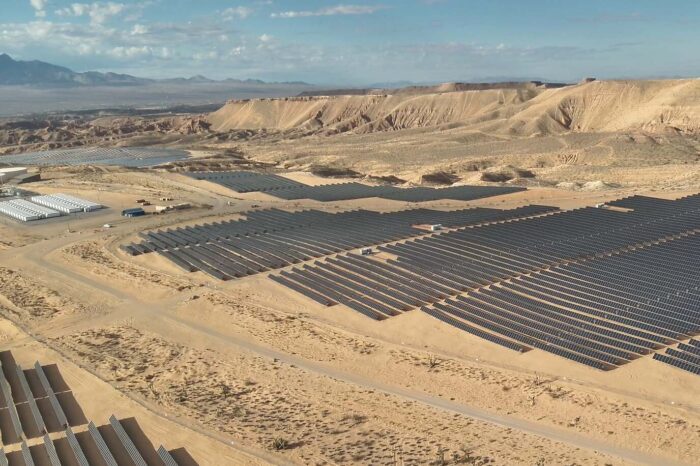
The Escape Solar + Storage Project demonstrates how strong partnerships can create value for energy customers, workers, and communities. Escape serves four key Nevada customers who have ambitious renewable energy targets – MGM Resorts International, Caesars Entertainment, Wynn Las Vegas, and Overton Power District. The four-PPA structure allows each customer to access renewable energy at prices that would usually only be available at larger contract sizes. The inclusion of BESS allows MGM to use power when it is in shortest supply and work toward its 100% renewable goal.
Nevada has no shortage of challenging solar sites, and yet Escape still stands apart due to its complex terrain, hydrological conditions, interconnection and deliverability approach, and location within desert tortoise habitat. Arrays were constructed on slopes of over 15% using the ATI Omnitrack system. Three utilities are involved with the project, with Tesla grid forming technology strengthens the radial 138 kV system.
The project team included three EPCs, each focused on their area of excellence: Bechtel (array), Tesla (BESS), and Dashiell (substation and network upgrades). The project was delivered early and under budget despite challenges faced during construction and design, including module supply and tariff concerns. In fact, Escape was delivered in 26 months from the time that Estuary first identified the site, to first power production.
The project creates substantial economic development for a rural county that has not seen much renewable development, and created over 400 well paying union jobs during construction performed by IBEW, OE, and LIUNA locals – all of whom have indirect ownership in the project through their pension plans.
Developer: Estuary Power | EPC: Bechtel, Tesla, Dashiell | Modules: Jinko | Inverters: Sungrow | Mounting/Racking: ATI | Storage: Tesla
Gibson City Solar
McLean and Ford County, Illinois | 346 MWdc
The 346-MWdc Gibson City Solar Project demonstrates how utility-scale solar can address major industry challenges. Developed by Earthrise Energy and delivered by Burns & McDonnell, the project achieved commercial operation under budget while advancing solutions for grid interconnection, construction execution and site sustainability. Rather than waiting years for new transmission capacity, the project leveraged Earthrise Energy’s surplus interconnection strategy, using available capacity through the existing switchyard of an adjacent natural gas peaking facility. This transformed an interconnection constraint into a repeatable model for accelerating renewable generation deployment. Constructed across approximately 1,700 acres in Ford and McLean counties, the facility includes more than 586,000 Runergy high-efficiency solar modules mounted on approximately 6,000 NextPower terrain-following trackers.
One of the toughest challenges was serving multiple power purchase agreements (PPAs) which required coordination among counties, townships, utilities and permitting authorities. The work included a new 34.5/138-kV collector substation, a gen-tie connection to the existing brownfield gas peaking station, and controls capable of coordinating multiple PPAs. The team also engineered multiple collection circuits extending nearly four miles, creating a complex electrical design and commissioning effort. A controls upgrade allowed the facility to tie into existing infrastructure.
Gibson City also served as a proving ground for AI-enabled solar construction. Burns & McDonnell deployed autonomous construction technology from Gritt to install a portion of the modules using intelligent systems integrated with conventional construction equipment. The site helped test the technology and improve real-world learning for future projects. The technology demonstrated how automation can reduce worker exposure to repetitive lifting motions common in solar installation.
The project’s peak workforce exceeded 350 craft professionals and successfully overcame challenging subsurface conditions. Approximately 900 piles required remediation after failing pull tests, leading the team to develop and implement an approved solution — involving larger, deeper augured foundations filled with concrete — while maintaining project momentum.
Developer: Earthrise Energy | EPC: Burns & McDonnell | Installer: AZCO | Modules: Runergy | Inverters: SMA | Mounting/Racking: NextPower
Tilden Solar
Tilden, Illinois | 150 MWac
Sol Systems’ Tilden Solar represents transformation within the rural Southern Illinois community of Tilden, whose history and economy were deeply rooted in coal mining. Following the closure of the Tilden mines in the 1990s, the former mining land faced limited opportunities for redevelopment. Today, that land is home to the world’s largest solar facility constructed on reclaimed mining land. With McCarthy serving as the Engineering, Procurement, and Construction (EPC) contractor, the team delivered a 150 MWac / 186 MWdc solar facility, generating enough renewable energy to power more than 33,800 Illinois homes annually.
Technical Merits & Installation Challenges:
Manufacturing delays with the originally selected module threatened the construction schedule. To keep the project on course, Sol Systems pivoted to Canadian Solar modules just two weeks before the first scheduled delivery. The McCarthy team adapted the design for differences in module weight, connections, and wattage while preserving the original site layout.
The transition to the new modules required the team to adjust installation logistics across more than 260,000 panels. To accommodate these changes, the project team utilized a specialized skidsteer attachment to rotate the modules 90 degrees for more efficient installation, supporting the project schedule and limiting physical strain on craft installers.
Subsidence, or the gradual sinking of the surface above a mine, was a critical consideration throughout design and construction. The team used InSAR satellite technology to monitor ground movement from baseline through completion, with final reporting showing less than one inch of displacement throughout construction. Site conditions were further tested by two 100-year floods that shut down critical civil work for more than three weeks, followed by an ice storm that challenged access, equipment and installation conditions. Despite the redesign, weather impacts and schedule disruptions, the team delivered Tilden within budget and three weeks ahead of schedule.
Developer: Sol Systems | EPC/Installer: McCarthy Building Companies, Inc. | Modules: Canadian Solar | Inverters: Sungrow | Mounting/Racking: Nextpower
Wattsmart VPP Battery Program
Madison, Utah, Idaho, Wyoming, Oregon, Washington | Over 72 MWh
The Wattsmart Battery VPP program, developed by sonnen and Rocky Mountain Power (RMP), is a large-scale VPP that aggregates both residential and commercial solar batteries to strengthen grid stability, lower community energy costs, and reduce reliance on fossil fuels. The program provides participants with eight distinct grid services, pays participants upfront ($15 – $50 per kW), and gives ongoing incentives (on top of upfront enrollment incentives of up to $2,000) while also retaining a safe reserve of 10% – 20% so participants always have emergency power during local utility outages.
The program uses advanced software to aggregate hundreds of home and business batteries into a unified, responsive power station. It responds instantly to rapid, unexpected grid fluctuations instead of only acting during planned peak times. The program is dispatched every single day of the year, including 365 dynamic daily cycle dispatches + > 160 frequency response dispatches.
The Wattsmart program goes beyond basic demand response by allowing the utility to use the battery hive for a full suite of daily grid services (e.g. frequency support, voltage stabilization, etc.), which offsets the need to build or dispatch traditional, dirty peaker plants. The physical hardware has a projected lifespan of 10 to 15 years. It has created a localized boom for participating installers, with sonnen’s contractual partners like ES Solar seeing 90%+ battery attachment rates for new solar sales and high demand for retrofitting batteries to existing systems. Contractors like ES Solar have seen massive growth since partnering with sonnen: the team grew from ~40 employees to over 600 in four years, becoming the largest residential solar contractor in Utah.
The Wattsmart Battery VPP program exceeds 6,000 homes and provides more than 72 MWh of fully dispatchable energy reservoirs in the Mountain West region alone. The program was featured in the Department of Energy’s 2025 VPP Liftoff Report, being cited as “among the most advanced VPP(s) in the U.S.” Today, the Wattsmart program is active in Utah, Idaho, Wyoming, Oregon and Washington. sonnen and RMP initially kicked off the program in Utah during the Fall of 2021. During the second half of 2025, the Wattsmart program was further expanded by PacifiCorp (parent company of RMP) to include the Western U.S. Grid that encompasses much of the Rocky Mountains and Pacific Northwest, making it one of the most expansive VPP programs in the country.
Developer: Sonnen Inc. USA and Rocky Mountain Power | EPC/Installer: ES Solar | Modules: Sonnen | Inverters: Sonnen | Storage: Sonnen