Vote: Under 100 kW | 2026 Project of the Year Awards

Here are the Under 100 kW finalists for the 2026 Solar Builder Project of the Year awards.
The form is at the bottom of the page. You are allowed to vote once per day from now until Friday, Oct. 16 at midnight (ET). (FYI: Our voting widget will let you vote more than once a day, but we filter these out in the back-end. Sorry, ballot stuffers.) Winners will be announced and prominently featured in the Q4 issue of Solar Builder magazine and online in December.
Thanks to Aurora Solar for sponsoring the 2026 Project of the Year Awards.
Be sure to vote in every category!
Cal Black Memorial Airport Microgrid
San Juan County, Utah | 40 kW solar + 200 kWh BESS
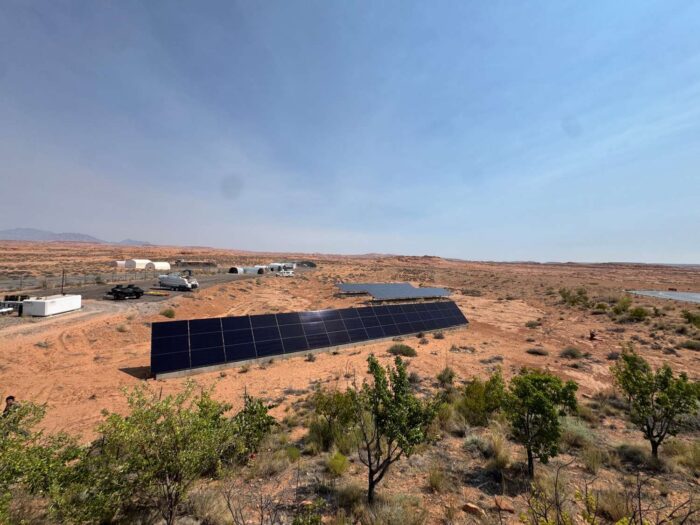
More than three decades after Cal Black Memorial Airport became the first fully solar-powered airport in the U.S., Obodo Energy Partners returned to modernize the off-grid energy system that keeps the remote Utah airport operating. Located near Lake Powell, the FAA-operated airport functions independently of the utility grid and relies on its energy system for runway and approach lighting, fuel pumps, navigation aids, communications, and emergency operations including firefighting and medical evacuations.
By 2025, the airport’s electrical demands had grown since the system was overhauled in 2014, with additional lighting, heating and air-conditioning needs, and other operational loads. As existing equipment approached the end of its useful life, the system was repowered to increase capacity and reliability while maintaining its independence from the utility grid. The upgrade added 48 REC 420-watt solar modules, bringing total solar capacity to 40 kW, along with 204.8 kWh of battery storage, three Sol-Ark 15K-2P-N hybrid inverters, and dual 50-kW Kohler diesel generators for backup power.
The repower did not require rebuilding the airport’s electrical system from the ground up. Careful evaluation identified which infrastructure could remain in service and which components required replacement. Most of the existing solar array, electrical power distribution infrastructure, and switchgear interface remained in place. Aging solar modules, batteries, power conversion equipment, and one diesel generator were replaced, allowing the project to modernize components that had reached the end of their service life while retaining viable infrastructure.
Cal Black’s remote location presented logistical challenges, making planning essential. The airport is 70 miles from the nearest town and an eight-hour drive from Obodo’s headquarters in Arizona. Limited nearby services meant personnel, equipment, materials, and lodging had to be planned in advance. The initial assessment required two full days at the airport to measure and evaluate the existing system, with the team staying overnight in sleeping bags on the terminal floor. For a later site visit, the team flew by small aircraft, reducing a 16-hour round trip to a same-day visit.
Developer/EPC: Obodo Energy Partners | Installer: New Grid and Gardner Energy | Modules: REC (new modules), Kyocera (existing modules) | Inverters: Sol-Ark | Mounting/Racking: Existing system | Storage: Discover Energy System – AES Rackmount
Catholic Charities Catherine Sheridan Houses Rooftop Solar
Queens, New York | 100 kWdc
At Catherine Sheridan Houses in New York City, the challenge was not fitting 100 kW of solar on the roof. It was integrating a raised array into a fully occupied senior residence, working around existing rooftop obstructions without making residents adapt to the construction above them.
The Astoria, Queens project uses a raised, planar array rather than a standard flush-mounted rooftop system. The structure is anchored to the concrete roof deck, requiring close sequencing between the roofer and solar installer: remove roofing at each attachment point, set the base plates, install the structural posts and flash the penetrations back into the roof assembly. Those details are straightforward on a drawing. On a fully occupied building serving low-income seniors, every handoff matters.
Laudato Si & Crauderueff Solar developed the project from evaluation and system design through incentives, financing and construction management, with SunKeeper Solar as EPC and installer and Catholic Charities’ preferred roofing contractor coordinating the roof work. Deliveries were staged, the electrical shutdown was coordinated well in advance and noise-producing work was controlled so residents could stay in their homes and building operations could continue safely.
“As an affordable housing operator for 50-plus years, across 35 buildings and 3,500+ residential units, it is imperative that we focus on operational efficiency to ensure the long-term sustainability of our housing portfolio. The Catherine Sheridan project aims to maximize Federal tax credit incentives, New York State subsidy resources, and our own investment to reduce energy costs and contribute to renewable energy production in our tightened utility landscape.” — David Downs, Senior Vice President, Catholic Charities POP Development and Founding Director, Laudato Si Corporation.
Developer: Laudato Si Corporation & Crauderueff Solar | EPC/Installer: Sunkeeper Solar | Modules: Silfab Solar | Inverters: SolarEdge | Mounting/Racking: Sunmodo SunTurf
Maine High Adventure Off-Grid Solar & Battery Upgrade
Grand Lake Matagamon, Maine | 1.78 kW PV + battery storage
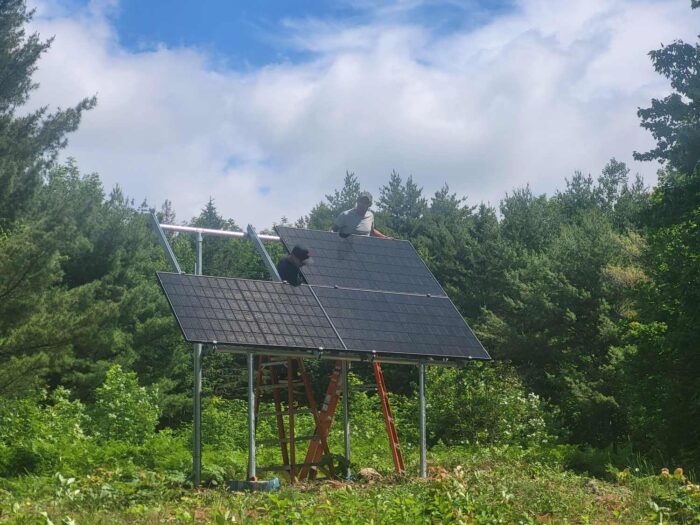
For more than 20 years, an aging solar-and-battery system helped provide power at the remote camp. By 2026, however, it could no longer reliably meet current needs. Maine High Adventure still uses a 15-kW propane generator for larger loads, including water pumping and other camp operations, but running that generator solely to support small critical loads is inefficient.
At the remote Matagamon base, reliable communications are a critical safety need. With no dependable cellular service, staff rely on satellite phones connected through Starlink to reach the outside world in an emergency. A primary goal of the solar-and-battery upgrade was to provide reliable power for that communications system, helping ensure staff can call for assistance when incidents occur deep in the backcountry.
Everybody Solar partnered with Maine High Adventure and CM General Inc. to replace and modernize the aging solar system with four 445-W Canadian Solar modules on a ground mount, a Victron SmartSolar MPPT 150 charge controller, new electrical equipment and a bank of twelve 6-V Trojan batteries.
Completed June 24, the 1.78-kW system demonstrates an important principle of off-grid solar: resilience is not always about eliminating conventional generation or building a larger array. It is about matching generation and storage to the loads that matter most. At Maine High Adventure, the upgraded system reduces unnecessary generator use while providing more reliable stored solar power for essential low-load needs, particularly the communications equipment staff depend on when help is miles away.
Developer: Everybody Solar | EPC/Installer: CM General Inc. | Modules: Canadian Solar | Inverters: Unknown | Mounting/Racking: Ground-mount system | Storage: Twelve 6-V Trojan batteries