
Clemson University engineers unveil fully solar-integrated car prototype
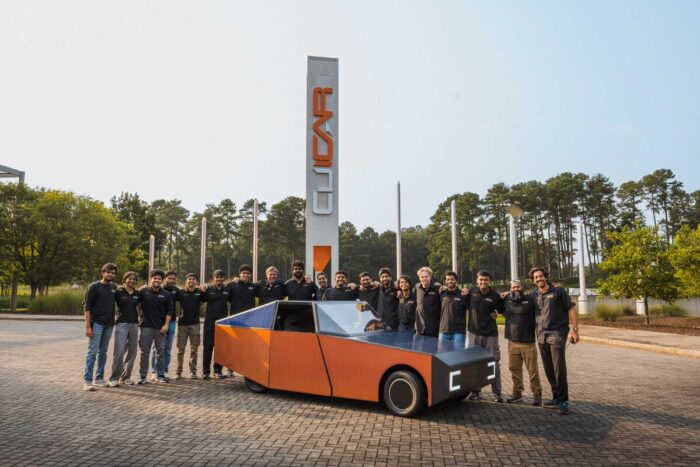
Clemson University’s International Center for Automotive Research has unveiled a prototype for a fully solar-integrated vehicle, designed to run completely on intrinsically generated solar energy.
Dubbed “Deep Orange 17,” the concept vehicle is the latest to be developed by the South Carolina school’s Deep Orange automotive engineering program. The team developed the vehicle in tandem with German auto giant BMW’s research and development team, and the car aims to answer one of the automotive industry’s most consequential questions: Could an EV power itself, with no need for external charging?
The Clemson automotive engineering team designed the car to be able to generate more energy than it consumes on a given day of urban commuting. The positive-energy vehicle acts almost like a modern battery system, storing solar energy for use during “peak hours;” in this case, urban commute times.
“This is a project we’ve wanted to pursue for years, so it’s incredibly rewarding to see this group of students come together over the last two years, overcome so many technical challenges and constraints, and bring an energy-positive vehicle to life,” says Stephan Augustin, project manager of research and new technologies at BMW.
The Deep Orange engineering team designed the lightweight coupe around drivers who value ease of driving, as well as energy efficiency and a reduced dependence on traditional EV charging infrastructure. Following successful testing in the U.S., Germany, Spain, and India, BMW Group representatives say the vehicle “represents a new approach to sustainable mobility.”
Engineering for solar power
Deep Orange 17 contains more than 1,700 PV cells, the engineering team says, which are directly integrated into the vehicle’s exterior surfaces. This allows the car itself to harvest solar power while parked, and during motion, and further allows the solar energy system to continuously replenish the car’s battery using only sunlight.
In order to maximize solar energy efficiency, the team at Deep Orange had to make the vehicle as light as possible. The finished prototype weighs only 1,212 lbs, about 25% of the weight of a standard coupe vehicle.
“This was an incredibly challenging project—not only to create a working energy-positive prototype, but to demonstrate how a vehicle can become increasingly energy independent through solar integration,” says Harsh Manghnani, a Deep Orange team member and lead on the project’s solar integration efforts. “Seeing our initial research and design validated in a working prototype has been incredibly rewarding.”
The vehicle draws engineering inspiration from the boxfish, which the team says has an aerodynamically functional body designed to naturally reduce drag. This is paired with what the Deep Orange crew calls “retro-modern styling,” making the vehicle not only highly efficiency, but visually striking.
The engineering team also added other technologies, such as regenerative braking. First heavily commercialized by the Toyota Prius, the regenerative braking technology partners with optimized drivetrain controls and intelligent torque distribution to maximize the vehicle’s electrical efficiency.
“It’s rare for a master’s student to have the opportunity to experience the complete process of developing a prototype vehicle,” says Anshul Karn, Deep Orange’s project manager. “Many engineering programs include courses in areas like digital modeling or marketing, but very few give students the opportunity to begin with a vision, work through the entire development process and ultimately deliver a fully functioning prototype. That experience is what makes Deep Orange so unique.”
All 16 students who developed Deep Orange 17 have graduated from Clemson as of Aug. 7, with each receiving a Master of Science degrees in Automotive Engineering degree.



Comments are closed here.