
Big opportunities for solar carports in U.S., amid unsteady market
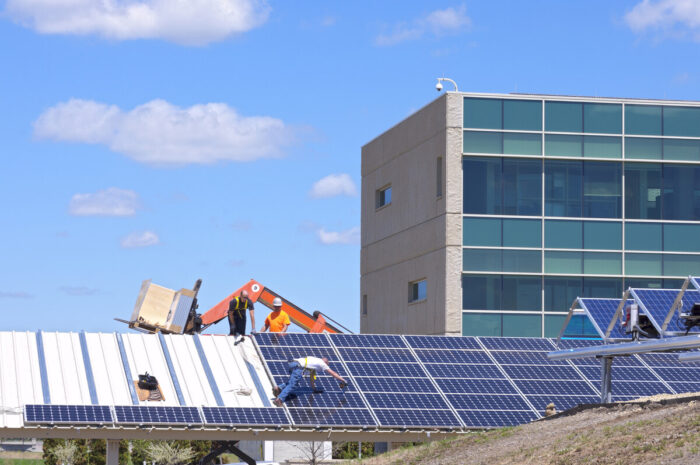
A May 2024 report by Allied Market Research predicted the carport market, then valued around $813 million, would more than double to a total of $1.7 billion by 2032. A more recent report says the outlook is even rosier, with market research firm Research Intelo predicting the solar canopy fast charging market could reach $8.5 billion by 2033.
Gary Eberhart says there’s plenty of reason for that excitement.
“There’s a lot of work going on in this sector, especially when you look at existing infrastructure and buildings,” says Eberhart, VP of energy solutions and RME for carport construction firm Baja Construction Co. “Anything from car dealerships, to golf courses, to schools, prisons, to multi-family housing. Carports provide a methodology for the construction of solar arrays and battery storage.”
Once overlooked as a “middle child” of the solar industry, occupying a space somewhere between traditional rooftop options and ground mounted systems, carports now have a marketplace all their own.
That market has seen a surge of interest in recent years, according to Eberhart, thanks in part to a number of factors. But the bottom line is that parking lots are becoming more and more part of the energy infrastructure, thanks to simple supply and demand.
“What happens is, the energy prices get so high that it reaches a tipping point,” he says. “We’re reaching that tipping point. Utility prices are continuing to rise. The need for energy around the country has continued to go up.”

Necessity over policy
The One Big Beautiful Bill Act’s (OBBBA) general slashing of renewable energy incentives could have spelled doom for the solar industry at large. But another nationwide crisis may have evened the odds back in solar’s favor.
The closure of Iran’s Strait of Hormuz earlier this year, combined with already-spiking energy bills thanks in large part to the data center boom, has brought about the most dire energy crisis in at least 60 years. Eberhart says a large-scale energy crisis is far from a good thing for Americans, but if nothing else, it has allowed the solar carport market to capitalize.
“In many cases, (a parking lot) is the only available space around businesses and entities that need additional power generation as a way to offset utility bill increases,” he says. “They don’t have other options. It’s not like they can install a utility-scale solar project right next door. They’ve got to use the available real estate they have.”
Along with making the most of a space, carports provide to the extra benefit of shade and weather protection. Eberhart says that added benefit is more than just nice to have — it’s actually financially impactful.
“Big box stores suffer a significant reduction in cash register receipts when it’s raining,” he says. “By placing carports in the parking lots, you mitigate some of that reduction. Not only is it an energy financial play, but it could also have direct correlation to other parts of your business where you realize revenue and profit.”
The ability to make the most out of existing space has been a massive boon for the carport market, Eberhart says. But that market is still slightly unsteady on its feet, despite the surge in interest.
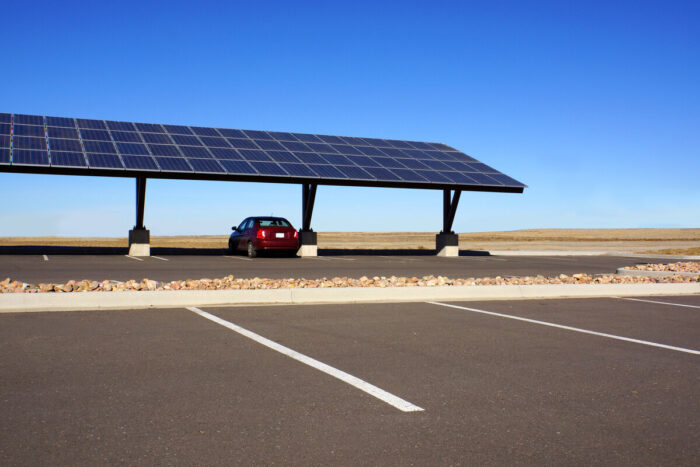
Nurturing a growing, but unsteady market
Eberhart says that solar carports can be a wildly useful tool for electric vehicle (EV) charging. There’s only one problem. Released on Jan. 30, the Institute for Energy Research’s latest report on global EV sales offers an overwhelmingly positive outlook on the worldwide EV market — with the glaring exception of North America.
In the United States, EV sales only increased by 1% over the past year, a far cry compared to the 7.3% jump the market enjoyed going from 2023 to 2024. The IER chalked much of that stagnation up to policy shifts between the Biden and second Trump administrations, with the latter focusing much more on traditional internal combustion engine vehicles. Trump also eliminated the EV tax credit at the end of Q3 2025, causing sales to fall nearly 50% between the third and fourth quarter last year.
“The U.S. EV market in 2026 is expected to be weak due to a lack of consumer incentives and supportive legislation, and investment favoring internal combustion engine production,” the company’s research says. “EV sales in the United States are expected to decline by 29% in 2026.”
Even so, there are still an estimated 7 million EVs in the U.S. market, about 2.3% of all vehicles. According to a 2024 report by CleanTechnica, California alone makes up about one-third of that number and the Golden State has the nation’s largest carport — a 12.37 MW project at Six Flags Magic Mountain in Los Angeles — to prove it.
Eberhart says that battery storage and EV charging play equal roles in the ascent of the carport market.
“Here in California, a lot of the cars are EV. Ten years from now, most of the cars will probably be EV,” he says. “Building that infrastructure so that folks have a place to charge vehicles (is crucial). You typically wouldn’t see something like that in a multi-family housing facility, but now we’re seeing them needing to provide that from an equity perspective to the people that live there. But also, it’s a marketing play.”
EVs are already playing an important role in the growth of the solar carport market, Eberhart says, but the vehicles are destined to play an even larger part in its future.
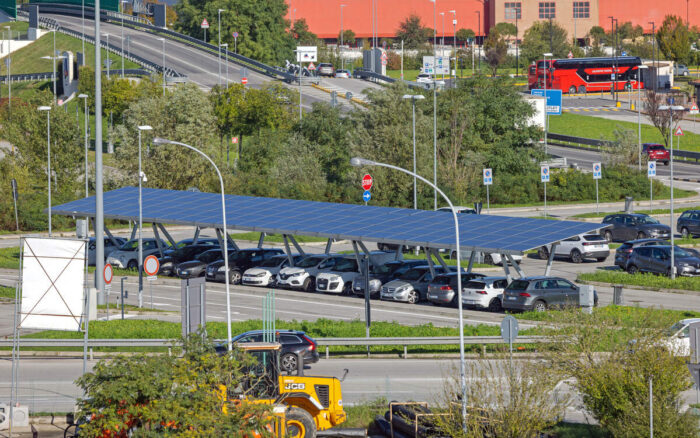
Future applications
The future of solar carports lies in quite a few places, but perhaps most importantly in two sectors, Eberhart says. Specifically, he says storage and battery infrastructure, along with fleet charging, are the sectors seeing the largest surge in interest.
“The incentives on batteries are pretty good,” he says. “You can get a 30% incentive for a battery installation and those incentives continue until I think 2032, so we’ve still got some runway on the incentives. Batteries are getting better and better, and batteries are huge right now.”
The contracts that Baja Construction is signing in its carport division largely focus on a few key sectors, Eberhart says. But perhaps the area with the most intense interest right now is fleet EV charging.
“We just signed a contract to build out an EV truck charging (carport) for fleet charging in semi-trucks,” he says. “There’s going to be a huge battery at that site. There’s going to be a fair amount of PV at that site. They’re still going to need the utilities … but we’ll be able to provide a good chunk of (their energy).”
Eberhart foresees the carport market becoming an essential player in the vehicle electrification space at large, but with the current adoption rates, it may take some time to spread around the United States. Still, he expects a large jump in the market by the end of the decade.
“I definitely see a lot more EV infrastructure going on, all across the United States,” he says. “It’s going to be a requirement from an end user perspective. That’s just not going to slow down. The other thing that’s going to drive continued innovation and additional carports and parking lot solar is the continued rising of energy costs.”


Comments are closed here.