PG&E announces new California microgrid grant awardees
Pacific Gas and Electric Co. (PG&E) has announced new grant agreements for a suite of community microgrid solar projects, representing more than $30 million in new investments across California.
Paired with the selection of six new projects through the second application window of PG&E’s Microgrid Incentive Program, the investment marks a “major milestone” in the utility’s development of microgrids across the Golden State. The work builds on a former investment of $43 million by PG&E, which covered the development of nine projects in 2025.
The projects span rural areas, as well as coastal, Tribal, and high wildfire risk regions across northern and central California.
“In addition to the grid investments PG&E is making, community microgrids empower communities to take an active role in building local resilience,” says Dave Canny, head of PG&E’s North Coast region. “PG&E is proud to partner with communities by providing incentives, technical support and the safe interconnection needed to bring these projects to life. The North Coast has helped lead the way in microgrid innovation through pioneering projects like the Redwood Coast Airport Microgrid and the Blue Lake Rancheria Microgrid.
“Today’s MIP awardees — with advanced solar-plus-storage systems and innovative pumped-hydro designs — are building on that legacy, showing how communities and utilities can work together to strengthen resilience, keep critical services powered and advance clean energy solutions for the future.”
The microgrid projects will help to keep power on during brownouts and blackouts for sites like hospitals, fire stations, schools, and local businesses. The projects will utilize not only solar, but battery technology and other smart grid equipment to keep power running for potentially days.
Power in a FLASH
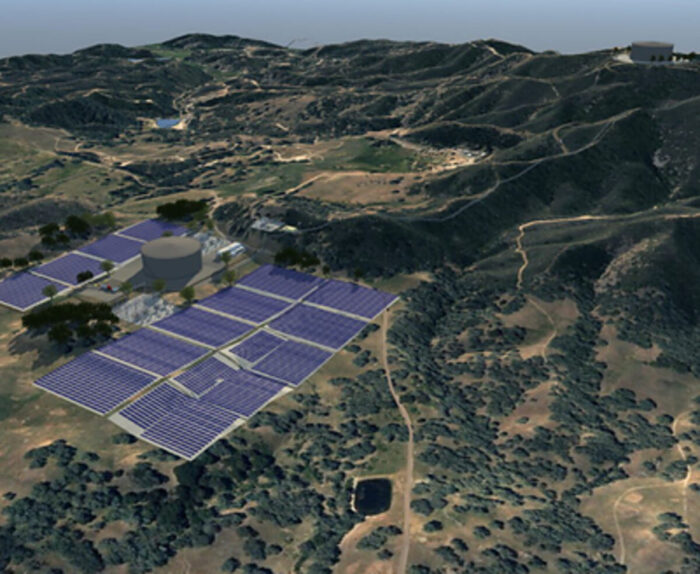
As part of the Microgrid Incentive Program, PG&E is advancing several of the nine projects it selected within the first application round through new grant agreements. Additionally, three proposed projects in California’s Lake County are advancing a first of its kind approach known as FLASHES, or Firemain Linked Auxiliary Supply/Hydraulic Energy Storage.
These new projects will pair locally generated solar energy with pumped hydroelectric storage at megawatt scale, using subsurface water resources. The solar power will pump the water to roofed tanks and, when the grid needs more energy, that water will be released through turbines.
“The FLASHES projects carry the potential to deliver energy and wildfire resiliency for Lake County communities, while also creating construction jobs and apprenticeships that could prove to be life-changing,” says Brad Rasmussen, chair of the Lake County Board of Supervisors. “Just as importantly, areas that would be hardened by the project, if constructed, include critical community facilities like the County Jail and Northwest Wastewater Treatment Plant. Funding pre-development work has long been a barrier to this project’s progress.”
The three new proposed microgrids will also serve communities throughout northern and central California, the company says. All three projects have received approval for early development to determine feasibility.
“FLASHES represents a new model for community resilience, bringing together dispatchable renewable energy, long-duration storage and critical water supply in a single project to strengthen grid resiliency, support wildfire emergency response and reduce carbon footprint,” says Johnny Brown, VP and regional general manager for Trane. “It reflects a shared commitment to advancing practical innovation that can help communities build a more resilient and sustainable energy future.”
Expanding the footprint
PG&E has also announced its intention to select six new projects from its microgrid application window. The selection will direct $30 million to projects that will more than 2,200 customers, and that will support critical facilities like schools and health centers.
The second wave of microgrids aim to expand the Golden State’s access to reliable and local energy solutions across PG&E’s wider service area. The sites cover six different counties, with one — San Mateo County’s Pescadero project — already advancing.
“When a community faces a challenge that doesn’t have an obvious solution, local public agencies like WestLight Energy have an opportunity to bring partners together,” says Shawn Marshall, CEO of WestLight Energy. “That’s exactly what happened here. This project shows what’s possible when community organizations, local government, utilities and clean energy partners work toward a common goal.”
Each project of the six will receive between $2 million and $6 million from PG&E, the company says. This will come from the overall MIP wallet of more than $200 million in grants statewide.