
Solving Soil and Topography Challenges from End to End
Advanced technologies and design innovations are creating new opportunities for solar in even the toughest conditions.
In the past, the combination of ledge , rocky soil, stubborn frost, undulating topography, steep hills, frigid temperatures, and high winds could rule out a site location entirely. The degree of difficulty for construction was too high and the risks too great.
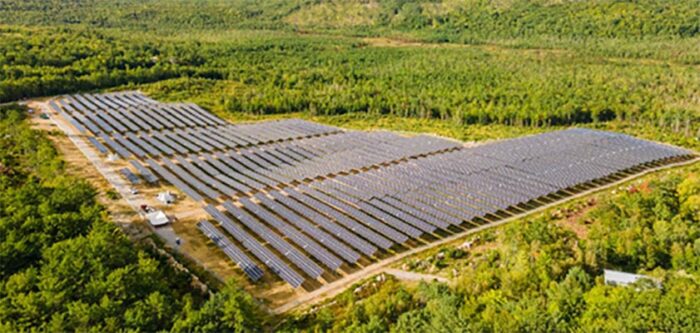
Today, while all of these conditions are still challenges, they’re now fully solvable. Terrasmart has pioneered end-to-end solutions that turn sites with even the most complex terrain and harshest weather into clean-energy assets that maximize production and revenue.
Grading Analysis
Grading analysis shapes every downstream decision for difficult sites, from foundation type to racking design to installation sequencing. Earthwork manipulation through leveling and/or cut-and-fill grading can get a site ready for construction, but it also increases risks, expands time required in tight construction schedules, escalates cost, and creates adverse environmental impacts.
Terrasmart’s advanced trackers and engineering methods allow projects to work within the natural landscape, for example, by utilizing shorter rows and leg extensions to allow for adaptability on undulating topography.
Foundations
Pile foundations are often efficient and cost-effective options in warmer climates and flat terrain, but they carry significant refusal risks in sites with tough conditions like bedrock or persistent freeze/thaw cycles.
Ground screws have expanded opportunities to build in freezing temperatures and on difficult terrains. They essentially eliminate refusal risks and protect foundation integrity from frost heave. Ground screws work hand in hand with adaptable racking to generate predictable performance in unpredictable conditions. Terrasmart is an industry leader in ground screw technology, with U.S.-based, in-house manufacturing and proprietary machines for efficient and reliable installation.
Installation
Installation efficiency is always important, but when executing a build on complex terrain and in frigid conditions, the window of opportunity for smooth and speedy installation is smaller. Terrasmart’s proprietary ground screw installation machine drives screws quickly and efficiently, keeping projects on schedule even in challenging conditions.
Racking
Racking is where engineering meets reality. Terrasmart’s TerraTrak single-axis tracker is uniquely designed to pair with ground screw foundations while meeting demanding structural requirements such as wide slope tolerances, and resistance to extreme wind and snow loads. TerraTrak’s telescoping screw extensions provide best-in-class field adjustability, helping crews navigate variable slopes without sacrificing accuracy or structural integrity.
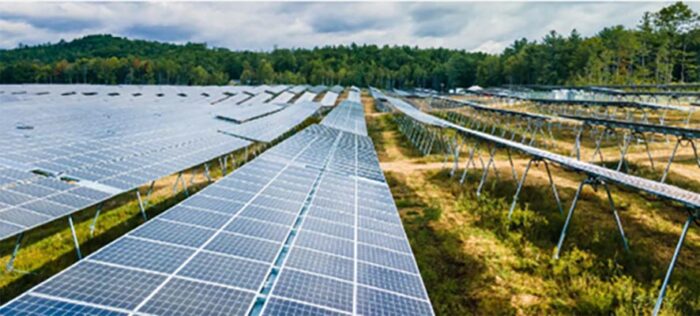
TerraTrak’s A-frame structure redirects loads into favorable forces on the ground screws, while screw extensions add versatility across challenging terrain.
Case Study – Rumford, Maine
Terrasmart’s partnership brought environmental and economic value to the
Rumford, Maine community, despite its location checking nearly every box on a difficult site condition checklist.
The project was developed and built by Nexamp with Terrasmart as its partner. Here’s a look at how we overcame tough condition after tough condition:
- To mitigate rocky soil, steep heels, and up to 50 inches of frost heave, we utilized more than 5,000 ground screws to create a stable foundation.
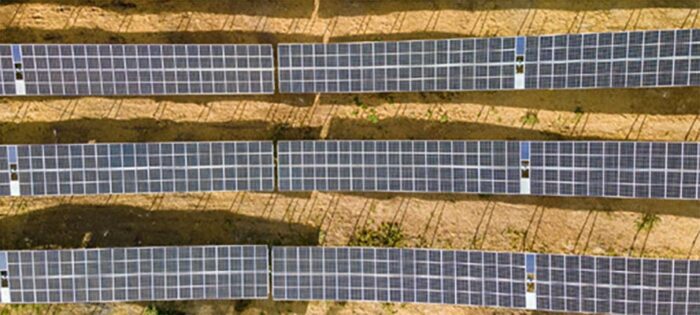
- To solve for the significant sloping – up to 20% grade in some spots – we utilized 215 tracker rows for adaptable racking with built-in flexibility. The rows protected 16,068 bi-facial modules. In this case, TerraTrak was designed to allow for 11% E/W and 20% N/S slope adjustments while providing a +/- 60-degree range of motion.
- High front panel clearance of 45 inches accommodated the heavy 100 psf snowloads common in Maine . Few single-axis trackers have the structural integrity and flexibility to use ground screw foundations while clearing this front edge height.
- Terrasmart designers worked hand-in-hand with Nexamp to design an optimal site layout, incorporating multiple configurations of tracker rows to maximize yield.
- Designing the 2P tracker system to optimize bifacial technology entailed increasing E/W spacing between panels. While TerraTrak typically has 0.5 inches between modules for monofacial panels, the team increased this spacing to 4.5 inches to ensure the tracker structure did not block reflected sunlight on the backside of the panel.
- Early snow meant harsh winter conditions for installation. Frozen ground, snowfall, and freezing temperatures required extra measures to keep installation crews safe. Terrasmart’s proprietary ground screw installation machine allowed the crews to install quickly and minimize time in the elements.
Today, Rumford Solar is an operational 6.5 MW solar farm that benefits from Maine’s Net Energy Billing Tariff Rate program, delivering significant annual electric cost savings to the Town of Rumford, local businesses and municipal organizations. Because TerraTrak’s design allows for custom module attachment brackets, the Rumford team was able to increase the overall power output. The project is expected to offset more than 12 million pounds of CO2 annually.
The strong partnership with Nexamp thrived through tough weather and terrain conditions, and together we turned a frozen, rocky, sloping site into a revenue-generating asset. Providing economic value and clean energy to communities like Rumford, where solar farms seemed previously out of reach, is an example of our mission in action.
Learn more about our approach to tackling challenging topography here.
Comments are closed here.