
California group completes water-saving pilot for Project Nexus
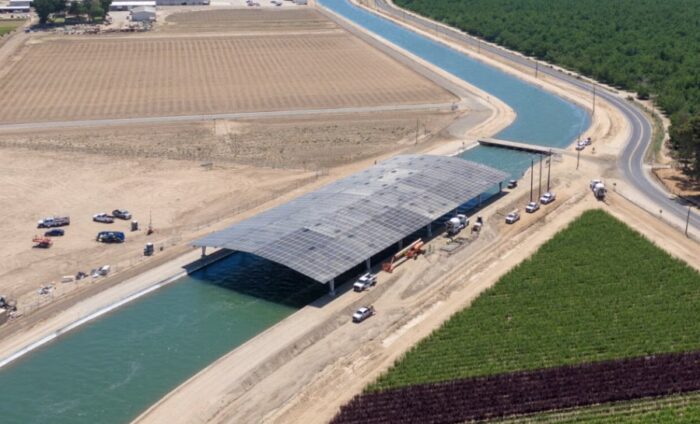
The first solar project of its kind in the U.S., Project Nexus combines the efforts of public, private, and academic sectors to help solve two of the Golden State’s most urgent crises at once: energy and water.
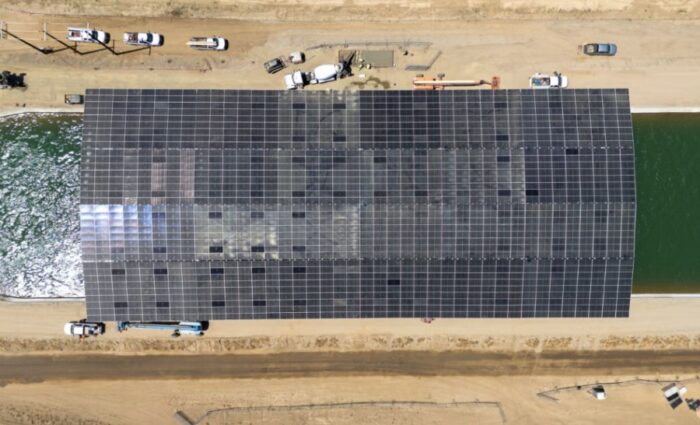
The 1.6 MW “solar canal” project is the fruit of a partnership between project construction firm Solar Aquagrid, the University of California Merced, California’s Department of Water Resources, and California’s Turlock Irrigation District. The four groups came together to construct a testbed pilot project that lasted four years.
Jordan Harris, once a Virgin Records executive who had a hand in turning acts like Paula Abdul and The Smashing Pumpkins into household names, now serves as co-founder and CEO of Solar Aquagrid. He says the $20 million Project Nexus has done much more than serve as simple proof of concept.
“It’s very encouraging,” Harris says of the pilot. “It met or exceeded the feasibility study, in terms of performance.”
The University of California Merced’s initial 2021 study appeared in the scientific journal Nature Sustainability in 2021. The study estimated that shading California’s 4,000 miles of open water canals could save up to 63 billion gallons of water annually, helping secure funding and positive sentiment for Solar Aquagrid’s current efforts.
After the groups’ pilot project finished up earlier this spring, the real-world results are even more promising, Harris says.
“This has been a four-year journey,” he says. “Bridging water is very different than building solar on land, obviously, with interesting challenges but also some unexpected benefits.”
Two birds with one solar panel
The research data Solar Aquagrid received from the project’s pilot program says their efforts could help solve California’s energy issues and water issues in equal measure.
“The most expensive and biggest headache for any canal operator is aquatic weed growth and algae growth,” Harris says. “You block the sunlight coming in, you interrupt the photosynthesis, and it literally stops growing. We know have a full irrigation season of data … We’ve been able to measure the reduction in evaporation and the reduction in aquatic weed growth, and they’re significant.”
The Golden State’s water woes have rocketed past being “well documented” by now. Though recent winter storms have left many of the area’s reservoirs around historical averages, the state recently experienced a years-long drought that represented the driest span in the state in the last 1,200 years.
So, water is still very much at a premium. Perhaps the most obvious solution to mitigating this issue, Harris says, is preventing the state’s existing water from going anywhere. The state has already dumped about 96 million “shade balls” into the Los Angeles reservoir, leading to a savings of about 290 million gallons, according to a 2025 article in the Toronto Star.
Of course, solar projects can be wildly expensive, and further in-depth research was needed. For the Project Nexus team, the goal was to let the solar industry come to them by bringing down the cost of these projects as much as possible.
It takes a village
Bringing together public utility providers and private companies is normally a very difficult undertaking. However, Harris says Project Nexus’s work with the Turlock Irrigation District (TID) created a near-perfect storm of working conditions, thanks to TID’s unique positioning in the Californian energy and water ecosystem.
“(TID) have 250 miles of open canals,” he says. “Their canals are various widths and orientations, and the other perfect thing for them, and for us, is that they are one of a handful of water irrigation districts that are also power providers in their districts. They would be the offtaker of the power, and that’s very significant.”
Solar Aquagrid’s work with TID, alongside UC Merced and Project Nexus’s other groups, gathered enough data to present to both the state of California and potential other solar project installers. In tandem with the University of Southern California and researchers from seven other California universities, the team created the California Solar Canal Initiative to further boost potential interest.
“The goals of CSCI are to look at what policy can be put in place to accelerate the adoption of solar canals. And number two, get to a true cost analysis by monetizing the benefits, and really looking at the economics,” Harris says. “Finally, we are creating a GIS mapping dashboard to identify the opportunities across that 4,000 miles of California canals.”
The “tier-one” opportunities for the Project Nexus team, Harris says, are mostly the low-hanging fruit that are easiest to identify. Specifically, canals that are adjacent to electrical substations or EV charging ports would be prime real estate for future projects. Fortunately, as TID also happens to be an electrical provider in central California, some potential solar interconnection points would be just 15 feet away.
All of this, Harris adds, is in service of making solar waterway adoption as enticing — and as easy — as possible. Harris says the team’s method seems to be working.
From California pilot to worldwide projects
For the solar industry to look at already disturbed spaces like irrigation canals and aqueducts and not take advantage of them would be a huge misstep, Harris says, and it seems the industry is recognizing that themselves. The company has already seen a spike in interest from several different solar developers, both in the U.S. and abroad.
“One of our main goals is really to stimulate the industry to recognize the opportunity, and it is an enormous opportunity,” Harris says. “Not just here in this country, but we have had visitors travel from Romania who are interested in doing this off the Danube. We’ve had visitors from Ukraine, from Saudi. We’ve met with three different water districts in Spain. … It’s a global opportunity.”
Still, Harris and the Solar Aquagrid team recognize that change is often difficult to swallow, especially in the world of infrastructure. He expects a lot of visitors to look at the Project Nexus pilot and learn from it, rather than copy it directly.
“We can just see where this can go, as you’ve seen from early EVs to where they’re going, and anything like this, with the brilliant minds that exist in the industry,” he says. “We at Solar Aquagrid have been technology-agnostic, and we’ve wanted to really do due diligence and study different design solutions.
“There’s some exciting innovation happening that I think will drive down the cost, even before we start looking at the revenue from the benefits.”
As Harris says, the opportunity is there for the taking once the economy of scale kicks in, driving down the price of projects like this as they become more prevalent. The Project Nexus team is proud to let their pilot serve as both a functional solar generation project, and a proof of concept for the wider world on solar canals of its size.
But what helps even more, he adds, is that aqueducts themselves have had millennia of refinement. Now, the solar industry is the one that must take the next steps.
“Let’s face it: we’re dealing with infrastructure, design-wise, that’s thousands of years old. The Romans (made aqueducts),” Harris says. “So, there’s plenty of room for innovation.”

Comments are closed here.