HelioVolta releases annual SolarGrade PV Health Report and inaugural awards
Solar inspection and servicing firm HelioVolta has released its fourth annual SolarGrade PV Health Report, aiming to assess quality and workmanship in U.S.- and Puerto Rico-based solar assets.
After assessing more than 1,500 solar assets, HelioVolta field engineers found that up to 87% of projects contained “major issues requiring urgent corrective action,” the report says. Additionally, 8% of projects had critical issues that require immediate de-energization, up 1% from 2025’s report.
These quality issues, the report finds, can raise a solar asset’s levelized cost of energy (LCOE) by more than 20%. Driven largely by lost production and higher operational costs, the lowest-quality PV systems can underperform by an estimated 6% over their lifetimes. This translates to requiring up to three times more unplanned maintenance than the highest-quality systems.
“Quality in solar is no longer a matter of opinion; it’s a number you can put in a contract,” says David Penalva, co-founder and CEO of HelioVolta. “This year’s report proves that excellent workmanship is empirical, not subjective, and the projects from Onyx Renewables and Greenskies Clean Energy show exactly what quality looks like.”
More specifically, the report finds tracker systems — 10% of all systems inspected — have the highest rate of critical issues of any type of PV asset. Coming in at an 18% clip, these tracker-related critical issues largely came from connector and wire management failures.
Grading the solar world
The 2026 edition of the report stems from the company’s revamped HelioVolta Quality Standard (HQS) rubric. Developed in conjunction with HelioVolta affiliate SolarGrade, the proprietary grading scale starts every project at 1,000 points. Then, the rubric subsequently deducts points from a project based on the number, severity, and remediation status of quality issues that project inspections find.
“Our (HQS) modeling reveals that the gap between an A-rated and an F-rated PV system can raise the levelized cost of energy by more than 20%,” says James Nagel, co-founder and CTO of HelioVolta. “That’s the difference between a profitable asset and one stranded by expiring tax credits. Asset owners who tolerate aggressive EPC cost-cutting can no longer operate profitable portfolios.”
The report uses its letter grades to tie projects directly to their lifetime energy costs, the company says.
Additionally, the firm’s inspection and research team had a few systemic issues it prioritized for remediation, officials say. The report says inverter terminations, connector installations, DC wire management, and module lead routing were the top priorities, as they can have some of the highest cost and production impacts.
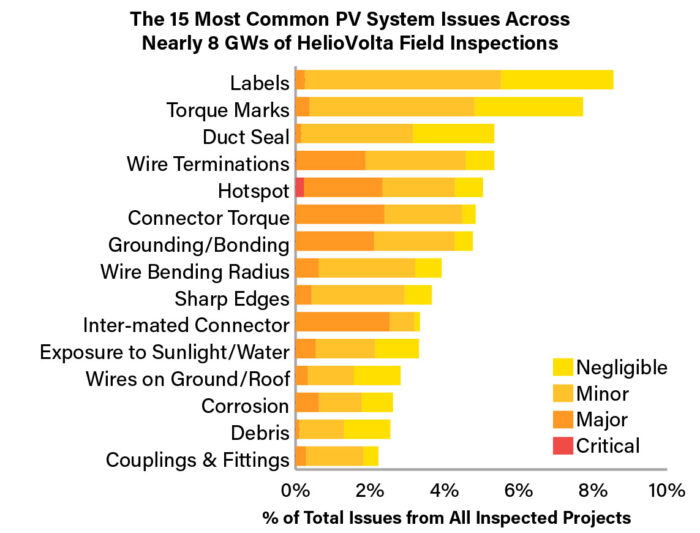
Common issues with project health included torque marks, which were extremely common but largely minor in scale, and connector torque issues, which were half as prevalent but about five times more likely to have major consequences.
Top performers
In this year’s version of the SolarGrade PV Health Report, the HQS rubric analyzed nearly 8 GW worth of solar assets around the U.S. and Puerto Rico. Although 87% of projects contained major issues requiring urgent corrective action, the company honored New York City-based Onyx Renewables and North Haven, Connecticut’s Greenskies Clean Energy as two of its top performers.
“Not all energy is delivered equal. Our customers need solar that is engineered, inspected, and validated to perform,” says Angie Daoud, COO of Onyx Renewables. “We build accountability into every step of how we develop, build, and care for our projects, and this independent award recognizes and confirms that this approach delivers.”
Additionally, the report has also chosen to recognize excellence through its inaugural HelioVolta Quality Standard Awards. The awards honor the report’s two highest-scoring projects under 5 MWdc that the company inspected in 2025.
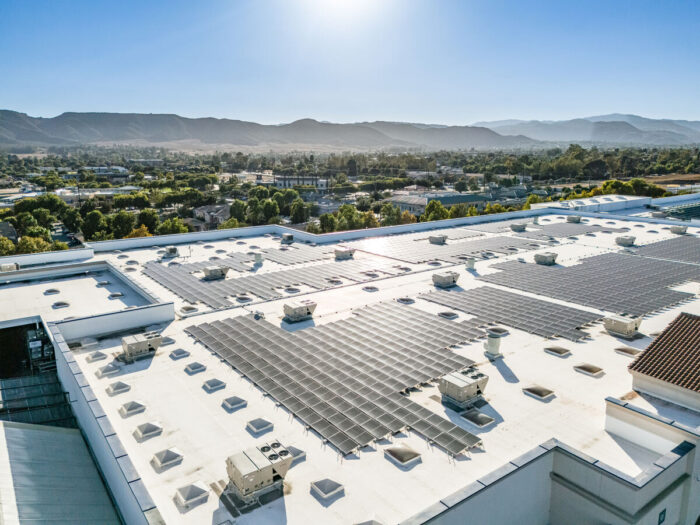
Heovlix Electric’s 1.15 MWdc ground mount array for a California homeowners association took home one award this year, the company says. Developed and owned by Onyx Renewables, the project had the higher wattage of the two award winners. The other award winner, a 760 kWdc rooftop array for an unnamed Fortune 100 retailer, is under Greenskies Clean Energy’s ownership following its construction by Opulent Power Solutions.
“This recognition from HelioVolta is meaningful because it independently validates the standards we work to uphold across our portfolio,” says Vijay Singh, CEO of Greenskies Clean Energy. “As a long-term owner and operator, we know the quality of how a project is built directly supports how it performs over time. That focus on disciplined execution and lasting performance guides every project we deliver.”
Outside of the solar assets themselves, the report also breaks down quality trends by PV system type. The company found that canopy systems, making up just 3% of all systems the company inspected, have the lowest issue rates. With just 59% containing any sort of major issues, HelioVolta inspectors have never found a critical issue in a canopy-style system.
This year’s edition of the SolarGrade PV Health Report is available now.