
Canada’s EDC finances solar export projects around the globe
Financing solar export projects is a bit easier for Canadian solar EPCs these days thanks to the ongoing support of Export Development Canada (EDC), a crown financier with global reach into the Green Bond markets.
“EDC significantly increased its support for cleantech in 2025, facilitating $8.3 billion in business, with a substantial share going to renewable energy, this includes solar. This reflects our focus on helping Canadian companies grow and export in priority areas like clean power,” writes Anil Handa, a spokesperson for EDC, in an email response to SB.
To date, EDC has supported nearly $50 billion in cleantech exports, “helping companies of all sizes and sub-sectors achieve success expanding beyond our borders,” the agency said in a statement.
EDC’s efforts to help solar grow are not merely altruistic. “Clean technologies continue to show strong global growth potential as they are increasingly profitable, low maintenance and well-suited for mainstream adoption,” says Prerna Sharma, author a senior EDC economist, in a recent agency review.
Extending Canadian solar exports globally
Most recently, B.C.-based Stardust Solar in June tapped EDC for $2 million in export trade credit insurance coverage on energy-related receivables associated with the company’s 30 MW solar project in Zambia. The $90 million project is being built for end-user ZESCO Ltd, Zambia’s national utility, which has signed a 20-year PPA at 7 cents per kWh for the energy produced by the array.
The Zambia deal is just part of a global EDC vision. “As we continue advancing utility-scale opportunities internationally, access to export credit insurance can help support project financing discussions, strengthen cash flow visibility, and enhance the overall financial profile of our development pipeline,” says Stardust founder and CEO Mark Tadros in a company statement.
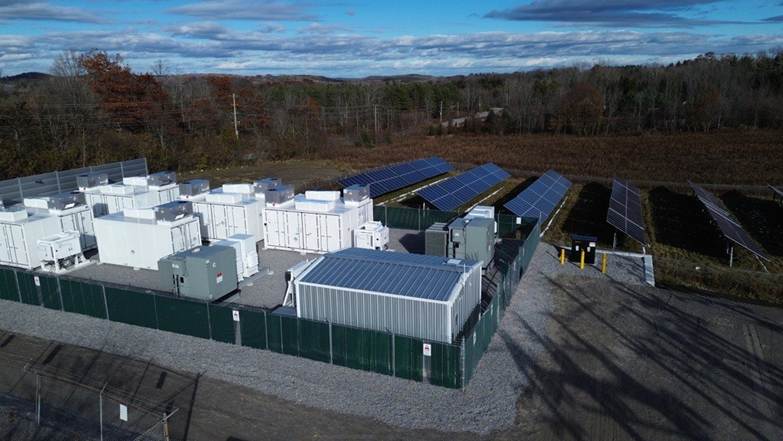
EDC has supported Canadian solar exports to a host of countries, including the United States, Australia, Spain and Chile. Other export markets are within EDC’s scope as well. “In the project finance space, EDC is seeing opportunities to support Canadian investment/ownership of solar projects in Spain, Australia and India. We are increasingly seeing solar projects being co-located with battery energy storage systems, particularly in Australia,” notes Handa.
“The growing demand for energy security — particularly from regions such as Europe and the Indo-Pacific — positions Canada to respond thanks to our strong capabilities and our global reputation and expertise in the cleantech sector,” says Guillermo Freire, EDC’s senior VP of the Mid-Market Group in a company statement.
EDC has locations in Atlanta, Chicago, Mexico City, Monterrey, Bogotá, Lima, Santiago, Rio de Janeiro, São Paulo, Düsseldorf, Istanbul, London, Johannesburg, Dubai, New Delhi, Mumbai, Beijing, Shanghai, Singapore, and Sydney.
U.S. projects key to Canada’s solar exports
Apart from solar equipment exporters in Canada using EDC financing, like panel producer Canadian Solar, a variety of EPCs have developed or are developing solar projects in the United States, its largest market.
“The U.S. has been a key market for EDC in the solar sector, reflecting both its scale and its strong demand for renewable energy,” Handa says. “From a project finance perspective, EDC has facilitated Canadian participation across a range of segments including utility scale solar projects, distributed generation and community solar projects. Over the past five years, EDC’s support for Canadian investors through project finance in the U.S. has grown substantially.”
Geographically, the EDC sees the U.S. Midwest as a key region for Canadian solar exports served by the agency’s Chicago office.
“Canada has a long history of success doing business in the Midwest, but we’ve done the research and we know there are significant opportunities for growth,” says Mairead Lavery, EDC’s president and CEO, in an agency announcement of the Chicago office.
“We’re putting our own team on the ground in Chicago to fuel that growth, to build connections and relationships that will open doors to new opportunities –- especially for small- and medium-sized businesses. By expanding Canada’s footprint in this region and helping more companies export, we’re also growing our economy at home,” Lavery said.
EDC’s U.S. solar project list grows
In 2025, Innergex [since acquired for $10 billion in 2025 by La Caisse (CDPQ)] began work on the 200 MW Palomino Solar Energy project developed by in Lynchburg, Ohio, expected to initiate operations in 2027. The project was supported in part by some $30 million in insurance lines that EDC has provided the company. CDPQ is Canada’s largest public pension fund manager.
Another Canadian pension fund with a renewables subsidiary that has tapped EDC funding for U.S. solar projects is Ontario Municipal Employees Retirement System (OMERS), which owns Leeward Renewable Energy (LRE). LRE began commercial operations in 2024 at the Horizon Solar Energy farm, a 200 MW facility near Pearsall, Texas, that supplies electricity to Verizon.
Similarly, Invenergy [now majority owned by La Caisse] used EDC credit lines for its U.S. solar development portfolio, including the $110 million, 200 MW solar facility in Calhoun County, Michigan, that began operations in 2023. EDC also has helped fund Invenergy’s acquisition of other U.S. solar assets.
In 2023, EDC acted as a coordinating lead arranger for a “$1.5 billion credit facility for IRG Acquisition Holdings (IRGAH), a partnership between Invenergy, CDPQ and funds managed by Blackstone Infrastructure Partners (Blackstone), closed on the acquisition of American Electric Power’s (AEP) 1,365-megawatt (MW) unregulated, contracted renewables portfolio for $1.5 billion,” the bank said.
While EDC does not disclose the names of financial institutions with which it works in financing Canadian solar exports, the list involved in the AEP acquisition is a global Who’s Who of banks. The institutions included: Banco Santander S.A., New York Branch as Structuring Agent, Coordinating Lead Arranger, and Co-Green Loan Coordinator; Coöperatieve Rabobank U.A., New York Branch, as Coordinating Lead Arranger and Due Diligence Bank; Natixis CIB as Coordinating Lead Arranger and Co-Green Loan Coordinator.
Additional lenders in the AEP deal included: Banco Bilbao Vizcaya Argentaria S.A., New York Branch; Banco de Sabadell, S.A., Miami Branch; Bayerische Landesbank, New York Branch; CaixaBank, S.A.; MetLife, Inc.; National Westminster Bank plc; Norddeutsche Landesbank Girozentrale, New York Branch; Société Générale; and ICBC, New York Branch.
Tapping the global Green Bond market
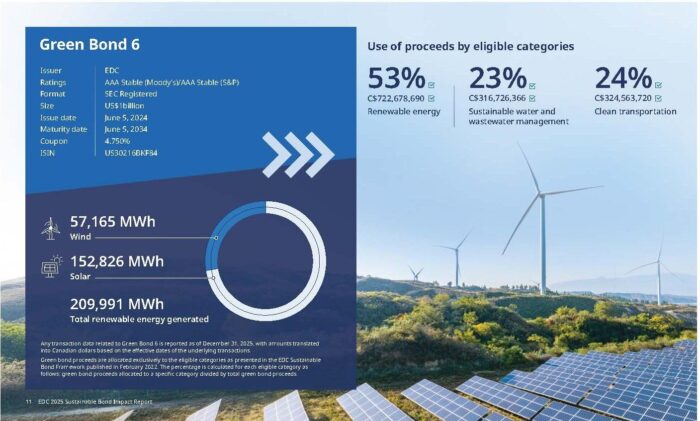
Part of the funding for EDC’s solar export guarantees is the Green Bond market. EDC has been active in the market for more than a decade, issuing six Green Bonds, including a $1 billion issuance in 2024, under the agency’s Sustainable Finance Framework.
In issuing its first Green Bond, EDC brought new global finance sources to Canada. “[We] Pioneered the market in Canada, having been the first Canadian financial institution to develop a Green Bond Framework and issue a green bond,” says Scott Moore, EDC’s executive VP, chief financial officer and chief operating officer, in a forward to EDC’s 2025 Sustainable Bond Impact Report.
U.S. investors are well represented among an international blue chip group of investors that buy the Canadian bonds. “We continue to see interest in our Green Bonds from U.S. based investors with ESG mandates but also see strong interest from European based investors,” says Handa.
Charles W. Thurston is a contributor to Solar Builder.
Comments are closed here.