
PolyJoule announces self-extinguishing polymer for BESS products
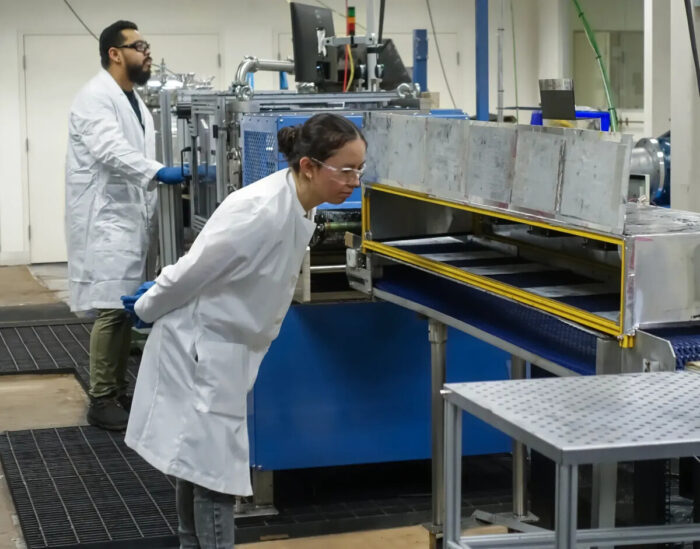
Battery manufacturer PolyJoule Inc. has released its latest technology, a self-extinguishing and conductive polymer chemistry for battery energy storage systems (BESS).
Originally spun out from MIT, the technology is based on a new proprietary chemistry produced by PolyJoule. The newly announced polymer includes a new conductive cathode and a liquid salt electrolyte, officials from the Billerica, Massachusetts-based firm say.
“PolyJoule has always been at the forefront of energy storage safety,” says Eli Paster, PolyJoule’s co-founder and CEO. “We were the first company in the world to prove through UL 9540A testing that our conductive polymer cells do not go into thermal runaway. We approached this next-gen chemistry with a very simple thesis: Batteries shouldn’t start fires. Batteries shouldn’t spread fires. Batteries shouldn’t catch on fire.”
BESS manufacturers and battery buyers often run into issues with safety, complexity, and the foreign supply chain, representatives say. The new chemistry aims to solve three of the biggest problems with modern lithium-ion batteries.
Battery advantages
The new polymer’s fire safety measures and fully domestic manufacturing pipeline make it an easy fit for the wider energy transition, the company says. The newly released chemistry tested well under “extreme thermal conditions,” officials say, sporting the ability to self-extinguish after being exposed to a nearly 3,600°F flame.
“Materials that have a propensity to catch fire often contain reactive metals that spontaneously react with air and volatile liquids,” says Timothy Swager, the John D. MacArthur Professor of Chemistry at MIT, and a co-founder of PolyJoule, who now serves as a technical advisor for the company. “The advantage of PolyJoule’s batteries is that they have neither.”
PolyJoule’s new product is part of its wider push into critical markets where safety is a foremost requirement. The company says the product also unlocks a ten-fold improvement in energy density over the first generation, while still being able to run for more than 10,000 cycles in one lifetime.
The company’s battery cells do not require any form of active thermal management, officials say, which allows the manufacturer to simplify system design and operation.
“PolyJoule has created a product that can safely be put inside homes and businesses,” Swager adds, “using non-flammable conducting polymers and a liquid salt electrolyte that has a vapor pressure a billion times lower than that of the electrolytes used in Li-ion batteries.”
Following the new polymer’s release, PolyJoule will be accepting applications from solar, battery, and generator installers in “select markets” later this year. The company will offer its energy storage systems for commercial, industrial, and residential market segments.



Comments are closed here.