
Drake Plastics gets new carport project near Houston | Projects Weekly


AWM provides tailored cable management solutions for PV and BESS that are durable and reliable.
This week on Projects Weekly, Trinasolar and Spear Commercial & Industrial have finished a rooftop solar and carport installation for Houston’s Drake Plastics. In California, a trio of projects by Recurrent Energy, Arevon, and TotalEnergies are strengthening different sectors of the Golden State’s wider grid. In Connecticut, Greenskies and Titan Energy have partnered with Andover Elementary School to provide the school with a rooftop solar project. In the Midwest, Pando Energy Partners has launched a new community solar platform in Illinois, and All Energy Solar has finished a rooftop installation for Omni Brewing Co.’s new location in Rosemount, Minnesota. Finally, Canada’s PowerBank Corp. has announced a new solar project in southern Ontario. Keep reading for all the details!
PowerBank announces new solar project in Ontario’s North Bruce Peninsula
Canadian solar firm PowerBank Corp. has announced a new lease agreement for a 4 MW ground-mounted solar project in North Bruce Ontario.
Currently known as the “ON-765 West Solar Project,” the site is expected to generate enough energy to power the equivalent of 640 Ontarian homes once operational. The project is also likely to fall under Canada’s Clean Technology Investment Tax Credit, providing eligible development corporations 30% of the capital cost of qualifying investments in renewable energy.
“As artificial intelligence, electrification, and broader digital infrastructure growth place unprecedented new demands on Ontario’s electricity grid, distributed energy projects like ON-765 West are becoming an increasingly important part of the province’s energy mix,” the company says. “Unlike large, centralized generation facilities, distribution-level solar projects add capacity in smaller increments across many points on the grid, closer to where power is actually consumed, reducing strain on transmission infrastructure and losses along the way.”
Bright spot: The project now joins PowerBank’s portfolio of more than 1 GW of solar and storage projects currently in development, the company says. The company already has 100 MW of completed projects, and says that its institutional-grade development capabilities will allow upcoming projects to be reliable and high impact for the energy sector.
“This model can also improve grid resiliency and often be brought online faster than utility-scale projects, which frequently face years-long interconnection and permitting timelines,” PowerBank says of the project. “As demand grows, a broad base of distributed generation helps ensure power availability keeps pace without relying solely on a small number of large projects.”
Recurrent Energy Secures $695 Million for California Cobalt Solar Project
Canadian Solar Inc. subsidiary Recurrent Energy has announced the successful close of about $695 million in project financing and tax equity for California’s Cobalt Solar.
Bright spot: Located about 20 miles west of the border town of Blythe, California, the 330 MW project is already fully permitted and under construction thanks to the Minnesotan EPC firm Blattner Energy. The project is expected to reach full completion and commercial operation by the end of 2027.
“This project represents a significant addition to the U.S. energy landscape and will contribute meaningfully to meeting the country’s growing electricity demand,” says Dylan Marx, CEO of Recurrent Energy. “We appreciate the continued support and collaboration of MUFG, Nord/LB, and Wells Fargo in bringing this initiative forward.”
In addition to its energy contributions to the area, Cobalt Solar is also expected to “deliver tangible economic benefits” to southeastern California. Representatives say the new facility will power the equivalent of 82,000 homes every year, as well as bringing in $14 million in property tax revenue for Riverside County.
“MUFG is pleased to support Recurrent Energy as they strive to meet the growing energy demands of the U.S.,” says Fred Zelaya, Managing Director at MUFG. “We value the opportunity to help Recurrent Energy augment large-scale renewable energy infrastructure and power capacity.”
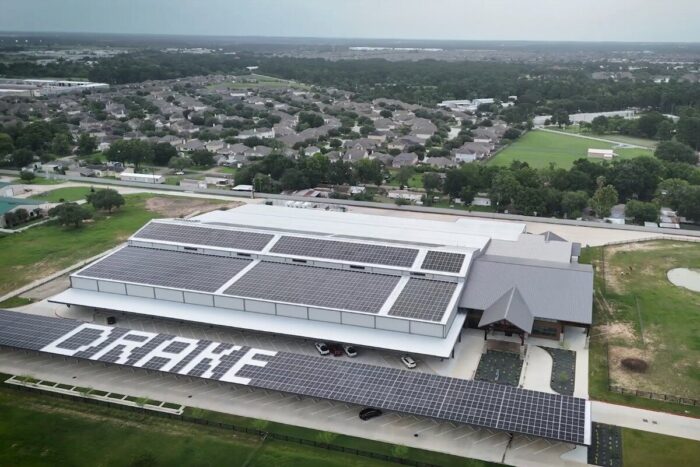
Trinasolar, Spear Commercial complete solar installation for Drake Plastics
Solar energy firm Trinasolar has announced its collaboration with Spear Commercial & Industrial on the new rooftop and carport solar system at Drake Plastics.
Trinasolar officials say the company supplied exactly 324 Vertex N PV modules to the project, which were then integrated across the facility’s roof and custom-designed carport for employees and visitors. The system’s daytime output is about 120% of Drake’s average afternoon power consumption, the company says, and achieves the company’s goal of 30% overall energy usage offsetting.
“Trina’s Vertex N modules let the system maximize solar energy generation despite the constrained footprint of the rooftop and carport design,” says Mark Rangel, executive VP of Spear. “We’re pleased that it provides Drake a very attractive rate of return in a short payback period and satisfies their energy objectives cost-effectively. And we enjoyed working with Drake to inject some creativity into the project by using the modules to display a highly visible brand statement.”
Bright spot: The unique 1.3 MW project also includes a branding statement, as the module layout spells out “DRAKE” when viewed from the airplanes that pass the complex on the way to Houston’s George Bush Intercontinental Airport.
The commercial installation is also expected to eliminate about 719 tons of carbon dioxide emissions every year, equivalent to removing 137 cars from the road every year.
“The new solar installation fulfills several important goals,” says Steve Quance, president of Drake Plastics. “It aligns precisely with our Mission Statement commitment to “Be good stewards of our environment and an asset to our community.” Our solar plant puts power into the grid when it is needed the most- doing the right thing never goes out of style. It also tracks with our “Lean” ethos to eliminate waste and inefficiency; the direct power offset provides cost benefits that help Drake compete and grow.”
Arevon energizes California’s Nighthawk Energy Storage Project
American energy developer Arevon Energy Inc. has announced the commercial operation of its 300 MWh Nighthawk Energy Storage Project in California, one of the region’s largest new energy storage facilities.
Located in the town of Poway, the installation sits about 22 miles northeast of San Diego and will provide enough energy to power hundreds of thousands of San Diegan homes for up to four hours. The system utilizes lithium ion phosphate battery technology, which the company says has been “recognized for its strong safety record and long operating life.”
“Energy storage is becoming increasingly important as electricity demand continues to rise across California and the United States,” says Arevon CEO Justin Johnson. “Projects like Nighthawk are critical to America’s growing energy needs because they strengthen grid reliability while delivering lasting economic benefits for local communities.”
Bright spot: Over its operational lifetime, the Nighthawk storage center is expected to generate more than $30 million in property tax revenue, officials say. This funding will help to fund local schools, public safety, infrastructure improvements, and other services throughout the wider San Diego community.
“One thing that clean, green energy has taught us: battery storage is essential,” says Joel Anderson, supervisor of San Diego County District 2. “This project strengthens our infrastructure, boosts our local economy, supports grid reliability, and provides enough capacity to power up to 385,000 homes when we need it most.”
Sonoma State University completes on-campus solar and battery installation
TotalEnergies has completed the 4.1 MW solar array project at California’s Sonoma State University (SSU), with the school stating that the project will both stabilize its energy bill spending and enhance its electrical resilience.
TotalEnergies and SSU are currently five years into a 30-year contract the two entities signed in 2021. The agreement locks half of SSU’s consumed electricity at lower than average utility prices, over the course of the next 30 years. This allows the university to stabilize its total energy costs and insulate itself from potential utility volatility.
“Sonoma State University’s investment in solar infrastructure is a meaningful example of how CSU campuses are advancing the system’s broader goal of carbon neutrality by 2045,” says Lindsey Rowell, chief of energy, sustainability and transportation in the California State University Office of the Chancellor. “TotalEnergies has been a significant partner in this work, supporting more than 30% of the CSU’s solar projects across our 22 campuses.”
Bright spot: The installation is among the North Bay’s largest institutional solar projects, according to the university. Larger utility-scale projects do exist in the region, the company says, but SSU’s project is notable for its on-campus setting. The 4.1 MW installation covers SSU’s average peak energy demand of 3 MW on hot summer days, and also includes a 1.55 MW battery bank.
“For many years, TotalEnergies has had the privilege of partnering with the CSU system to advance sustainable energy across California, with more than 20 MW of completed solar and battery storage projects – and more on the way,” says Eric Potts, managing director of TotalEnergies Distributed Generation USA.
“Together with SSU, we are building more than just modern energy infrastructure, we’re inspiring a cleaner, more resilient future for the next generation of climate leaders.”

Andover Elementary School, Greenskies, and Titan Energy form solar partnership
In partnership with energy business consultant Titan Energy and solar firm Greenskies, Andover Elementary School has completed a rooftop solar energy project on its Andover, Connecticut campus.
The new project “represents the culmination of years of planning and collaboration between school leadership, community stakeholders, and energy partners,” Greenskies representatives say. The three entities were collectively focused on creating an environmentally responsible future for the school district, as well as the broader central Connecticut community.
“I am proud of the new solar project at our school and the efforts of the Andover educational community and partnership with Titan Energy to promote sustainability and energy efficiency,” says Dr. Valerie Bruneau, superintendent of schools in Andover. “I hope the town will continue to support these initiatives, creating further opportunities for financial savings and environmental stewardship in our community.”
Bright spot: According to Greenskies, the installation is a small part of a broader effort to improve the district’s sustainability and energy efficiency. The district’s Board of Education recently approved additional improvements, including LED lighting upgrades and other efficiency measures on school buildings.
The district expects the project to generate “meaningful” savings on its utility bills. Ryan Linares, head of real estate at Greenskies Clean Energy, says that projects like this demonstrate that solar doesn’t have to break the bank, and that school districts and small communities can still take real steps toward energy sustainability and independence.
“This project reflects what’s possible when schools take a proactive, long-term approach to energy management,” says Kyle Ramm, managing director at Titan Energy. “By combining solar generation with broader efficiency initiatives, Andover Elementary School is creating a more sustainable and cost-effective future for its students, staff, and community.”
Pando Energy Partners launches new community solar platform
Pando Energy Partners LLC has announced that it holds exclusive EPC rights for a new platform of 16 community solar and battery storage projects in northern and south-central Illinois.
The initial portfolio totals about 108 MWdc in solar generation, the St. Louis-based company says, with battery systems also exceeding 157 MWh across eight of the sites. All told, Pando estimates its total EPC scope at just under $200 million.
“World-class development capabilities paired with genuine local roots,” says Byron DeLear, founding partner of Pando Energy Partners and CEO of Sustainable Equity LLC. “Our partner chose a team that lives here and hires here. The communities hosting these projects, starting with East St. Louis, will share in the value they generate.”
Bright spot: Orbital Energy, a principal member of the Pando platform, has development and EPC offices in both St. Louis and Chicago. The company says its team has designed, built, and subsequently supported more than 1.9 GW worth of solar and nearly 6 GWh of battery storage project nationwide. Further, the firm has already completed engineering work on “several” of the 16 new projects.
“Illinois sun, Illinois batteries, and Illinois workers earning prevailing wages, our work in this state will put power back into the hands of the people,” says Matt Connell, founder and CEO of Orbital Energy.
Omni Brewing partners with All Energy Solar at Minnesota brewery
St. Paul, Minnesota-based Omni Brewing Co. and All Energy Services have finished a new rooftop solar project on Omni’s newest location in Rosemount.
The idea of an integrated solar installation came from the very beginning of the brewery’s design, according to owner Justin Walsh. The original design for the building incorporated a custom solar array, with the company prioritizing energy efficiency and sustainability from the earliest planning stages.
“Going solar has been one of the more satisfying investments we’ve made at Omni Brewing,” Walsh says. “From the start, the goal was to run a cleaner, more sustainable operation, and this installation moved us meaningfully in that direction — a real part of our brewery now runs on the sun, which is something we’re proud of.”
AES managed every phase of the new project, officials say, with the company covering everything from initial energy analysis to final construction. The firm landed on a 74.8 kW system, featuring 176 solar panels complete with Enphase-branded microinverters.
“The monitoring from the Enphase microinverters is a genuine plus, because we can see exactly how each part of the array is doing at a glance rather than guessing,” says Walsh. “We have peace of mind knowing those components carry a 25-year warranty, which is well beyond what we’d expected going in.”
Bright spot: The solar solution was specifically chosen for the brewery’s east-west orientation, AES officials say. AES’s engineering team aimed to deliver optimal energy production throughout the day, and Enphase’s inverters also ensured cost-effective materials and long-term system reliability, the company adds.
“The completed system integrates seamlessly into the taproom’s sloped roof design, and nearly matches the roof color for a clean aesthetic,” says Michael Thalhimer, director of business development at AES. “The environmental impact is significant, covering the majority of the on-site usage.”

Comments are closed here.