Reliability, product testing front of mind for BESS industry in 2026
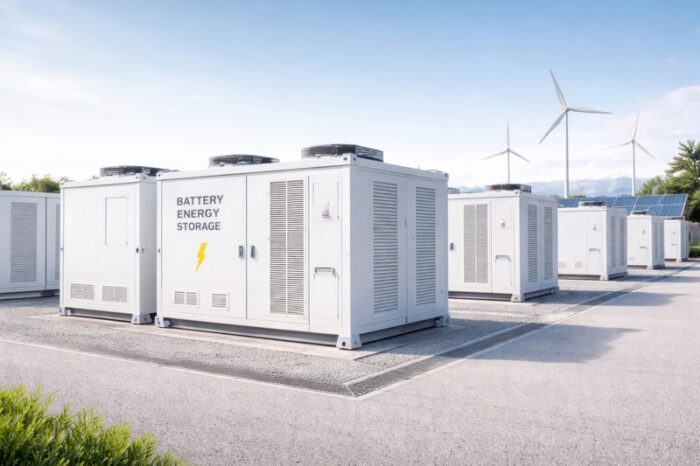
Battery energy storage system (BESS) products are skyrocketing in popularity. According to research from Benchmark Mineral Intelligence, the BESS market saw a 51% demand jump in 2025, and that train isn’t slowing down in 2026. However, these products are still somewhat volatile when it comes to reliability.
In the latest webinar by solar quality assurance firm Sinovoltaics, titled ‘When Models Meet Reality – BESS Performance Forecasting vs. Operational Surprises,’ solar and BESS experts discussed the state of the industry in 2026 and what manufacturers, installers, and consumers can expect through the year.
The lay of the land for 2026
Sinovoltaics media manager and webinar moderator Rasa Jakaitis says the BESS industry has a bright 2026 ahead of it. Citing the recent research from Benchmark, she says the market is expected to see more than a 40% jump in installation over the 315 GWh put in around the world last year, which itself was a 50% improvement from 2024’s figures.
“Yesterday, Benchmark Mineral Intelligence announced that 2026 is expected to be another strong year for battery energy storage, with forecast additions exceeding 450 GWh,” Jakaitis said Jan. 21. “Energy source project development is clearly not slowing down this year. At the same time, it’s crucial for asset owners, project developers, and investors to understand that best performance forecasts often look very different from real world outcomes.”
That gap between initial expectation and eventual performance can result in “unpleasant surprises,” Jakaitis adds.
Merus Power sales and marketing director and webinar panelist Markus Ovaskainen says that now more than ever, the energy space is driven by institutional investors. That level of money moving through the space creates a strong desire for guaranteed operation for financial gain, rather than physical performance.
“In many countries, (BESS companies are owned by) public companies,” he says. “This means that the technical performance guarantees, based on which the performance during lifetime is forecasted, are simplified to serve financial metrics, that then correspond to certain revenue streams.”
Reliability is key in critical application industries like energy and solar, and adding investors simply adds to that pressure cooker. Ovaskainen says that the biggest challenge may be just that: managing rising investor expectations.
“Many competitive companies, especially with a short-term vision and wanting to win deals, are giving into this demand,” Ovaskainen says. “We want to be a reliable and reputable EPC company and system integrator and show that all of our systems really work, and for a long period of time, and they have—we have references to show that.
“But within this crunch of demanding more and having to give guarantees for very long time periods that nobody really knows about, that would be the biggest challenge.”
Getting closer to the models
To align with investor performance expectations, BESS companies around the world are working to bring their battery and system specifications closer to modern performance models, Ovaskainen says.
“The first big realization that everybody should have is that all of this, especially round-trip efficiency and energy capacity, are operation-point dependent design values,” he says. “They do not say anything about performance of even given equipment. For example, all of the energy storages that we have built, the round-trip efficiency is different.”
Ovaskainen adds that the difference in efficiency and other variables comes from a difference between installed power and energy and the guaranteed power and energy, alongside other variables. Therefore, comparing different BESS example systems will essentially tell you nothing, he says, unless you understand the system’s design as a whole.
“My advice would be to get an understanding of how these values are defined by standards, what do the measurement methods imply, and how do these change different operation conditions,” Ovaskainen says.
As former New York Giants coach Bill Parcells might say, “the best ability is availability.” Developing BESS products with a long, consistent lifespan should be a top priority, according to Ovaskainen, as it greatly affects the bottom line for every company in the energy industry.
“Since this market is very (capital expenditure) price oriented, that incentivizes the suppliers to make compact, simple solutions that do not necessarily last,” he says. “But I would like to remind everyone that availability of energy storage is directly correlated to the bottom line of the revenue stream that you have available every year.
“If the system is not built for a long time, if it does not have a credible operation and maintenance plan, … it will not last the investment lifetime, or even break even.”

Mitigating BESS degradation and other issues
Ville Julin, the director of business development for Sinovoltaics, says that recent studies show 1 in 5 BESS projects will experience some sort of “operational issues.” Although that downtime is normally short-lived, even just a 1-2% drop in operation efficiency can be a financially dire situation, racking up millions in lost revenue for renewable energy operators.
“There has been commissioning delays that greatly impact (BESS projects) because as we all know, the battery industry and the market is very new,” Julin says. “Projects need to be on time, otherwise they risk saturation. Also, there has been a lot of performance shortfalls on site acceptance tests, so when the project is being started, it hasn’t reached the nameplate capacity of the contractual value.”
Those commissioning delays, at one to two months long, can not only delay cash flow but crater return on investment in the long run, according to Julin. Production monitoring and factory acceptance testing (FAT) can be prime quality assurance tools for the BESS industry, he adds, ensuring that products meet specifications and avoid any short-term installation problems before they even leaving the manufacturing plant.
“(Production monitoring) is a very common thing to do in the PV industry, but we are just recently starting with our first projects with batteries,” he says. “It’s like saying that there’s a recipe for making a chef, and then how does the chef follow the recipe? It’s the same thing on the factory floor: How are the machines being calibrated? How are they maintained? What kind of conditions are the raw materials stored in, temperature, humidity for example?”
“The other part is to verify that your (system) is being built with the correct bill of materials.”
Factory acceptance testing often includes a full charge to discharge cycle for the battery, according to Julin, verifying that both energy capacity and round-trip efficiency of the battery are at acceptable levels. Julin adds that many BESS manufacturers have been able to leave some proverbial wiggle room in their energy levels, should there be an issue that arises in production.
“Manufacturers leave a buffer on this contractual capacity,” he says, “meaning that if you buy the 5 MWh container for example, you can have a few modules inside of the container that are not working as they should. Still, the overall level of the container will pass.”
Still, however, the traditional FAT test leaves the risk of having BESS modules inside racks that are performing suboptimally, Julin says. In response, Sinovoltaics has developed a quality assurance software known as ‘BESSential’ to evaluate capacity, round-trip efficiency, and data for each battery pack in a system. With up to 500 data points per BESS container, the software is able to get data on voltage, temperature, total energy capacity, and other variables.
The recent research by Benchmark leaves the BESS industry in a promising, yet still precarious spot. In 2025, BESSential analyzed more than 500 MWh of products, good for more than 10 projects throughout the year. Most issues found related to thermal management at higher temperatures, according to Julin, highlighting one of the biggest issues with the BESS and lithium-ion battery industries.
“Since every manufacturer is using their own design for the container, the layout, the cooling system, the heat will be differently dissipated,” he says. “The equipment used is different, so that will also impact how they can cool the system.”