
Stoneridge Solar adds 200 MW to Texas grid | Projects Weekly

Welcome back from the Thanksgiving holiday (for those of you in the United States). This edition of Projects Weekly highlights RWE’s newly commissioned 200 MW PV + 200 MWh storage Stoneridge Solar project in Texas. Plus, Wisconsin utilities received approval to add solar + storage and other renewables to the state’s energy supply. Additionally, the Confederated Tribes of the Colville Reservation (Colville Tribes) in northeastern Washington and Open Access Technology International Inc. (OATI) are collaborating to deploy microgrids across the reservation. Finally, a Minnesota school district is switching to solar energy through a partnership with All Energy Solar.
RWE energizes solar + storage project in Texas
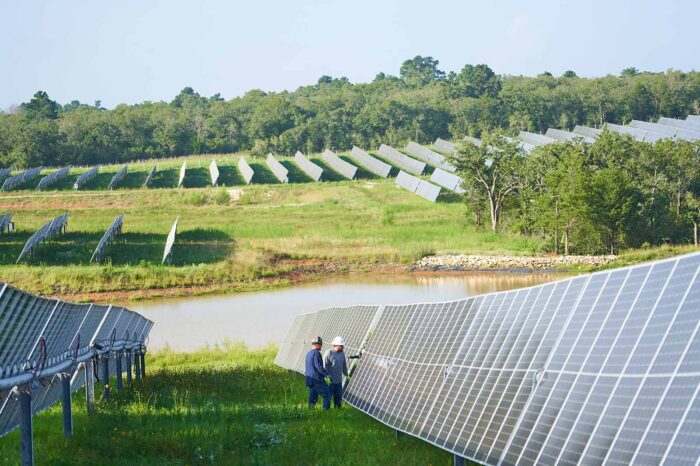
RWE has commissioned its Stoneridge Solar project, delivering 200 MW of PV and 100 MW (200 MWh) of battery storage Milam County, Texas.
“Stoneridge Solar is a great example of the power of local partnership and the positive role energy projects play in economic stimulation,” said Andrew Flanagan, CEO of RWE Clean Energy. “We are helping Texas and the nation secure their energy future with scalable, homegrown energy while also delivering meaningful benefits to communities across America’s heartland.”
Cool factor: Stoneridge Solar created more 200 construction jobs and now supports permanent operational roles. The project is expected to generate millions in tax revenue for Milam County and the Thorndale Independent School District, with direct investments supporting first responders and educational initiatives. From funding renovations at Thorndale Elementary School to partnering with the local volunteer fire department, RWE is helping communities like Milam County remain resilient and prosperous.
RWE’s energy capacity across the United States has grown to more than 11 GW, reinforcing the company’s leadership in delivering reliable and affordable power to homes and businesses.
MGE adds solar + storage and other renewables to Wisconsin energy supply
Wisconsin utility companies have partnered to add more renewable energy to the state’s energy supply. Madison Gas and Electric (MGE), in partnership with We Energies and Wisconsin Public Service (WPS), subsidiaries of WEC Energy Group, received approval from the Public Service Commission of Wisconsin to purchase solar capacity, battery storage and wind capacity from four renewable energy projects. MGE will own 35 MW of solar, 5 MW of battery storage and nearly 18 MW of wind in total from the different projects.
“The approval of these projects is another important step in our ongoing effort to reduce carbon emissions, increase our use of cost-effective renewable generation and advance new technologies to benefit all customers,” said Jeff Keebler, chairman, president and CEO of MGE. “With our current plans, by 2030, we will have added more than 40 renewable generation and battery storage projects since 2015, totaling more than 750 MW, propelling us toward our goal of net-zero carbon electricity by 2050.”
Cool factor: MGE will own a 10% share of four renewable energy projects, including two solar projects, the Saratoga Solar Energy Center and Ursa Solar Park. The Saratoga Solar Energy Center will include a 150 MW solar array and 50 MW battery energy storage system located in Wood County. MGE will own 15 MW of solar capacity and 5 MW of battery storage. The solar array and battery energy storage system are both expected to start serving customers in 2028. The Ursa Solar Park is a 200 MW solar facility that will be located in Columbia County. MGE will own 20 MW of solar capacity. The solar array is expected to begin serving customers in 2027.
The company will also own shares in two wind farm projects. The Badger Hollow Wind Farm is a 112 MW project in Iowa and Grant counties. MGE will own 11.2 MW of wind capacity. The wind farm is expected to begin serving customers in 2027. The Whitetail Wind Farm is a 67 MW wind farm will be located in Grant County. MGE will own 6.7 MW of wind capacity. The wind farm is expected to begin serving customers in 2027.
Colville Tribes seek energy sovereignty through microgrids
The Confederated Tribes of the Colville Reservation (Colville Tribes) and Open Access Technology International Inc. (OATI) announced a landmark collaboration to advance tribal energy sovereignty and resilience through the design and deployment of multiple microgrids across the reservation in northeastern Washington. The program represents a significant step toward improving reliability, reducing outages, and providing long-term energy independence for the Colville Tribes. The initiative is backed by federal and state grant awards and addresses vulnerabilities such as winter storm disruptions and wildfire risks.
OATI is delivering professional project design and development services, hardware, and its advanced GridMind platform to support the microgrids through resource management and market integration. Planned sites include:
- Nespelem HQ Campus (Lucy F. Covington Government Center): Rooftop solar PV, battery energy storage, EV charging, and microgrid controls, with an expansion to create a full campus resiliency hub.
- Paschal Sherman Indian School (PSIS) Community: Microgrid design to support education and community resiliency.
- Keller and Inchelium Districts: Additional distributed energy resources and microgrid infrastructure for local resilience.
Cool factor: The Colville Tribes microgrid program is rooted in the principle of energy sovereignty — the right of tribes to produce, deliver, and manage energy on their own lands. With the Colville Reservation served by multiple utilities offering varied levels of service, the ability to self-generate electricity provides resiliency and reliability for vulnerable communities and ensures critical services, including healthcare, commerce, and housing, remain powered during outages. Colville Tribes may also leverage the microgrids to offer additional grid benefits to local utilities and/or engage in energy markets as they evolve and grow.
“Since the Colville Reservation is in a remote location, subject to natural events like winter storms and fires, it has always been difficult for us to sustain a reliable supply of power,” said Jarred-Michael Erickson, chairman of the Confederated Tribes of the Colville Reservation. “Our hope is that this microgrid technology will not only keep our lights on, but will also position us for new economic opportunities.”
Future expansions envision integration with gaming operations and potential data centers, supported by tribal-owned utility and telecom infrastructure. With multiple microgrids underway, Colville Tribes is establishing itself as a leader in tribal energy innovation. The partnership not only secures reliable power but also positions the tribe for new economic opportunities, including data center hosting and advanced commercial development on tribal lands.
Minnesota school district switches to solar energy with All Energy Solar
Earlier this year, Minneota Public Schools made a powerful move to solar energy for its high school’s electricity needs. All Energy Solar, a leading solar installer in the Midwest headquartered in St Paul, Minnesota, helped the school make that transition with assistance from a state program designed for just this type of project.
“The school’s solar energy system has a capacity of 47.56 kW and consists of 82 panels installed on the gymnasium’s rooftop,” said Les Engler, Minneota facilities manager. “The system has been working very well for the school with the help of All Energy Solar.”
In 2021, the Minnesota State Legislature launched the Solar for Schools grant program for all school districts across the state. This program aims to encourage the installation of solar energy systems for educational institutions, while also providing an opportunity to incorporate renewable energy awareness and instruction into the schools’ curriculum.
Cool factor: Minneota Public Schools, a Kindergarten through 12th grade school district located in southwest Minnesota, is a beacon of academic excellence. With impressive rankings, including No. 17 in the state for State Assessment Proficiency and No. 19 in State Assessment Performance, coupled with a remarkable 100% graduation rate, the school’s commitment to educational excellence is unwavering. Upon learning more about the Solar for Schools program in 2024, Minneota Schools pursued a project as a forward-thinking solution that benefits both the environment and their community.
There are currently three science classes that are incorporating solar energy into their curriculum. Each class utilizes an innovative app that enables them to monitor the new array’s solar inverters and even individual solar panel output. This hands-on experience not only enriches their understanding of renewable energy but also empowers them to engage with real-world technology in a meaningful way.


Comments are closed here.