SolarEdge, Infineon extend deal to fix DC fault protection for AI data centers
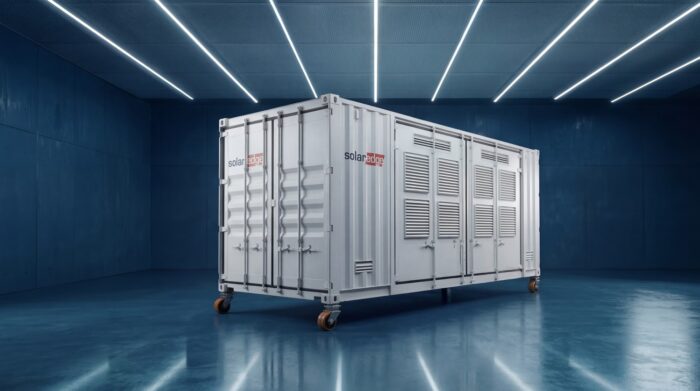
Two companies are extending their partnership to solve fault protection challenges associated with DC power used in AI data centers. SolarEdge and Infineon are building a faster, all-electronic “circuit breaker” for the high-power DC systems that run AI data centers. This replaces slower mechanical switches, allowing power faults to shut off almost instantly, which company officials claim makes it easier to pack more computing power into less space.
SolarEdge Technologies Inc. is a global leader in smart energy, while Infineon Technologies AG is a global semiconductor leader in power systems and IoT. The two companies announced an extension of their collaboration to advance solid-state circuit breaker (SSCB) technology for high-voltage DC distribution in AI and hyperscale data centers. The collaboration addresses a key challenge in the adoption of 800 VDC architecture: Safe operation of increasingly power-dense infrastructure requires a very fast fault-isolation to achieve selectivity while maintaining high efficiency.
“High-density AI infrastructure at 800 VDC demands uncompromising efficiency and protection,” says Shuki Nir, CEO of SolarEdge. “Solid-state protection will enable operators to achieve both, delivering ultra-fast and dependable fault isolation without sacrificing conversion performance. Infineon’s silicon carbide technology is what makes it practical at scale.”
Extending the collaboration to solid-state protection addresses a critical gap in the distribution layer between the solid-state transformer (SST) and the compute rack, advancing a comprehensive grid-to-rack solution. SolarEdge is leading the design of its SSCB solution, with Infineon providing its silicon carbide (SiC) JFET technology at the core of the protection devices.
Enabling safe, reliable operation
As rapidly increasing AI compute density drives the industry toward higher-voltage DC distribution, SSCBs address one of the most fundamental challenges in enabling safe and reliable operation. Unlike conventional AC systems, DC protection presents a different engineering challenge.
Without a natural current zero, mechanical interruption faces challenges with arcing. It is comparatively slow, and as such requires a different approach to circuit protection than conventional AC systems. SSCBs are designed to interrupt faults within a few microseconds, with no mechanical contacts to separate, while Infineon’s CoolSiC JFET devices deliver efficient operation and superior robustness. Together, these capabilities help protect high-value compute equipment and enable more compact, higher-density DC distribution designs.
The collaboration builds directly on SolarEdge’s SST platform with Infineon SiC components, first announced in November 2025. The SST is designed to enable direct medium-voltage (13.8-34.5 kV) to 800-1500 VDC conversion at over 99% efficiency, collapsing multiple conversion stages into a single solution while reducing physical footprint.
“Today’s data infrastructures have become more vulnerable to electrical faults, thereby driving the demand for smarter, faster and more robust power distribution systems,” says Andreas Weisl, executive VP and chief sales officer of industrial and infrastructure at Infineon. “By combining our advanced silicon carbide JFET technology with SolarEdge’s expertise in final power distribution, we are addressing these demands to ensure fast, safe and reliable operations in AI data centers.”
Building on more than 20 years of leadership in DC-coupled power electronics, SolarEdge is developing an 800 VDC powertrain for AI factories, a DC-native chain that carries power from the medium-voltage grid connection through conversion, distribution and protection to the compute rack. Infineon’s broad portfolio of silicon, silicon carbide and gallium nitride solutions provides that foundation, supporting the decarbonization of AI infrastructure through lower losses, reduced environmental impact, and improved total cost of ownership.