
Unpopular opinion: Tax credits bought customers, not panels
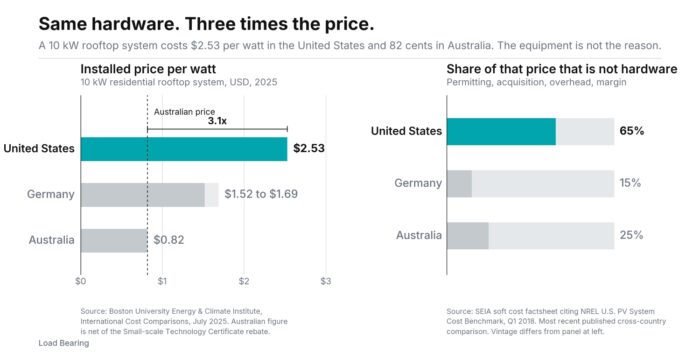
By Nicole Tomasin, Energy Access Innovations | Consider this: A 10 kW rooftop solar system in Australia costs about $0.82 per watt. The same system in the United States costs $2.53 per watt. Boston University’s Energy and Climate Institute puts the American figure at roughly three times the Australian one.
The panels are the same. The inverters are largely the same, and in many cases they ship from the same factories. Australian installation labor is not cheap. Australian roofs are not simpler.
What differs is everything that is not hardware. In the most recent published cross-country comparison, soft costs ran roughly 65% of total system cost in the United States, against 25% in Australia and 15% in Germany.
For 20 years, the United States ran the most generous residential solar subsidy in the developed world and produced the most expensive rooftop solar in the developed world. Those two facts are related, and the relationship runs in the direction most of us would rather not say out loud.
Headroom does not sit idle
The IRS Section 25D residential clean energy tax credit expired Dec. 31, 2025, under Public Law 119-21. No phase-down, no grace period. It had existed in some form since the Energy Policy Act of 2005, which means an entire generation of installers, dealers, lenders, and sales organizations built their businesses inside it.
A 30% federal credit is not just a discount to the homeowner. It is 30% of headroom in the price of the system. In a competitive market, headroom does not go unclaimed. It gets absorbed by whoever sits closest to the transaction.
In residential solar, that is the sales channel.
Consider what the redline model actually does. The installer’s cost is fixed. The installer’s margin is fixed. The dealer fee on the loan is fixed. What floats on top is the sales commission, and the rep’s job is to sell as far above the redline as the homeowner will tolerate. The price a customer pays became a function of what could be extracted rather than what the system cost to build.
That structure cannot survive without headroom. With headroom, it thrives.
Module prices have collapsed. Installed prices in this country followed at a fraction of the pace, which is the entire reason a system that costs $0.82 per watt in Sydney costs $2.53 in Phoenix. The difference did not evaporate. It was absorbed, and the largest absorbing category is the cost of finding and closing a customer.
What happened in the first quarter without it
Here is where the argument stops being a theory.
In Q1 2026, U.S. residential system pricing fell 7% year-over-year. SEIA and Wood Mackenzie attribute that decline to two things: falling module prices, and lower residential customer acquisition costs.
Read that again. The first quarter in which no homeowner could claim a federal credit is also the quarter in which the cost of acquiring that homeowner came down.
Nobody invented a new sales technology in 90 days. What changed is that the 30% available to spend on finding customers was no longer there to spend. Customer acquisition cost in residential solar was never a floor set by physics. It was a ceiling set by what the subsidy would absorb.
We had 20 years to fix the other things
I started in this industry in 2005. The fragmentation I encountered then is still here. The AHJ patchwork is still here. Interconnection review timelines still vary by an order of magnitude depending on which utility territory a roof happens to sit in.
None of it got solved, and the credit is a large part of why. Thirty percent of headroom is 30% of tolerance for your own dysfunction. You never have to fix permitting, or acquisition cost, or a commission stack that adds real dollars per watt and no capability, because the federal government is covering the spread.
Australia fixed those things because it had nowhere to hide them.
I will concede the obvious objection before someone makes it. The gap between the two countries is not caused by the tax credit alone. Australia has a national installation standard and a far more uniform connection process. That is real, and it is a large share of the difference.
But that is the point rather than a rebuttal. The credit is what paid for our fragmentation. It is the reason two decades of soft cost reform stayed a conference topic instead of a business necessity.
What the market did next
If the industry were prepared to stand on its own, we would be watching a wholesale cost reset. We are watching part of one, and part of something else.
Third-party ownership share is projected at 65% of residential installs in 2026, up from roughly 44% in 2025, as the market reorganizes into Section 48E, which survived. That is not standing on your own. That is re-papering the same 30% through a different section of the code.
It is also a bridge with a visible end. Begin-construction had to occur before July 4, 2026, to qualify under current rules. That gate closed eight weeks ago. Safe harbor equipment is finite, and every megawatt consumed brings the market closer to the unsubsidized price it has been avoiding since 2005.
SEIA and Wood Mackenzie expect residential solar to decline 21% in 2026. Freedom Forever, one of the largest residential installers in the country, filed bankruptcy in April. That is the cost of 20 years of deferred maintenance on our own business model, and it is being paid by operators who did nothing except respond rationally to the incentives in front of them.
The tell
Section 25D covered standalone residential battery storage. Storage lost exactly the same 30% credit that solar did, on the same date, with the same cliff.
Residential solar is forecast to contract 21% this year. Residential storage is forecast to contract 5%.
Same shock. One quarter of the damage.
And the attach rate went the other direction entirely. The national residential storage attachment rate reached 45% in Q1 2026, up from 38% in Q1 2025, a record. In the first quarter with no federal credit on either product, a larger share of solar customers bought a battery than ever before.
A product that holds its volume when its subsidy is removed is a product someone actually wanted. Nobody buys a battery because of a tax credit. They buy it because the power went out during the last event, or because their export compensation got cut and the arithmetic of self-consumption changed.
That is what an unsubsidized value proposition looks like. It does not require three hours at a kitchen table.
Why the survivors will be stronger
The credit set a floor under our cost structure and we called it a market.
Remove it, and the cost structure has to come down or the volume goes away. We have one quarter of evidence that it comes down. Every dollar of commission stacking is now a competitive disadvantage rather than a source of upside. Every week of permitting delay is now carried by a company that cannot pass it through.
The companies still standing in 2028 will be the ones whose economics work at Australian soft cost, because that is the only structure that closes a deal without a federal credit doing the closing for you.
That is a brutal reset. It is also the first honest cost pressure this industry has faced in 20 years, and what comes out the other side will be the first U.S. solar companies that never needed the subsidy in the first place.
[Disclosure: I sell equipment into this channel. A residential contraction is not good for my company either. I am arguing that what survives will be worth more than what we are losing.]
Supplied art
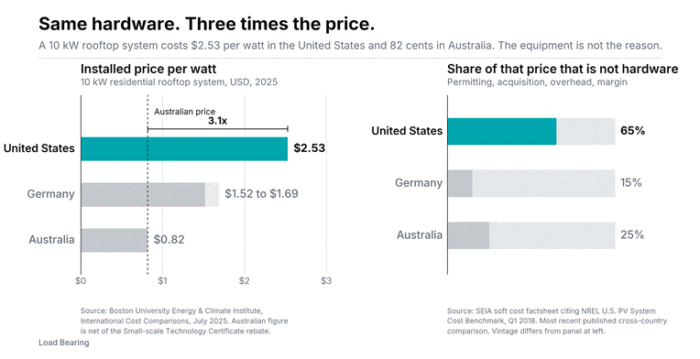
Suggested caption: American rooftop solar costs roughly three times the Australian equivalent for the same equipment. The difference is not hardware. Sources: Boston University Energy and Climate Institute (2025); SEIA and NREL (2018 benchmark).
Supplied as vector PDF and 300 dpi PNG. Note that the two panels carry different source vintages, which is stated on the chart. They are deliberately not combined into a single stacked bar, because multiplying 2025 price levels by 2018 soft-cost shares produces an implied hardware cost that is not credible.
Nicole Tomasin is chief commercial officer at Energy Access Innovations and has spent 21 years in solar and storage across distribution, product strategy, and commercial partnerships. She has built and led commercial teams across residential, C&I, and utility-scale channels, and now focuses on storage economics and interconnection strategy. She publishes Load Bearing, an operator’s newsletter on the energy transition, at nicoletomasin.substack.com.



Comments are closed here.