
Will solar float on Canadian hydro reservoirs?
Canada’s hydroelectric utilities are faced with a dilemma to be prepared for growing electricity demand over the next decade: Whether to refurbish older generating units, build new hydro, or add renewables — particularly floating solar (FPV). While floating solar has taken off like a bolt of sunlight in Europe, Asia and Africa, and elsewhere in the Americas, Canada has been slow to embrace the technology.
FPV system providers have been at work for several years educating Canadian hydroelectric utilities of the value proposition of this type of solar, but to date, FPV has only been installed at a small scale at a few commercial mine and agricultural sites in the country. (See last month’s Solar Builder Canada story for more details.)
But that may change in the near future, suggests one provider: “We’ve had a bit more interest from the local utilities and generation asset owners,” says Eden Yesh, president and CEO of Infinity Solar Group, based in Invermere, British Columbia. “It’s likely going to take some [more] pre-feasibility economics and references from other cold-climate applications to make these folks make a decision.”
Another FPV purveyor that manufactures composite panels for marine vessels, Open Waters Solar, based in Prince George, B.C., has held talks with BC Hydro but with little success thus far, according to Simon Angus, the founder of the company. His marine panels weigh only one-tenth of what a standard solar panel weighs, an advantage that could reduce the cost of FPV floatation infrastructure, which represents the bulk of the cost of an array, Angus told SB.
Thus far, the utilities are mum. “We are aware of floating solar technology, which involves installing solar panels on floating platforms on bodies of water such as reservoirs. While this technology exists, we are not aware of any floating solar projects currently operating in British Columbia and have not deployed floating solar on our reservoirs,” says Whitney Deane, a spokesperson for BC Hydro, in an email response.
FPV at 6,000 ft and still cranking
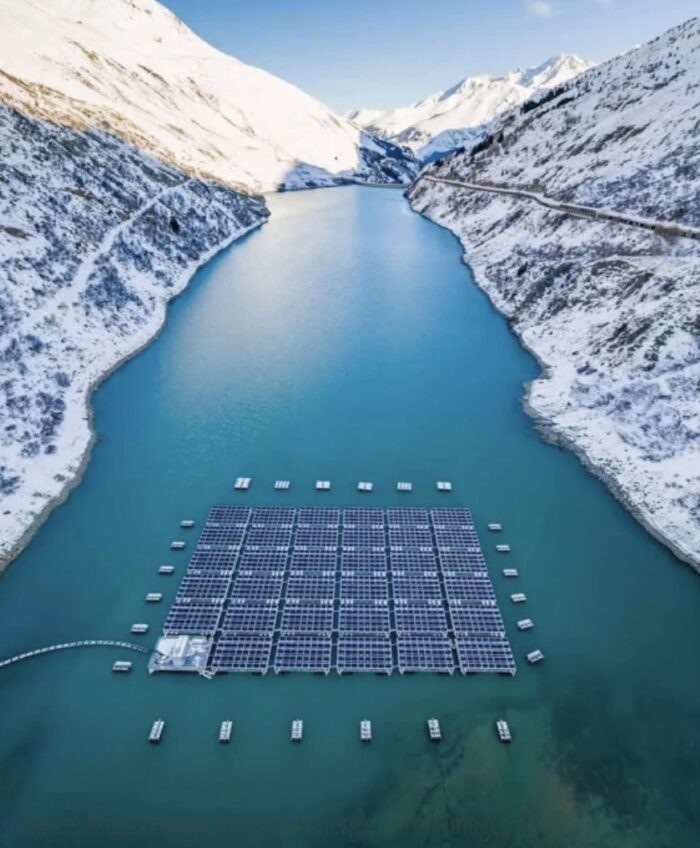
While Canadian hydro utility analysts may not yet believe that FPV will work in climates with substantial snow and ice, forward-looking planners in other cold countries have embraced the technology substantially. For example, on Switzerland’s Lac des Toules, at an altitude of 5,938 feet, Romande Energie S.A. and ABB built a 24,000-square-foot demonstration FPV array to withstand -30 C° temperatures, winds blowing up to 120 km/h, freezing of the lake (60 cm of ice) and heavy snowfall (up to 50 cm),” notes Polau Marine, the equipment provider for the array.
Using bifacial panels, the Lac des Toules array yielded a 30% gain over what a same-size array at sea level was projected to yield, according to a statement by Guillaume Fuchs, co-director of energy solutions at Romande Energie. The utility is now developing a 721,000-square-foot commercial scale FPV array of some 27,000 solar panels on the lake, expected to produce almost 23 million kWh per year, with a 2030 completion date.
“We believe in the large-scale project and even plan to develop alpine solar energy on other artificial lakes in Switzerland,” Fuchs said in a company statement. The Swiss Federal Office of Energy is supporting the project.
Largest European hydro FPV — so far
Thus far, Europe’s largest floating solar plant on a reservoir is the Alqueva Reservoir in Portugal, operated by EDP. The array includes 12,000 panels and has a hybrid power line design that carries both solar and hydro generation. The €6 million project generates 7.5 GWh annually, the utility reports. The race goes on.
Elsewhere in northern Europe, Ciel & Terre built a 13 kW FPV installation on a reservoir in Bor, Sweden. The company designed the array “to face temperatures from 0°C to -40°C/F and a snow load exceeding 350N/m² (62 psf),” the company said in a report of the demonstration project. The Bor array also was designed to be compliant with UL2703 (with tests performed up to 1000N/m² snow load), the company said.
“Even with snow loads beyond [the company support design] Hydrelio buoyancy, we have not had a single issue of sinking floats because ice is forming before significant snow amounts arise and therefore preventing this extra load from sinking the structure,” the company notes.
Potential for Canadian Hydro FPV
Given the European experience with hydro FPV, Canada seems to have great potential for adoption of the technology. Hydro reservoirs are spread across Canada, with more than 500 facilities coast to coast in almost every province and territory, according to WaterPower Canada, the hydroelectric trade association. “Canada’s waterpower sector is on track to add roughly 11,000 MW of new capacity over the coming decade, representing approximately $100 billion in planned investments by 2035,” the association calculates.
“What often gets lost in the telling is where that capacity is actually coming from. Greenfield development accounts for 5,700 MW of that total, while expansions and refurbishments contribute another 5,300 MW — nearly as much as all planned greenfield development combined,” the association recounts.
“More than 25 projects in total are currently planned or underway across Canada, requiring tens of thousands of skilled workers over the coming decade. They represent one of the largest ongoing construction programs in the country,” WaterPower Canada reports. “Refurbishments extend the operating life of a generational asset by approximately 50 years.”
Limits to FPV Hydro Growth
Snow and ice are considerable elements to be contended with in the application of FPV to hydro reserves. To help design a system that controls some of this weather, Western University researcher Koami Soulemane Hayibo tested a FPV installation designed to prevent ice formation in winter on an Ontario pond.
“Your main challenge is going to be winter ice formation,” Hayibo said in a collegiate press story. “Hayibo and his team suspended bubblers — similar to those used to aerate aquariums — about 30 centimeters below the panels. The devices pushed warmer water to the surface and kept it moving, preventing ice from forming,” the story explains. Hayibo and his colleagues published their results in the journal Renewable Energy, in December 2023.
Hayibo’s team estimated that the bubblers consume up to 14.5 per cent of the electricity yield of the panels. However, the FPV panels typically generate more electricity than comparable land-based panels because the cooling effect of the water improves their efficiency, the story reveals.
“The researchers estimated the net cost of the electricity generated at about three cents per kilowatt-hour, similar to other solar installations in Canada. That was despite the system’s small size of 7kW.”
Another challenge to FPV on reservoirs is the potential under-design of moorings. To help alleviate that design problem, DNV developed norms in May of this year as standard DNV-ST-E309. The standard “focuses explicitly on the design, principles, and methodologies for mooring and station-keeping systems. It sets specific requirements for components and system configurations to minimize failure risks,” the company explains.
Charles W. Thurston is a special correspondent to Solar Builder.

Comments are closed here.