
Canada ponders floating solar solutions
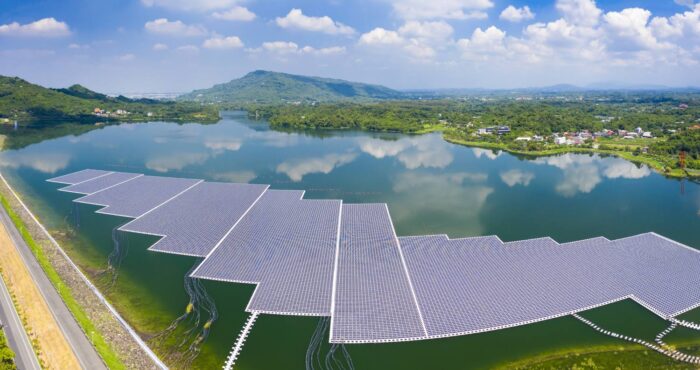
Floating photovoltaic (FPV) solar technology is being considered by a rising number of Canadian project developers, seeking solutions for sites ranging from tailings ponds to hydroelectric dams.
Utility adoption of floating solar could account for the largest installations in Canada, especially on hydroelectric dam reservoirs. While many utilities are grappling with a rising demand for electricity, the cost of adding new dams or retooling older dams is expensive, when compared with solar.
British Colombia is one promising location for FPV adoption. “The B.C. Sustainable Energy Association thinks so. It suggests that covering 10% of the Williston Reservoir behind BC Hydro’s W.A.C. Bennett dam, for example, could generate 13,500 gigawatt hours a year — as much as the hydropower from the dam itself,” writes Emily Chung on a Google discussion group hosted by the Canadian Association for the Club of Rome (CACOR). The BCSEA was unable to comment on the analysis by deadline.
B.C. Hydro, the largest utility in the province, is beginning to plan and test FPV as one of the “emerging” alternative energy sources it expects to begin using in the near to mid-future. “Engineers are testing floating platforms on B.C. Hydro reservoirs to create hybrid water-energy systems. Solar generation peaks during the sunny summer months, allowing the province to reduce the draw on water reserves when energy demand is high,” writes Engineering Post, on its Facebook blog. B.C. Hydro did not respond to requests for comment.
Commercial FPV adoption is also in the cards. Mining facilities are among the types of commercial clients looking to FPV for alternative energy sources, according to Chris Bartle, director of sales and marketing for Ciel & Terre USA – The Americas, in San Rafael, California. “There is a company in northern Alberta that has been looking at floating solar on their tar pits — big, contaminated water bodies that can’t be used for anything else — and you know that would be perfect for floating solar,” says Bartle, in an interview with SB.
Others agree that mines are strong candidates for FPV. “We’ve recently formed a joint venture to bring FPV and water filtration technology to mine tailing ponds, and finally expect a first contract within a few months’ time,” says Peter Robison, CEO of Lightvolt Solar, based in Calgary.
Limits to Canadian FPV growth
While Canada has a plethora of potential sites for FPV deployment, the level of insolation at more northern sites may be one limit to growth. “I think the biggest hurdle in Canada for FPV is not snow and ice, it’s sunlight in northern latitudes,” says Bartle. “To get as much sun up there to maximize their sun exposure, they want steep tilt angles and the floating solar can’t do that.” Bartle notes that Ciel & Terre FPV can be tilted up to about 12 degrees.
Some FPV system developers have developed vertical arrays to overcome the low light issue. Sinn Power, based in Gauting, Germany, for example, recently installed a 1.8 MW vertical floating solar plant in the Bavaria region. “With bifacial panels catching sunlight from both sides and a design that thrives during storms, this technology is set to outperform traditional solar farms in both efficiency and durability,” the company states.
The difference between Canadian and U.S. insolation is significant. “The United States receives significantly higher average solar insolation than Canada, largely due to its lower latitude and more arid climates in the Southwest. The U.S. typically sees annual averages of 3.5 to 6.5 kWh/m²/day, whereas Canada generally ranges from 2.5 to 4.5 kWh/m²/day,” according to the U.S. Energy Information Administration.
That difference is greater in the north. “Canada receives an average daily solar insolation of about 3.1 to 3.6 kWh/m². However, solar potential varies significantly by region, ranging from about 1,004 kWh/kW/year in British Columbia to over 1,330 kWh/kW/year in the prairies, averaging roughly 1,133 kWh/kW/year nationwide,” according to EnergyHub.
Another challenge for FPV in Canada is snow and ice accumulation. One recent study showed that injected air beneath panels frozen in ice could augment performance. “A primary hurdle for water-based solar in B.C. and the rest of Canada is the formation of heavy ice and freezing winter temperatures. To solve this, innovators (such as researchers at Western University) have developed air-bubbler systems that push warmer bottom water to the surface, preventing thick ice from locking the flexible panels in place,” one blogger writes on Tech Xplore.
Deployed on an Ontario stormwater pond, the 7 kW system’s bubbles circulated warmer water from the pond’s bottom to prevent ice from locking the panels in place, the blog indicates. The solar panels were adhered to foam board to help insulate the solar cells. “The new methodological approach, detailed in this study, enables FPV operations of any kind in cold climates where ice formation has historically constrained deployment,” wrote researchers Koami Soulemane Hayibo, Motakabbir Rahman, and Joshua Pearce in Applied Energy, Volume 420, 1 October 2026, 128159.
Early adopters of demonstration FPV projects
One of the first FPV projects in Canada was the floating array on a storm pond for Under Sun Acres, in Leamington, Ontario, developed last year by the Netherland’s Profloating. “This project is the first of its kind in Canada, to the best of our knowledge,” said Thom Plettenburg, the head of development at Profloating BV, based in New York, in an interview with SB.
Profloating has experience in the U.S. market, where it developed a 3.2 MW FPV system at Cohoes, New York, billed as the first municipally owned floating solar array in the United States. There, the $8 million City of Cohoes Floating Solar demonstration project is being installed on its water reservoir, featuring 5,880 panels of 545 Wp each. The array will generate local clean energy while helping to reduce reservoir evaporation and algal bloom formation, city planners indicate. The system also benefits from increased energy yield thanks to lower module temperatures and sunlight reflection from the water surface.
The Cohoes project included Profloating’s FLOTAR floats, manufactured in the United States, supported by the mooring system designed and supplied by strategic partner Seaflex. The project was managed by DLC Electric. The FLOTAR system is engineered and tested to support panels up to 710 Wp, including regional snow load requirements, the company states.
Charles W. Thurston is a special correspondent for Solar Builder.

Comments are closed here.