Twin peaks | Vertical solar arrays offer rising potential
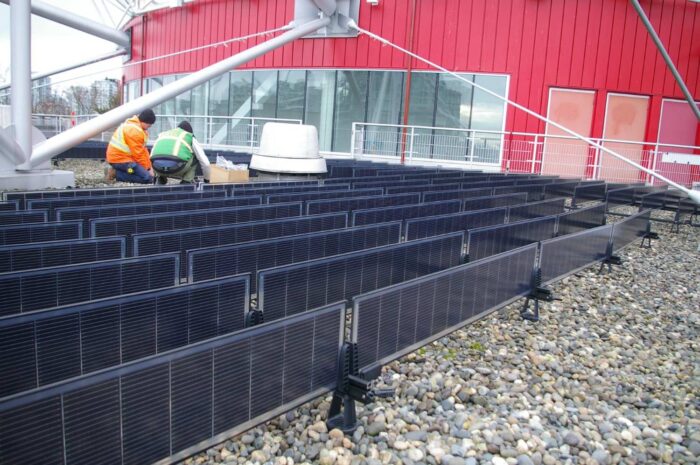
East Vancouver’s VREC Solar is advancing the potential adoption of vertical solar in Canada with both urban and off-grid installations.
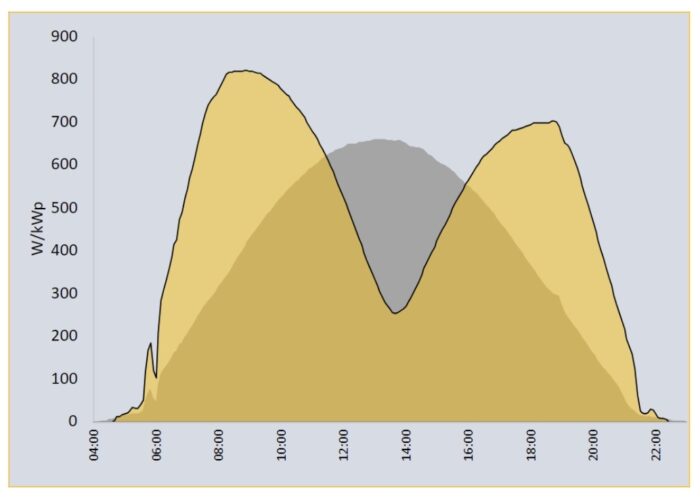
“Vertical solar panels are getting more sun because they’re square to the low-angle sun in the morning and the evening, and of course the benefit there is that you get some of the production during peak demand rate times,” says Duncan Martin, operations manager at VREC for the install, in an interview with SB.
Vertical solar complements the traditional duck curve of solar production, typically generating two peak production curves, like a Bactrian camel.
“Apart from urban installs, at off-grid sites they’re concerned about maximizing their winter generation. You want to point the modules at a deep angle when the sun is low in the sky. We’ve installed off-site vertical solar for that reason,” Martin adds. “We’ve installed vertical ground mount vertical solar in the Gulf Islands, off the coast of the lower mainland.”
Showcase vertical install: Science World, Vancouver
Norwegian vertical PV specialist Over Easy Solar, based in Oslo, Norway, completed its first commercial installation in Canada at Science World in Vancouver in April as part of a $39 million energy efficiency upgrade. The project was backed by $20 million from the BC government and $19 million from federal green infrastructure programs. Local utility BC Hydro is monitoring the installation as part of a plan to roll out vertical PV in areas of British Columbia where snow poses a challenge during the winter, according to Over Easy representatives.
The project involved Over Easy’s xM-3 QUATTRO-256S product with ST125 feet, which produces 256 Watts peak. Overall, the 19.5 kW system used 76 bifacial units, each of which contains four solar cells sandwiched between horizontal glass panels, oriented east-west.
The design for the Science World roof required low weight, which the Over Easy unit delivers with 12.4 kg per square meter, or about 2.5 pounds per square foot without ballast. The wind load-resistance of the design also is certified with up to 47 meters per second or about 105 mph, fulfilling a Norwegian guideline under NS-EN 1991-1-4. The racking system is cross connected as one large grid, providing resistance to wind lift.
Assuring vertical solar wind resistance
Over Easy has tested its vertical design resistance to wind using Computational Fluid Dynamics Simulations at Fraunhofer ISE, Europe’s leading research institute in solar technology. Similarly, the design was wind tunnel tested at IFI Aachen, a leading institute for wind load assessments in Europe.
In the case of the Vancouver install, the monolithic racking structure grid alone was nearly enough to withstand local winds, shielded by parapet walls that often are several feet high to hide HVAC equipment from view.
“The array was designed by the manufacturer to need minimal ballast. Compared to a standard ballasted rooftop system for which you’re craning up pallets of concrete pavers, this design, only involved carrying a few bricks up the stairs,” Martin explains. “The panels sit about six inches off the rooftop, and then they’re about 10 inches tall.”
That height will withstand winter snow buildup yet absorb the near 100% albedo of the snow accumulation.
“Even if there is accumulation, it’s not going to get a whole lot deeper than six inches in Vancouver,” he adds.
Vertical panels tend to heat and shed snow on the array itself.
“The technology presented challenges, like any new product that nobody is familiar with, whether it’s on the regulatory side, the local inspectors, or the installers,” Martin says. “There’s the question of how it attaches or if it’s just weighted down, and whether you have to attach seismic connections, because we are in a seismically at-risk area.”
Rising potential for vertical solar in Canada
“I think that vertical solar in Canada has great potential,” Martin suggests. “Vertical solar allows us to retrofit buildings like warehouses or box stores, or large industrial buildings that weren’t necessarily built to have a whole lot of extra load on their roof.”
Vertical solar works in Canada as well as anywhere, if not better, given the low climb of the sun during winter. Research performed by the University of York, in the UK, found that during a full year of monitoring across all seasons and weather conditions, vertical solar yielded 26.9% more energy production in early morning hours than conventional tilted panels, yielded 22.9% more energy production in late afternoon compared with conventional tilted panels, and yielded up to 24.52% more electricity in winter conditions.
“This array is part of an BC Hydro’s Innovation, Demonstrations, and Research Program,” Martin says. The program tests and accelerates clean energy technologies that make electrification more affordable and improve electrical utility management in British Columbia. “The utility also wants to find out what might be helpful to integrate into their customer generation program or any of their other power smart initiatives.”
Apart from BC Hydro, Hydro-Québec is testing out Over Easy vertical solar arrays for potential promotion, as part of its Free Electrons Program.
Larger vertical PV installs likely
After the test roofs in Canada have been analyzed for production in comparison with other roof mount solutions, larger pilot projects are likely. Over Easy has installed 6,400 vertical solar panels on the flat roof of a large cold storage facility in Tromsø Model, thus far the largest such installation in the world, as far as the company is aware.
“Currently we have many Canadian requests and couple of projects in the pipeline that might be built in the future, but I can’t share more about that yet,” says Klaus Pichler, head of sales and marketing at Over Easy Solar, in response to an email.
Other vertical solar players in Canada
One other solar developer promoting vertical solar is ZinCo Canada, a green roofing system company, which released its Vertical Solar Array system in February 2025. Vertical solar is easily integrated with green roofs, on which a low growth of plants helps to both insulate the building below, to mitigate greenhouse gas, and to cool solar cells.
“The ambient cooling effect of green roofs improves the performance of photovoltaic modules, ensuring higher energy output,” a ZinCo statement says. “Vertical panels are designed to shed snow naturally, eliminating the need for manual cleaning and ensuring consistent energy production.”
Another player in Canada is Next2Sun, which installs vertical bifacial solar modules both for AgriPV, for solar fences, and recently, for utility-scale solar. In June 2026, the company released the Fields2Sun Max for utility scale projects. “We are currently receiving a lot of inquiries in Canada and we are pleased that our products are so popular,” says a company spokesperson in response to an email.
Agrivoltaic demand also rises
Apart from roof-mounted vertical solar arrays, there is also great potential for vertical solar in agriculture. A recent study by Western University in Ontario showed that strawberry yields in Ontario, for example, increased by 18% as a result of ground-mounted vertical solar shading.
The Canada agrivoltaics market is projected to grow from $1.4 billion in 2025 to $6.9 billion by 2031, at a compounded average growth rate (CAGR) of 30.5% during the forecast period, according to a September 2025 analysis by Mobility Foresights.
Charles W. Thurston is a regular contributor to Solar Builder.