
U.S. solar projects seeing fewer delays
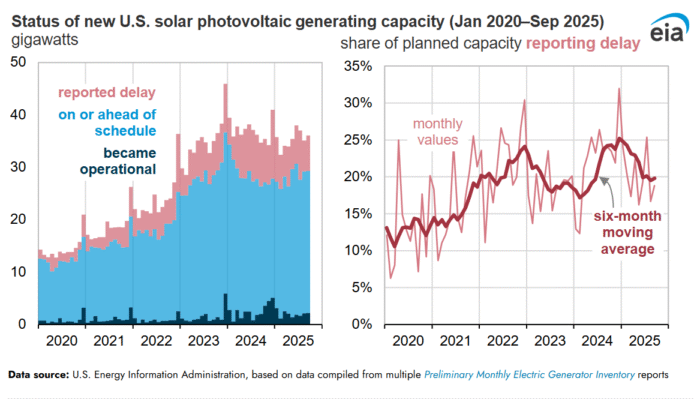
Despite the seeming regulatory attack on solar energy this year, projects saw fewer delays in Q3 than during the same period last year. While that progress is good news for U.S. energy demand, solar industry advocates are calling on federal agencies to speed up its process for connecting large-load projects to meet consumers needs.
The U.S. Energy Information Administration (EIA) reported that solar projects representing about 20% of planned capacity reported a delay during the third quarter of 2025, a decrease from 25% in the same period in 2024. The report was based on data compiled from multiple Preliminary Monthly Electric Generator Inventory reports.
Solar power is the fastest-growing source of new electric generating capacity in the United States, driven by large-scale solar PV projects built by electric utilities and independent power producers, according to a report by EIA analysts Katherine Antonio and Tyler Hodge. Delays in bringing these solar projects into operation have been trending down in recent months.
Despite the relatively high number of projects reporting delays in 2024, that year was a record year for U.S. solar capacity additions. Power plant developers added 31 GW of utility-scale solar PV generating capacity in 2024, which increased total U.S. utility-scale solar capacity by 34%. Delays in solar project schedules tend to be relatively short in duration, according to the EIA, and reports of delays are more common than cancellations, with less than 1% of planned solar capacity being entirely cancelled in a typical month.
Reporting on solar projects
Developers of new power-generating capacity report their project’s initial planned operational date on the EIA’s Annual Electric Generator Report (EIA-860) survey. Beginning 12 months before a project’s planned online date, the EIA asks developers to provide updates on the status and schedule of the project in our monthly update to that annual survey, the Preliminary Monthly Electric Generator Inventory.
Because survey respondents may not anticipate the occurrence or duration of delays, ultimate capacity additions tend to be less than the expected amount that developers report to the EIA at the beginning of the year. In January 2024, developers reported plans to bring more than 36 GW of solar capacity online through December 2024, or 5 GW more than the ultimate 31 GW installed.
Along with updates to timelines, the EIA requests that developers also categorize the stage of development, such as planning, permitting, construction, and testing. Much of the reported delayed capacity occurs at projects that are in the late construction or testing phases just before they come online. These delays are typically only for a month or two, according to the agency.
In the EIA’s most recent monthly inventory of power plants, developers reported plans to bring 32 GW of solar capacity online in the next 12 months (from October 2025 through September 2026). About 5 GW of that capacity is from solar projects that delayed their expected online date compared with what they had previously reported.
SEIA calls for policy solutions to quicken interconnection
The Solar Energy Industries Association (SEIA) filed comments today in two federal proceedings focused on meeting surging electricity demand in the United States. The association submitted comments to the Federal Energy Regulatory Commission (FERC) in its rulemaking on interconnecting large loads, including data centers, and responded to the Department of Energy’s (DOE) Request for Information on strategies to bring new power to market faster under its “Speed to Power” initiative.
SEIA president and CEO Abigail Ross Hopper expressed support for the government’s focus on “bringing new power online faster during this moment of sharply rising energy demand.” She explained that energy prices are increasing across the United States, and the addition of more power to the grid is the “only durable way to put downward pressure on those costs.”
“Solar and storage are leading the response to this challenge, making up 82% of all new power added to the U.S. grid this year,” Hopper said. “As more data centers and advanced manufacturing come online and drive unprecedented load growth, we need modern policy solutions to speed the deployment of all energy technologies, including solar and storage, which can be built faster and more affordably than any other power source.”
According to the SEIA comments to the DOE, building power quickly is “only one piece of the puzzle,” Hopper said. The United States also needs “a standardized process” to connect major power loads to the transmission system, she added, explaining the reasoning behind the SEIA also filing comments on FERC’s rulemaking on large-load interconnection.
“Taken together, DOE’s Speed to Power initiative and FERC’s large-load interconnection rule represent two elements of the same national priority: getting affordable, reliable power to the places that need it most,” Hopper said. “Smart, coordinated policies will allow us to meet this moment with more solar and storage generation, strengthen grid reliability, lower costs, and keep America competitive in a global economy.”

Comments are closed here.