
SOLON completes Arizona’s largest behind-the-meter solar facility | Projects Weekly

This week’s edition of Projects Weekly highlights the largest behind-the-meter solar project in the history of the state of Arizona in the form of SOLON Corp.’s new solar array near Tucson. Also on the list, Coach and Kate Spade parent company Tapestry Inc. has partnered with Pivot Energy to construct three community solar projects worth 13.475 MWac in Illinois. Elsewhere around the U.S., Treaty Oak Clean Energy has begun construction on two solar projects in Louisiana, and Altus Power closed a deal for 12 MW of commercial-scale solar assets across the Mid-Atlantic and the South. Keep reading for more project news from across the solar landscape!
SOLON Corp. Completes Largest Behind-the-Meter Solar Project in Arizona
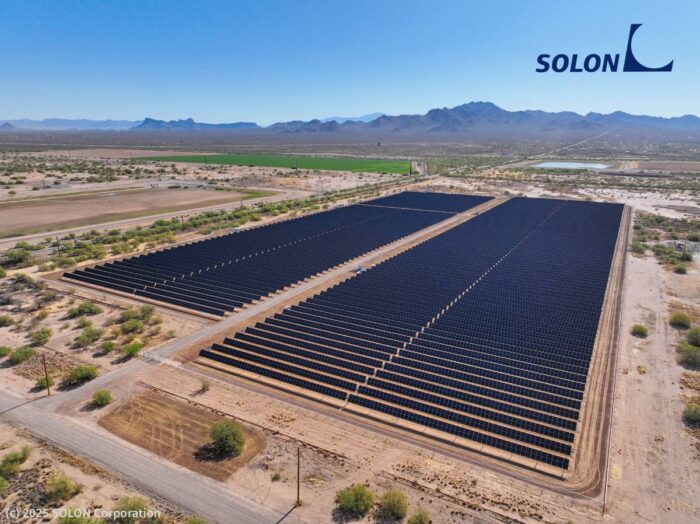
SOLON Corp. recently announced the completion of its 8.75 MW behind-the-meter solar project at Tucson Water’s Central Avra Valley Storage and Recovery Project (CAVSARP).
The largest known installation of its kind in the state of Arizona, the project’s solar array, a collection of 16,275 solar modules, takes up about 1.16 million square feet near the city of Tucson. Starting with its energization in August 2025, the solar field is projected to generate nearly 514.5 GWh of renewable energy for the state of Arizona over the next 28 years.
The project is set to “significantly decrease” CAVSARP’s reliance on traditional power sources in favor of renewable energy, and could deliver millions in energy savings over its multi-decade lifespan.
“SOLON is thrilled to deliver this groundbreaking solar project that supports the City of Tucson’s ambitious sustainability goals,” said Brian Seibel, President at SOLON Corp. “Our partnership with the City of Tucson demonstrates our shared commitment to advancing clean energy infrastructure and providing solar solutions that deliver meaningful long-term savings.”
Bright spot: The environmental impact of the project is “equal to removing 80,617 gasoline-powered vehicles from the road for one year, 72,025 homes avoiding electricity use for one year, or planting and growing over 5.7 million tree seedlings for ten years,” according to officials from SOLON.
Navajo Transitional Energy Co. Completes DOE-Funded Navajo Home Solar Installations
The Navajo Transitional Energy Co. (NTEC) recently completed its first 15 home solar installations for its ‘Navajo Sun Power!’ program.
Funded by the U.S. Department of Energy (DOE) in 2024 to the tune of $2.6 million, the project will support the installation of 125 solar units on Navajo homes in rural parts of the Navajo Nation. The DOE will cover 75 of the installations, with NTEC covering all costs for the remaining 50. Since its inception in 2020, NTEC has already finished 50 solar systems, worth approximately $1.25 million.
“We’d like thank the U.S. Department of Energy for its support of NTEC’s Navajo Sun Power! program,” said Vern Lund, chief executive officer for NTEC. “The additional funding provided by DOE allowed us to expand NTEC’s program to provide more solar installations and improve the lives of citizens living on the Navajo Nation. This program makes a real difference in the lives of Navajo people who would not otherwise have access to electricity. We are thrilled to partner with DOE to make this a reality.”
Each of the 15 homes belong to multi-family households within the Navajo Nation. In addition to providing renewable energy and carbon mitigation, the systems diversify the area’s energy grid, bolstering economic growth, NTEC officials say.
Bright spot: The first 15 installations mark the completion of all DOE-funded projects for 2025, and took place at homes inside the Monument Valley Navajo Tribal Park. Due to park regulations, these homes cannot have transmission lines or running water. With no other way to generate electricity, the new solar installations make heating, cooling, refrigeration, and running water possible.
“Usually when we go to the store, we buy some perishable food and have to use it up right away before it goes bad. Now we just put it in the fridge and use it later. I think having solar was a very good Christmas present,” says Loretta White, resident of Narrow Canyon. “We can’t thank you enough. It’s been many years coming.”
Another resident from Monument Valley, Valterra Sayetsitty, adds, “It’s very convenient with lights now. I don’t have to get gas for the generator anymore and the solar system is excellent and convenient.”
Pivot Energy, Tapestry Announce Completion of Three Illinois Community Solar Projects
Nationwide renewable energy provider Pivot Energy and lifestyle and accessories brand Tapestry Inc., have completed three Illinois community solar projects worth 13.475 MWac, representatives say.
“Pivot is thrilled to partner with Tapestry on this Illinois portfolio,” said Liz Reddington, vice president of development at Pivot Energy. “It demonstrates how companies are continuing to advance renewable energy solutions while providing support to local communities for workforce development, education, and more.”
Located in Peoria, Dover, and Ottawa, the three projects are the first of five community solar projects that Pivot will develop and own throughout the Land of Lincoln. The projects come as part of a 15-year agreement with Tapestry, which is purchasing Renewable Energy Credits (RECs) from Pivot. Combined, the projects are expected to produce more than 23,000 MWh per year, equivalent to powering about 2,500 Illinois homes annually.
“These Illinois solar projects mark a significant milestone in Tapestry’s renewable energy strategy. Our partnership with Pivot Energy has been instrumental in achieving 100% renewable electricity across our own operations, a key step toward meeting our science-based climate targets,” says Logan Duran, global head of ESG and sustainability for Tapestry Inc. “This collaboration demonstrates how we’re integrating sustainability into the way we operate, investing in solutions that deliver measurable impact for our business and the planet.”
Bright spot: Pivot will also be investing in the communities where its projects operate, officials say, with plans to contribute more than $115,000 across the five projects in this partnership. The funds will go to local organizations and initiatives including Illinois Central College and workforce training program HIRE360.
“We are thrilled to share that Pivot Energy has made a generous contribution to support our pre-apprenticeship programs. Its support will help us advance workforce pathways into the solar industry, focusing on transitioning workers from fossil fuel trades and empowering underrepresented groups like minorities and women. We’re grateful for Pivot’s partnership and commitment to purpose-driven solar development. Together, we’re creating opportunities and driving a more inclusive renewable energy future,” says Jay Rowell, executive director of HIRE360.
Terra-Gen Commences Commercial Operations at New BESS Project
Terra-Gen recently announced the commencement of commercial operation for its Lockhart CL I & II battery energy storage system (BESS) project in San Bernardino, California.
The combined project contains 164 battery enclosures and “utilizes the existing gen-tie line connecting to Southern California Edison’s Kramer Junction Substation,” representatives say. Combined, the CL I & II projects will provide an additional 128.7 MW of capacity to the Californian renewable energy grid, supplying more than 128,000 households for four hours.
“California’s clean energy goals are some of the most ambitious in the country, and I’m confident in the positive impact our new Lockhart facility will have in powering the state’s future with new, clean, and reliable energy resources,” says Terra-Gen CEO John O’Connor. “This milestone reinforces our mission to provide affordable energy, at a large scale, to help strengthen the California grid while also having a meaningful positive impact on climate change.”
Gus Luna, the company’s chief development officer, says Terra-Gen designed the expansion to “fit seamlessly” within the already-existing facility. The new complex is a testament to the Terra-Gen team’s ability, he adds.
“We designed this expansion to fit seamlessly with the existing facility and maximize the shared infrastructure,” said Gus Luna, chief development officer for Terra-Gen. “The Lockhart complex is a testament to our team’s ability to deliver integrated projects, at scale, on time and to the highest performance and safety standards.”
Bright spot: Construction of the facility created 115 jobs around the area at its peak, with employees collectively working more than 85,000 hours throughout construction and transition to operations.
Energy Vault Begins Construction of 150 MW SOSA Energy Center in Texas
Sustainable energy solutions company Energy Vault Holdings Inc. has announced the start of construction on the Madison County, Texas’s SOSA Energy Center. Originally developed by Shell subsidiary Savion, the 150 MW/300 MWh battery energy storage system (BESS) was formally acquired by Energy Vault in Q4 2025.
The firm expects this project to achieve commercial operation by Q2 2027.
“Breaking ground on the SOSA Energy Center so quickly after acquisition demonstrates the velocity with which we are executing and growing Energy Vault’s Asset Vault platform and underscores our strategic commitment to the Texas ERCOT market, one of the most dynamic energy markets in the United States,” say Energy Vault chairman and CEO Robert Piconi. “Texas continues to lead the nation in renewable energy adoption and grid modernization, making it a cornerstone market for our growth strategy. This project not only demonstrates our ability to rapidly execute on high-quality acquisitions and move swiftly from acquisition to construction, but also advances Energy Vault’s position as a key energy infrastructure partner in supporting Texas’s energy transition.”
The project “benefits from fully secured site control, clean title, and completed environmental and interconnection milestones, ensuring a streamlined construction process,” officials say. The company will be performing all engineering, procurement, and construction in-house, as well as completing all long-term service agreements for the project.
Bright spot: Energy Vault expects the SOSA Energy Center to deliver approximately $350 million in total revenue, alongside predictable, recurring high-margin cash streams over the technical life of the project.
Ampion and ENGIE Announce New Solar Farms to Deliver Energy, Savings to Illinois Households
ENGIE North America (ENGIE) is bringing two new community solar farms online in Knox County, Illinois, potentially powering hundreds of households and businesses with a subscription service.
ENGIE is partnering with community solar subscription management firm Ampion for the project, which will oversee subscriber enrollment across Knox County. Located in Galesburg, the projects will cut both carbon emissions and utility bills, producing more than 8.2 MWh per year, cutting out an expected 7,800 tons of CO2 emissions, equivalent to taking 1,655 cars off the road.
“Community solar is about more than clean power. It’s about ensuring that households – including those with the greatest need – share in the benefits of the shift to clean energy,” says Kristen Fornes, head of distributed solar and storage at ENGIE. “These projects in Knox County show how renewable energy can strengthen communities, reduce costs and create a healthier future for families.”
A community solar farm is a privately owned business established to capture energy from the sun and convert it into electricity that flows into the utility grid. Residents and businesses can subscribe to a share of the farm’s output and, in turn, receive credits on their monthly electricity bills that reduce costs. ENGIE owns and operates the Knox solar farms, while Ampion provides subscription management by enrolling new participants and supporting them as customers.
The Knox solar gardens will benefit 443 households and businesses in total, advancing renewable energy goals as well as economic relief goals. Nate Owen, CEO and founder of Ampion, says the partnership between the two firms will last throughout the course of these projects.
“Ampion is proud to work with ENGIE to help low-to-moderate income families in Illinois access the cost-saving benefits of community solar,” he says. “With the majority of the benefits reserved for households enrolled in programs like LIHEAP, Medicaid, and SNAP, these solar farms will deliver much-needed electricity savings.” We look forward to working with ENGIE throughout the course of these projects, while ensuring subscribers receive real cost savings on their utility bills.”
Bright spot: Over half of the project’s subscriptions are reserved for low-to-moderate income households. Already qualifying for programs like LIHEAP, Medicaid, SNAP, and TANF, these residents and others will also receive 20% savings on the value of solar bill credits applied to their monthly electrical utility bills.
Treaty Oak Clean Energy Begins Construction on 385MW of Solar Projects in Louisiana
Austin, Texas-based energy firm Treaty Oak Clean Energy recently announced that it has begun construction on both the Beekman Solar Project in Morehouse Parish, Louisiana and the Hollis Creek Solar Project in Sabine Parish, Louisiana. Combined, the two projects will add 385 MW of renewable energy capacity to the Pelican State, officials say.
The projects, which closed financing shortly before the turn of the year, will provide energy to Mark Zuckerberg-led tech giant Meta through long-term offtake agreements, Treaty Oak says. The projects are a “significant step forward” in Treaty Oak’s renewable energy infrastructure commitment
“Closing the financing for these two projects during a challenging economic year for renewable energy projects underscores our strong business model and commitment to bringing energy independence to states like Louisiana,” says Treaty Oak CEO Chris Elrod. “I’m incredibly proud of our teams and grateful to our financing partners, suppliers, and vendors for their collaboration in making these projects a reality while supporting our commitment to build a U.S. based supply chain for our customers.”
The agreement with Meta, inked in October, allows the company to purchase the environmental attributes generated by the projects to advance ongoing sustainability goals. The energy from the projects, however, will flow into the local grid in northern and western Louisiana.
Bright spot: Both projects are expected to begin operation within the first half of 2027, creating about 300 jobs and generating enough energy to power about 80,000 homes. Over their lifetimes, the projects are also expected to generate more than $100 million in state and local tax revenue.
Otovo Acquires Solar Service Professionals to Enter California
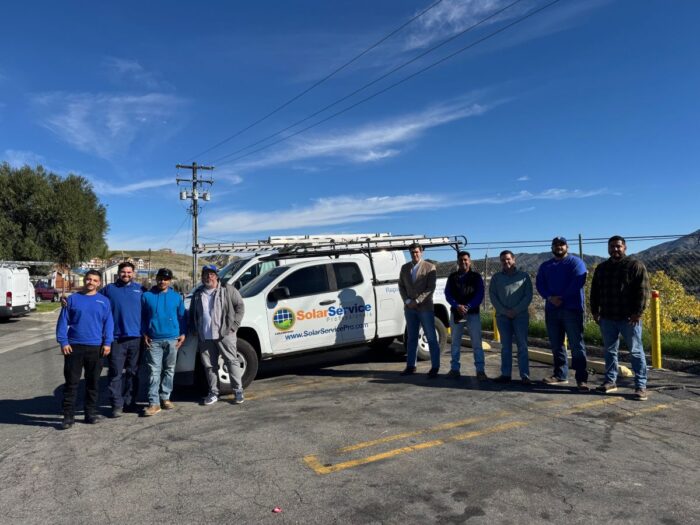
Home energy service provider Otovo has entered into a definitive agreement to acquire Californian service provider Solar Service Professionals Inc. (SSP). Set to close in early January, the deal marks Otovo’s strategic entry into the largest residential solar + storage market in the U.S.
Since its founding in 2017, SSP has built a “strong” base of about 38,000 customers in the solar service business. Now, that customer base will be integrated into Otovo’s existing service business, which will work to convert those customers into its subscriptions service. The expectation, officials say, is that the acquisition will “be accretive to net income in 2026.”
“This strategic acquisition represents a pivotal moment for Otovo’s U.S. expansion, launching our innovative AI-based energy service in California and potentially other markets thereafter, and establishing a foundation for significant growth in 2026,” said William J. (John) Berger, CEO of Otovo. “SSP’s established operations in California provide Otovo with an immediate footprint in the country’s largest solar market.”
Manny Hernandez, owner and CEO of SSP, called the acquisition the start of “an exciting new chapter” for both his team and the homeowners it serves.
“We are incredibly proud of the trusted reputation we’ve built over the years, and by integrating with Otovo’s cutting-edge Endurance platform, we can take that service experience to the next level,” Hernandez says. “This partnership not only secures a bright future for our employees but ensures our customers will benefit from faster response times and smarter energy management.”
Bright spot: Otovo’s power partner model contains a cloud-connected virtual power plant, as well as an AI-native Endurance platform. The platform “can triage issues and route the right crew in real time,” cutting down on customer wait time and closing the loop with a singular device network.
Altus Power Acquires 12 MW of Commercial-Scale Solar Assets Across Four States
Altus Power, a commercial-scale power company, has acquired a 12 MW solar operating portfolio from Hecate Energy. Spanning across Florida, Georgia, Maryland and Rhode Island, the deal expands the company’s footprint in both the Mid-Atlantic and Southeast markets.
“This portfolio underscores the power of our differentiated platform–disciplined investment, efficient execution, and long-term customer partnerships,” says Dan Griffin, co-head of investment and structured finance for Altus Power. “These projects enhance our existing asset base and expand our ability to deliver dependable, cost-effective power to customers across strategic markets with high demand.”
The projects “serve a diverse mix of enterprise and utility offtakers,” keeping in lock-step with Altus Power’s strategy of affordability and incremental power in strong markets. The company already boasts 1.3 GW of operating solar assets across more than 600 projects in 30 states, as well as Washington, D.C.
Bright spot: The deal services mainly Mid-Atlantic and Southern states, which have seen a major uptick in power demand in recent years.
Adapture Closes $233 Million in Financing from U.S. Bank for ‘Titanium’ Projects
Utility-scale solar and storage developer Adapture Renewables Inc. has closed $233 million in tax equity financing commitments from U.S. Bank for two solar projects within its Titanium portfolio.
“This tax equity close reflects the strong economic fundamentals of these solar assets, our ability to construct them efficiently and the growing depth of expertise in the organization,” says Thomas Houghton, president and CEO of Adapture.
The financing commitment from U.S. Bank “marks a major milestone” as the Oakland, California-based Adapture advances toward commercial operation of its multi-site renewable energy portfolio. The deal comes on the heels of another announcement from Adapture in March 2025, in which the company secured a $321 million construction and tax credit bridge facility with MUFG, supporting its 441 MW Titanium portfolio across Arkansas and Illinois.
“This tax equity close reflects the strong economic fundamentals of these solar assets, our ability to construct them efficiently and the growing depth of expertise in the organization,” added Houghton. “We are pleased to further our long-standing partnership with U.S. Bank with these projects as we continue delivering high-quality, reliable solar assets to the market.”
U.S. Bank’s tax equity investments are a critical source of funding for project construction. “U.S. Bank invests in renewable energy projects that help strengthen the energy grid and drive local job creation,” said Eric Barr, senior vice president, Environmental Finance, U.S. Bank. “We are proud to support our long-standing customer Adapture with our tax equity financing and expertise as it expands its Titanium portfolio and delivers clean energy generation.”
Bright spot: The first projects of Adapture’s Titanium portfolio, which began construction in September 2024, are expected to reach commercial operation later this year. Once fully online, that 441 MW portfolio is expected to generate enough renewable power to supply more than 71,000 homes annually.
Spearmint Energy Secures BESS Investment from Kyuden International Corp.
Large-scale battery storage company Spearmint Energy has announced its successful closure of an equity investment in southern Texas. The investment, going to BESS projects known as ‘Tierra Seca’ and ‘Seven Flags’ in Del Rio and Laredo, Texas respectively, support the addition of 400 MWh of energy capacity to ERCOT, officials say.
The overseas business arm of Japanese energy utility company Kyuden Group, known as Kyuden International, provided the investment, according to Spearmint Energy officials. In total, the two battery projects will supply more than 100 MW (or 200 MWh) to the grid on the southern border of the U.S.
“As power demand continues to rapidly increase across the U.S. accelerating the need for battery energy storage, we are pleased to partner with Kyuden International to advance our development of reliable and affordable energy solutions,” says Andrew Waranch, founder, president, and CEO of Spearmint. “We believe Kyuden International’s significant investment in Tierra Seca and Seven Flags underscores their confidence in Spearmint’s ability to safely and efficiently bring projects online that enhance grid stability and meet the needs of communities across ERCOT.”
Spearmint has already acquired more than $250 million in financing from Manulife, East West Bank, Investec, and Sugar Creek Capital during Q2 2025 to support construction on these projects. Both sites commenced operations in late December 2025.
“Our entry into the U.S. battery energy storage market required a partner with both vision and capability, and we believe Spearmint embodies both,” adds Takashi Mitsuyoshi, CEO of Kyuden International. “Spearmint’s technical expertise, scalable platform, and execution competence in complex markets make the company an exceptional fit for our investment strategy. We look forward to helping Spearmint advance critical infrastructure that strengthens grid resilience nationwide.”
Bright spot: Kyuden International’s investment in Tierra Seca and Seven Flags counts as the Chuo City, Japan-based firm’s first foray into the U.S. BESS market. The contribution follows earlier investments in the American solar power generation space, as well as four gas turbine combined cycle power plants.



Comments are closed here.