
Global solar ‘foundational’ for 2026 energy outlook, report says
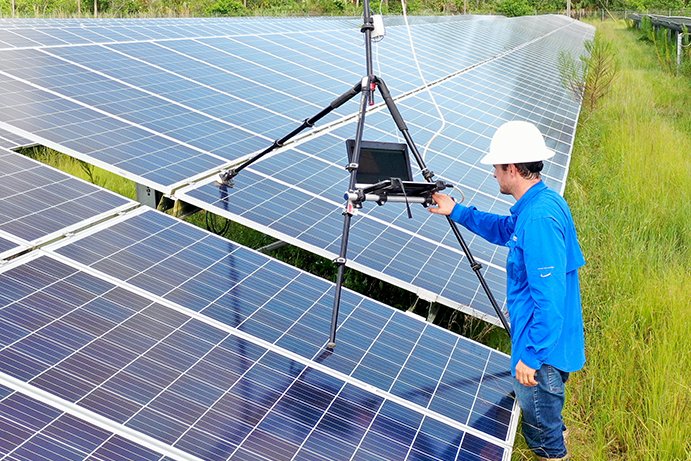
A new report from research firm Wood Mackenzie finds that solar is due for a big year in 2026, positioning itself as the “foundational technology of new power demand growth.”
The report, titled ‘Global solar: three things to look for in 2026,’ says that cumulative solar capacity installed worldwide is looking up for 2026 and beyond.
With capacity set to more than double, reaching nearly 8 TWdc over the course of the next eight years, Wood Mackenzie said that the forecast is looking good for the solar industry in the short term.
“As we look forward to 2026, our predictions for solar technology include its ability to address power demand growth, the prospects for balcony solar, and the implications of a new mega project in the Middle East,” the company says.
Bouncing back
Following a “challenging” year for the global solar market in 2025, the technology is poised to turn over a new leaf in 2026, the report says.
“In China, the world’s largest market, structural changes to energy market policy led to notably fewer solar installations in the second half of (2025) compared to the first half,” Wood Mackenzie officials say. “While the nation is estimated to have reached record deployments of nearly 400 GW in 2025, the market will contract for the first time in 2026. In the US, a stream of policy changes and executive actions by the Trump administration made for an uncertain and volatile environment for solar, causing numerous project cancellations and delays.”
The report adds that India, which is set to unseat the U.S. as the world’s second largest solar market, has seen challenges resulting in constrained deployments in 2026.
Solar will play a key role in fulfilling spiking power demand in the next few years, the report says. With electricity load growth accelerating thanks to electrification of manufacturing, the rise of data centers, and a bevy of other factors, solar is set to be one of the grid’s primary new generation sources through the rest of the decade, Wood Mackenzie says.
“In the US, our latest power outlook puts annual power demand growth at 2.9% through 2035,” the report says.
“Wood Mackenzie’s tracking of large load requests puts the total committed and under construction pipeline at 160 GW, or 22% of 2024 peak demand. Under such intense demand growth conditions, every power source is on deck to serve this load.”
Balcony solar brings a new era for the U.S.
Balcony solar systems for residential areas have seen growth in Germany. Thanks in part to the high percentage of people living in multi-story apartments equipped with, of course, balconies, the country has become the leader in plug-in balcony solar modules. But in 2026 and beyond, that growth is expected to make the trip over the Atlantic Ocean, according to Wood Mackenzie.
“The appeal of balcony solar is that a few solar panels and an inverter can be plugged directly into a wall outlet and supply a home with some electricity – no need for an electrician, utility interconnection approval, or time-consuming permits,” says Michelle Davis, global head of solar for Wood Mackenzie.
Specifically, Wood Mackenzie officials cited San Francisco-based non-profit Brightsaver as a major proponent of the legislation, and one that expects these bills to pass rather easily.
The jury is still out, however, on the extent of balcony solar adoption in America. Due to having different electrical safety standards and utility rates than Europe, the outlook on balcony solar in the U.S. remains uncertain right now.
“Some have argued that homeowners will be keen to add these units to backyards, etc., but it’s unclear how attractive this will be for American homeowners, particularly those concerned about aesthetics,” the company says. “Finally, while payback periods for balcony solar are typically short, the total bill savings are modest ($20 a month or less). Electricity rates in Europe are generally higher than those in the US, driving a more attractive value proposition.”

UAE mega-project takes center stage
In October 2025, Masdar and the Emirates Water and Electricity Company (EWEC) broke ground on the world’s first gigawatt-scale renewable project with deliverance capabilities of 1 GW of baseload power around the clock.
At a price tag of nearly $6 billion, the project will integrate a 5.2GWdc solar facility and a 19 GWh battery storage system in Abu Dhabi. The project “represents a structural shift in hybrid project development” in the Middle East, Wood Mackenzie representatives say.
“Instead of using battery storage as ancillary grid support or to smooth out the generation profile, the system has been designed from inception to provide firm renewable output,” the firm says. “This directly targets offtakers with inflexible load profiles such as data centers and artificial intelligence hubs. This comes as no surprise given the intense new demand growth anticipated from these sources.”
While still far too expensive to replicate across the world, the UAE mega-project could “redefine baseload power” across the world when it becomes operational in late 2027. Gas plant costs are expected to continue to spike, making hybrid solar and storage like this a more viable option than ever.



Comments are closed here.