
Floating solar powers 100% of Calif. vineyard operations to reduce annual costs by $90K
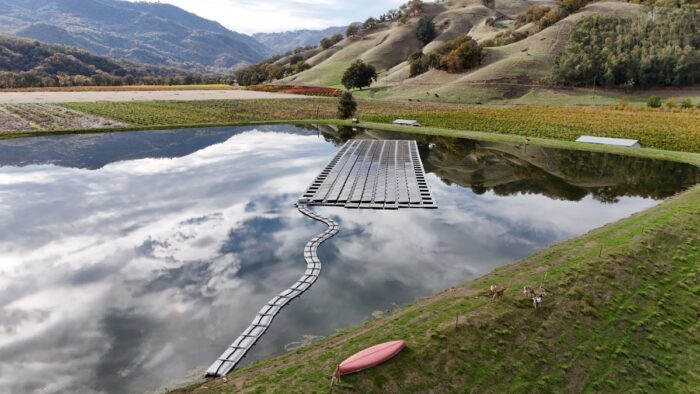
A newly installed floating solar system is powering 100% of the operations at Nelson Family Vineyards in Mendocino County, California. The innovative project was installed on an irrigation pond, enabling the 74-year-old, 1,800-acre family-run farm to operate entirely on renewable energy without taking any agricultural land out of production.
Along with an existing solar system on the roof of the winery, the floating photovoltaic (FPV) system is expected to generate about 200,000 kWh of electricity per year — enough to fully power the winery, agricultural pumps, tasting room, shop, and 12 on-site homes. The project is expected to save Nelson Family Vineyards an estimated $90,000 per year, reducing operating costs while also supporting its commitment to sustainable operation.
“With the cost of grid electricity rising so sharply, becoming energy independent will have a major and immediate impact on our operation. This investment will save us a tremendous amount of money year after year,” says Tyler Nelson, the owner of Nelson Family Vineyards. “Best of all, because the system floats on a pond, it does not take a single acre of land out of production. That means our full 1,800 acres can be used solely for what matters most, agriculture and supporting wildlife habitat.”
UC Davis gains real-world research site
The FPV installation will also serve as a key field site for a comprehensive U.S. study on the ecological impacts of FPV technology. Scientists from the UC Davis Wild Energy Center will use the system to examine how FPV systems influence water quality, aquatic species, microclimates, and biodiversity in an agricultural setting.
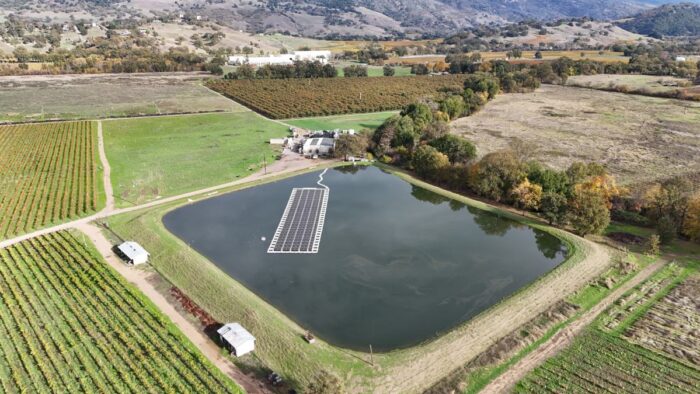
A major focus of the study will be to determine whether shading from the floating solar panels can help control invasive zooplankton (i.e., water fleas) and aquatic weeds that frequently clog the vineyard’s high-efficiency drip irrigation filters — an issue that requires hourly maintenance during peak season. By limiting sunlight, the panels are expected to slow the growth of the water fleas and aquatic weeds, reducing both labor-intensive maintenance and chemical use.
“In conjunction with deploying a new floating solar installation, Nelson’s Family Vineyards has enabled important ecological research on its property,” says Dr. Elliott Steele, postdoctoral researcher at the UC Davis Wild Energy Center. “By providing site access to researchers from the UC Davis Wild Energy Center, the vineyard is supporting studies on how floating solar interacts with wildlife and water quality, helping advance our understanding of how floating solar can expand responsibly.”
Demonstrating effectiveness of FPV
The floating solar system was designed and installed by Noria Energy, a Sausalito-based renewable energy specialist and an affiliate company of Sunrock Distributed Generation, a leading platform for commercial distributed energy solutions. The company enables companies of all sizes to take advantage of solar and energy storage solutions with no upfront costs by providing Power Purchase Agreements and Energy Services Agreements.
“This project demonstrates how FPV technology can turn underutilized water surfaces into reliable, highly productive power sources, enabling growers to improve both the sustainability and efficiency of their operations while keeping farmland fully productive,” says Ron Stimmel, president of Noria Energy.



Comments are closed here.