BrightNight breaks ground on new Arizona energy center | Projects Weekly
Key Takeaways
- REC Solar partners with Arctic Cold for a 3.3MW rooftop solar system in California, significantly offsetting energy costs.
- El Paso Electric and Base Power announce a pilot program to implement home battery systems, aiming for 10 MW of residential storage by 2026.
- BrightNight begins construction on the 300-MW Pioneer Clean Energy Center in Yuma County, promising substantial renewable energy generation.
- Leeward Renewable Energy’s Sierra Pinta BESS project is now operational, enhancing energy reliability in Yuma County with significant capacity.
- Georgia Power seeks proposals for 500 MW of energy storage resources to enhance reliability in the Peach State’s electricity grid.

This week on Projects Weekly, Arctic Cold and REC Solar have partnered for a rooftop solar system on a cold storage facility. Also, El Paso Electric Company and Base Power have announced a home battery pilot program, looking to bring up to 10 MW of residential storage to western Texas. Hanwha Renewables and Chrysalis Energy have partnered for a massive solar and storage rollout across North America, with potential to move off the continent as well. WeaveGrid and SolarEdge have partnered for utility-scale solutions from residential batteries. In the northeast, Greenbacker secured funding for the largest solar project in the history of New York. To the southwest, Arizona is in the solar news once again as BrightNight broke ground on a new energy center and Leeward Renewable Energy began operations at its newest BESS center, with both projects calling Yuma County home. Streetleaf is working with one of America’s top homebuilders to light up a new Texas suburb with solar-powered lights. Lastly, Georgia Power is looking for requests for proposals as demand grows for the Peach State’s energy grid. Keep reading for all the details!
Arctic Cold, REC Solar partner for 3.3MW rooftop solar system on cold storage facility
Solar independent power producer REC Solar has inked a contract with cold storage solutions and logistics company Arctic Cold for a 3.3MW rooftop solar system at Arctic’s new location in Santa Maria, California.
The new facility primarily provides storage for fresh and frozen fruit, REC Solar representatives say. From there, the products are distributed to food service providers and big box retailers, among other locations.
Bright spot: The ballast-mounted solar system will offset “roughly 83 percent” of the new facilities total energy needs. That energy will help Arctic Cold avoid about 2,953 metric tons of CO2 each year, officials estimate, along with significantly offsetting electricity expenses for the firm.
“We know that cold storage facilities require a lot of energy. Arctic Cold sought out to offset those expenses, and we were more than happy to offer a future-proofed solution,” says James Presta, business development manager at REC Solar. “Arctic Cold is setting a standard for the cold storage industry by optimizing their facility design with energy savings and future growth in mind.”
The site has been designed with future growth in mind, REC Solar says. The site will be able to accommodate future integration of a BESS system, and Arctic Cold will maintain its existing renewable energy credits.
“Arctic Cold has a unique history of long-term leadership and experience in the cold storage industry and our investment into sustainable facilities speaks to our commitment to future-proofing our business,” says Tim Dayton, Arctic Cold’s president and CEO. “As we continue our efforts to build new, state-of-the-art facilities, keeping energy costs low and guarding against future volatility will be critical. Partnering with REC Solar will help us identify creative, long-term solutions for Arctic Cold and its customers.”
The site and its future additions will enable Arctic Cold to pursue LEED certification at the new facility.
El Paso Electric, Base Power announce new home battery pilot program
El Paso Electric Company (EPE) and Base Power have announced a new pilot program that will use residential battery systems to reduce grid strain during peak demand.
The new program “represents a scalable model for utilities seeking to add flexible, customer-sited capacity to the grid,” company officials say. Additionally, the new initiative will operate on a significantly shorter timeline than other methods of generation and transmission buildouts.
“Distributed energy storage is becoming an increasingly important tool for utilities navigating load growth, extreme weather, and infrastructure constraints,” says Kelly Tomblin, CEO of El Paso Electric. “This partnership with Base Power allows us to add flexible, cost-effective capacity where it’s needed most, while maintaining operational control and delivering tangible reliability benefits for our customers.”
Bright spot: This new program is part of EPE’s Residential Distributed Energy Storage Pilot Program, which aims to bring up to 10 MW of residential energy storage online by summer 2026. The company expects this summer’s peak to strain the grid; the pilot system will address capacity constraints as well as improve the grid’s overall resiliency in western Texas.
“We’re excited for the opportunity to support EPE in adding flexible, reliable capacity to its system,” said Zach Dell, CEO of Base Power. “By aggregating residential batteries into a utility-controlled resource, EPE can strengthen reliability, manage peak demand, and defer costly infrastructure investments – all while providing customers with meaningful outage protection.”
The partnership is far from over, with contractual infrastructure in place to support future expansion in the coming years.
BrightNight breaks ground on new Yuma County energy center
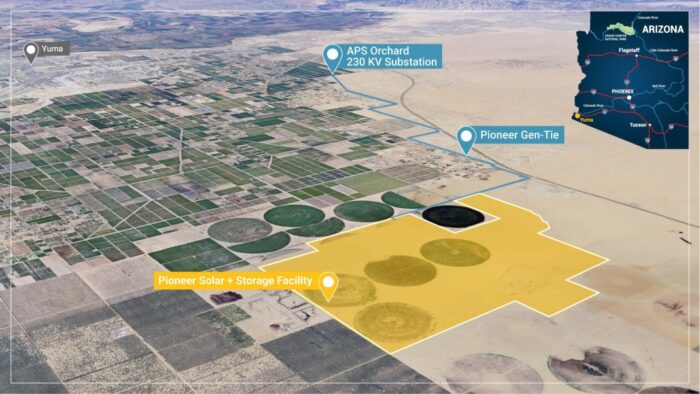
Next-generation power and digital infrastructure company BrightNight broke ground on its latest project, Yuma County, Arizona’s Pioneer Clean Energy Center, on Feb. 11.
Touted as “state of the art,” the 300-MW solar facility has been paired with an addition 300 MW (or 1,200 MWh) of battery storage, officials say. BrightNight has designed the project as “a model of baseload renewable power” as it hopes to deliver 900,000 MWh of renewable energy each year across Arizona.
“Pioneer reflects BrightNight’s commitment to delivering infrastructure at the scale and performance required to support reliability, economic growth, and long-term system resilience,” says Martin Hermann, CEO of BrightNight. “This project demonstrates how advanced clean energy and storage can work together to meet real-world utility needs while delivering meaningful benefits to local communities.”
Bright spot: When the energy center comes online in April 2027, it will generate enough renewable energy to power about 77,299 local homes and businesses, the company says. This removes 709 million pounds of coal from Arizona’s energy ecosystem and reduces water consumption by more than 99% compared to traditional generation methods.
Construction on the project began in October 2025, and the construction period is expected to generate between 250 and 300 jobs around Yuma County. Longer-term employment opportunities will be made available during operations.

Leeward Renewable Energy BESS project now fully operational
Leeward Renewable Energy’s (LRE) Sierra Pinta Battery Energy Storage System (BESS) project in Yuma County, Arizona is fully operational as of Feb. 10, the company says.
The 112.5-MW and 450-MWh battery facility is completely standalone, but is part of a six-phase rollout across Yuma County, which started with White Wing Ranch Solar in Dateland, Arizona. In total, the county’s projects bring LRE’s power in Arizona and surrounding areas to over 291 MW.
Sam Mangrum, the EVP of project execution at LRE, says the project is a milestone for the company’s renewable energy efforts on the western side of the U.S.
“Bringing Sierra Pinta online is an important milestone for LRE and demonstrates our commitment to delivering innovative and affordable energy solutions across the West,” Mangrum says. “With a 112.5 MW interconnection, the facility underscores our ability to deliver large-scale, dispatchable power when and where it is needed most. We are proud to support (the Pacific Gas and Electric Company) and the broader energy market by meeting growing energy demand while creating long-term economic opportunities in the region.”
Bright spot: The project created about 100 jobs for Yuma County during its construction, company representatives say. Additionally, the newly energized BESS center is expected to deliver “long-term economic benefits” for the area, to the tune of just under $12.4 million in lifetime local property tax revenue.
In total capacity, the Sierra Pinta BESS project about enough the power 90,100 U.S. homes for four hours. Designed to deliver during peak demand, the project will help flatten demand spikes for the straining American energy grid across the Southwestern region. LRE owns and operates more than 30 wind, solar, and energy storage projects, totaling about 4 GW around the U.S.
Hanwha Renewables, Chrysalis Renewables partner for 3.5-GW solar, BESS rollout
Hanwha Renewables and Morrison-backed global investment platform Chrysalis Energy have partnered to “accelerate the deployment of high-quality, construction-ready and operational renewable energy projects worldwide,” the firms say.
According to partnership terms, Chrysalis will acquire projects from Hanwha that are either ready for construction or already operational. The investment company has its sights set on more than 3.5 GW of solar and BESS deployment across North America for right now, but plans to expand the geographic reach of its platform to Europe, Asia, Australia, and beyond.
Morrison Partner Gordon Hay says the company’s collaboration with Hanwha is a significant step forward in the Chrysalis strategy of acquiring “high-quality, de-risked renewable assets” through long-term energy partnerships.
“By uniting Hanwha’s world-class project delivery with Chrysalis’s disciplined investment approach backed by Morrison’s expertise and resources, we are building an energy platform capable of delivering sustainable value and meaningful impact across key global energy markets,” Hay says. “We are excited for the attractive opportunities this partnership will create for growth, innovation, and the benefit of our investors.”
Bright spot: The partnership is already paying metaphorical dividends, with Chrysalis advancing Hanwha’s initial projects across North America. Hanwha has established one of the largest solar manufacturing footprints in the U.S. over the past over the past decade, and the two firms plan to make use of that name recognition to build a diverse and resilient asset portfolio, the companies say.
Hanwha Renewables chief investment officer Rich Chung says that the scale and pace of global energy buildouts requires “platforms that align capital and execution from the outset.” The partnership reflects Hanwha’s long-term renewable buildout capabilities and commitment to renewable energy, he adds.
“Together with Morrison and Chrysalis, we are building a platform that can serve as a model for how institutional capital and industrial capability can successfully work together to meet energy demand globally,” Chung says. “We look forward to executing on our shared vision to accelerate investment, unlock new markets, and deliver enduring value across the global energy landscape.”
WeaveGrid, SolarEdge partner to orchestrate utility-scale solutions with residential batteries
Grid-edge orchestration software provider WeaveGrid and smart energy technology firm SolarEdge Technologies have partnered to support participation of residential battery systems in local utility grid programs, the companies say.
Bright spot: The partnership marks an “important expansion” of WeaveGrid’s Distribution-Integrated System Capacity Orchestration (DISCO) platform. Originally designed for managing EV charging at scale, DISCO has evolved into a utility platform for aligning customer energy usage with grid needs at a distribution level. Thanks to the partnership, WeaveGrid will extend DISCO to include “additional bulk system value from residential batteries,” representatives say.
“As electrification accelerates, utilities need solutions that go beyond managing a single asset type,” says Apoorv Bhargava, co-founder and CEO of WeaveGrid. “Partnering with SolarEdge reflects the next phase of DISCO — coordinating EVs and residential batteries together so utilities can manage local and system-wide grid needs while giving customers more opportunities to support the electric grid and receive financial incentives.”
On the SolarEdge side of things, the partnerships adds ways that residential battery customers can participate in utility buyback programs like VPPs and other services. Utilities also benefit directly from the partnerships, gaining a more comprehensive approach to managing electrifictions through a unified platform created by the two companies.
“As the number one provider of residential solar solutions in the US, with over 500MWh of storage participating in grid services, SolarEdge is excited to work with WeaveGrid as a foundational battery OEM partner,” says Tamara Sinensky, senior manager of grid services product at SolarEdge. “This collaboration gives further access to utility programs that put more control and value directly into homeowners’ hands—from optimizing when their batteries charge and discharge to earning incentives for supporting grid stability.”
Streetleaf provides solar-powered streetlights in new Austin, Texas development
Solar-powered lighting provider Streetleaf announced its first foray into Austin, Texas Feb. 12.
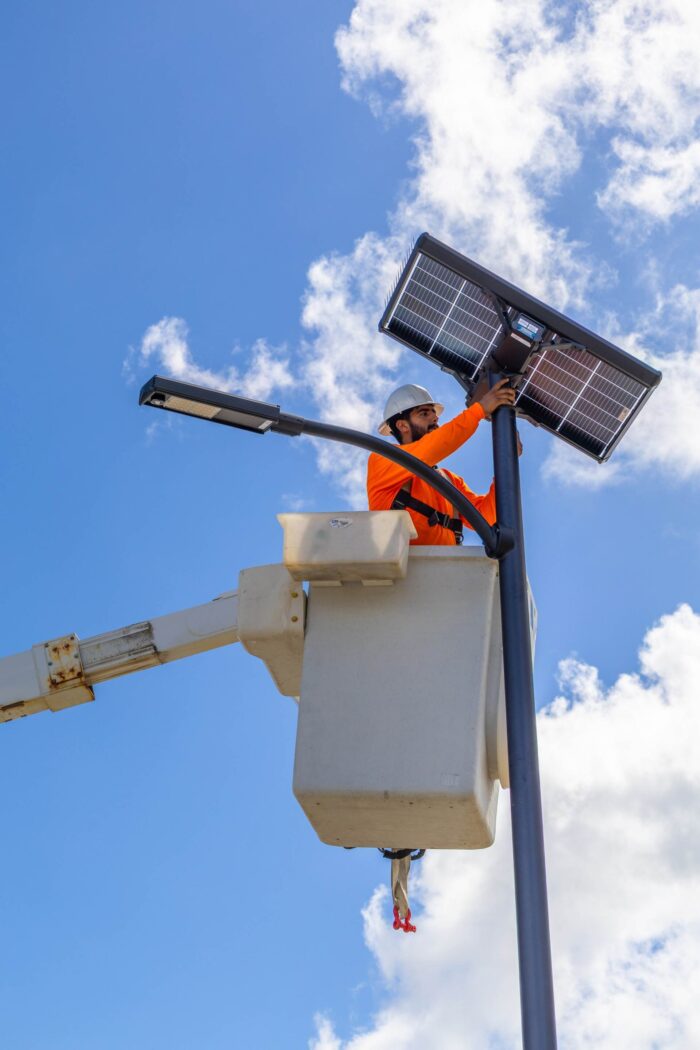
Through homebuilder Risewell Homes, the company will be installing solar-powered streetlights in Novel. A new master-planned community in southern Austin, the gated community will include parks, pools, pavilions, trails, and other entertainment for residents, Risewell says.
“This first installation with Risewell Homes in Austin marks another progressive move for Streetleaf in Texas, as we’ve previously brightened neighborhoods across Fort Worth with our solar streetlights,” says Streetleaf CEO Liam Ryan. “We’re continuing to see growing demand for reliable and resilient solar power throughout the state, and we look forward to illuminating more communities throughout Texas in the near future.”
Bright spot: Streetleaf’s endeavors in Novel will allow the community to operate completely independently from the Texan residential energy grid. The lights include battery backups, as well as 24/7 monitoring to make sure that Novel stays illuminated during outages of all kinds.
Risewell currently services a number of neighborhoods around Austin and its suburbs. The company was recently named a top 25 U.S. homebuilder and has more than 20,000 buyers find homes since its founding in California in 2009.
“Providing homeowners with a fully maintained, grid-independent option that enhances safety and offers long-term cost savings made Streetleaf a strong fit for this development,” said Adib Khoury, Austin division president of Risewell Homes. “It aligns with our focus on sustainable, high-efficiency, and tech-forward construction, and we’re excited to bring a solution like this to our new community.”
Greenbacker secures tax equity financing commitment for largest solar project in New York State history
Greenbacker Renewable Energy Company LLC has successfully closed a $440 million Tax Equity Commitment from U.S. Bank and M&T Bank for its Cider solar project in Genesee County, New York.
Bright spot: At 674 MWdc or 500 MWac, the utility-scale Cider solar farm is expected to be the largest solar project in the history of New York. When it comes online in late 2026, officials estimate it will generate enough energy to power about 120,000 homes annually.
Daniel de Boer, CEO of Greenbacker, says the commitment’s closing “marks a pivotal milestone for Greenback and for the Cider solar project.”
“With all key sources of capital secured, we are positioned to deliver one of the most impactful clean energy projects in New York State,” he says. “This achievement reflects the strength of our partnerships, the quality of the Cider asset, and our continued commitment to building infrastructure that accelerates the energy transition while creating long-term value for our stakeholders.”
Supplying more than 1.03 MWh annually, the Cider project is expected to pull a sizable percentage of the weight in the state of New York’s energy transition. Additionally, the project will supply “hundreds” of construction jobs, generating about $100 million in revenue for local communities like Elba and Oakfield. Greenbacker CFO Carl Weatherley-White says the transaction showcases his company’s “best-in-class execution across a highly complex financing structure.”
“The tax equity commitment meaningfully optimizes Cider’s capital stack and completes the final piece of financing required to advance the project to commercial operation,” he says. “We are grateful for the collaboration among our tax equity partners, lenders, and advisors, whose coordination was critical to achieving this milestone.”
Georgia Power announces 2025 energy storage system RFPs
Georgia Power has announced RFP Insurance for its 2025 Request for Proposals (RFP) and energy storage resources, the company says. The capacity-based RFP “provides a competitive solicitation for Georgia Power to procure 500 MW of ESS” in order to meet customer needs and increase reliability for the Peach State’s electricity grid.
Administered by independent evaluator Ascend Analytics, the RFP will solicit standalone ESS projects with grid charging capability, as well as ESS with renewable resources. The company’s procurement target sits at 500 MW with storage discharge duration of at least two hours, and Georgia Power prefers resources to be online by no later than the end of 2031.
Bright spot: Diversifying Georgia’s ESS solutions will “play a critical role” in both expanding and hardening the grid on America’s southeastern seaboard. Projected demand for electricity has surged across the state due to continued economic development.
All prospective participants must first register through the Ascend Analytics Power Procurement platform. Registered participants can submit their proposals through Ascend’s IE website from Feb. 11 to March 24, 2026.