BESS continues its American solar industry takeover | Projects Weekly


In-stock inventory. Strategic manufacturer partnerships. Field-ready delivery. Get started with Ampacity.
This week on Projects Weekly, “unusable land” has become new again, and batteries are more popular than ever in the U.S. The city of Arvin, California’s wastewater treatment plant has been decarbonized thanks to a new solar array by Veolia, and PowerBank has advanced its hybrid solar and BESS project inside an upstate New York landfill. ArtIn Energy has executed a $255 million investment from Agila Investments, and Doral Renewables has received $900 million in financing for its Cold Creek project in Texas. Also in Texas, esVolta has secured project financing for its Boxcar Energy Storage Project, and Sunraycer has entered PPAs with Google for its Lone Star State solar portfolio. Elsewhere, Cornview Development LLC and Linea Energy have closed financing for projects in Illinois and Michigan, respectively. All that and more in this week’s edition of Projects Weekly!
ArtIn Energy executes $255 Million investment from Agila Investments
ArtIn Energy has announced an agreement with Agila Investments LLC for a $255 million “strategic investment,” at a valuation of $14.58 billion. The new capital will support ArtIn’s American utility-scale solar portfolio, along with battery storage and other “green fuel infrastructure.”
Funding will go toward supporting late-stage development, including project interconnection, engineering and procurement, and advancement toward construction financing. Jhon Cohen, CEO of ArtIn Energy, says the new investment will greatly accelerate project deployment for the company.
“Agila’s investment validates ArtIn’s institutional platform and disciplined capital strategy,” he says. “This partnership accelerates deployment of large-scale renewable infrastructure while maintaining strong governance and risk management.”
Bright spot: The investment will align with what ArtIn calls “rapid U.S. renewable expansion” which has been driven by solar and batteries. Supported by long-term agreements, the projects will provide cash flow and financing visibility for the company.
“ArtIn has built a sophisticated platform integrating solar, storage, and renewable fuels, aligned with U.S. energy priorities, grid resilience, and large-scale infrastructure deployment,” adds Rachel Lucero, president and CEO of Agila Investments.
PowerBank advances hybrid solar and BESS project near New York landfill
PowerBank Corporation has announced the advancement of its NY-South Park 3.1-MW hybrid solar and battery storage project, which sits on a closed landfill near Buffalo, New York.
Bright spot: Construction on a closed landfill site has transformed what PowerBank considers “previously unusable land” and made it into a productive renewable energy asset. SolarBank will retain ownership of the project and Buffalo-based renewable energy firm Viridi will supply the battery.
“The Project advances New York’s ambitious Climate Leadership and Community Protection Act goal of 6 GW of solar capacity by 2025,” the company says. “As a national leader in community solar, New York accounts for nearly one-third of the United States’ 6.2 GW of installed solar capacity, and PowerBank is honored to contribute to this transformative milestone.”
Viridi’s products provide lithium-ion battery packs with integrated fire suppression and “pioneering” anti-propagation technology. The battery packs meet rigorous safety standards as Viridi isolates each battery cell, in an effort to prevent thermal runaway.
“This fail-safe design eliminates secondary impacts, making Viridi’s energy storage solutions the safest and most adaptable in residential, commercial, and industrial settings,” PowerBank says. “Whether deployed behind the meter to support Virtual Power Plants (VPPs), in front of the meter for grid-scale stability, or as a mobile power solution for remote, commercial, and industrial needs, Viridi delivers reliable, high-performance energy storage built for the demands of modern infrastructure.”
Doral Renewables secures nearly $900 million for Cold Creek Solar + Storage Project
Utility-scale solar and battery developer Doral Renewables has announced the successful financial close of its Cold Creek Solar + Storage project in Texas’s Schleicher and Tom Green Counties.
Bright spot: Coming in at 430 MWac solar generation and 340 MWh in storage, the project marks Doral’s second largest venture to reach construction financing. The project is only beaten out by the firm’s 1.3 GW Mammoth Solar complex, located in Indiana.
“We are delighted to announce the close of these financings for Cold Creek,” says Evan Speece, CFO of Doral Renewables LLC. “Partnering with such a robust lender group led by MUFG and expanding our network with new collaborators while also closing the PTC Transfer transaction positions us well for continued growth. This project will be a cornerstone for our future work across the Lone Star State.”
Commercial operation of the project is expected by the summer of 2028, Doral officials say. Once online, the project will be able to power the equivalent of about 66,000 homes in central Texas.
“We are proud to support Doral Renewables on the Cold Creek Solar + Storage project, which underscores our commitment to standing alongside clients as they advance critical infrastructure,” says Louise Pesce, head of North American power for project finance at MUFG. “Projects like Cold Creek play an important role in strengthening U.S. energy independence while helping meet growing power demands with reliable, utility‑scale solutions.
Arevon starts construction on Cormorant Energy Storage Project in California
Arevon Energy Inc. has announced that construction has begun on its new Cormorant Energy Storage Project, located in Daly City, California. Expected to be operation in 2027, the $600 million facility is expected to be able to power about 321,000 homes for up to four hours, Arevon says.
The project is under a long-term offtake agreement with electricity provider MCE, which serves more than 1.8 million businesses across four counties in the Golden State. Originally planned at 188 MW and 752 MWh, the project has expanded to 250 MW and 1 GWh.
“The start of construction marks an important milestone for the Cormorant project and the Daly City community,” says Arevon CEO Justin Johnson. “Projects like Cormorant are critical to strengthening California’s energy grid by storing power when it’s abundant and delivering it when it’s needed most. Arevon is proud to continue investing in infrastructure that supports reliability, affordability, and California’s long-term clean energy goals.”
Bright spot: The Cormorant project will use lithium iron phosphate (LFP) battery technology to ensure “safe, efficient, and flexible storage capabilities,” Arevon says. Expected to employe about 175 workers, the project will also support the local economy with increased business activity in the area. Over its lifetime, the site is expected to generate more than $73 million in property tax revenue.
“The Cormorant project demonstrates the importance of working closely with local leaders and community members as we develop projects that will operate for decades,” said Shanelle Montana, chief development officer at Arevon. “Community engagement is not simply a box to check — it is a commitment to being present, authentic, and aligned with the people who will live alongside our projects.”
EDP Renewables completes new Pleasantville Solar project in Illinois
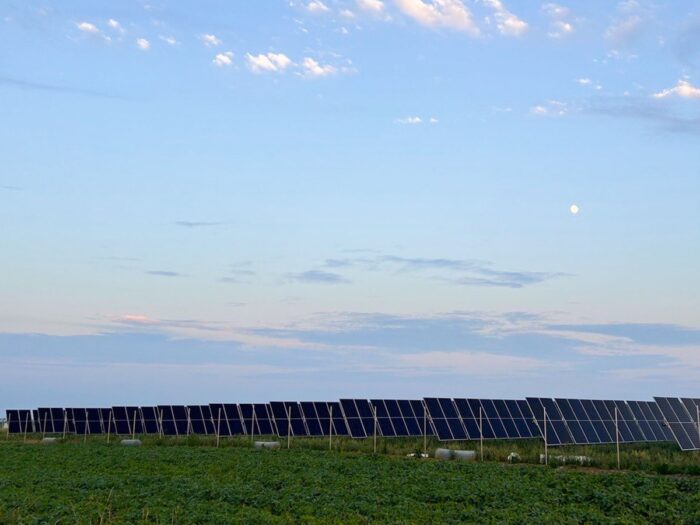
EDP Renewables North America has completed its latest solar project, the 150-MW Pleasantville Solar site in western Illinois’s Fulton County.
Generating enough electricity to meet annual demand for nearly 40,000 homes and businesses, the project is set to strengthen grid reliability across the Land of Lincoln. Additionally, the project will support the state’s energy independence and is expected to drive “sustained economic growth” for the county.
“Amid skyrocketing power demand in Illinois, Pleasantville Solar is fueling the Prairie State’s economy and communities with reliable, homegrown energy,” says Sandhya Ganapathy, CEO of EDP Renewables North America. “Projects like Pleasantville Solar ensure that local families and businesses reap the benefits of long-term revenue, job creation, and resilient energy infrastructure—all while supporting statewide economic development goals and rising power needs. As one of Illinois’ leading clean energy operators, we are proud to deliver projects that create lasting value for our communities and customers.”
Bright spot: EDPR NA’s new project will reinforce its commitment to partnerships around the local community, with the company donating over $45,000 to local entities and organizations. Among those organizations is the VIT Community Unit School District #2, the Fulton County Fair, and the Ipava Camp Ellis Days Festival.
Cole McDaniel, the president of hometown consulting and a consultant for the Fulton County Economic Development Administration, says his county is “grateful” for the continued collaborative efforts by EDPR NA.
“This project reflects what is possible when local government and private investment work together with transparency and mutual respect,” he says. “Beyond the construction phase, the long-term impact of this project will be felt for decades through a strengthened tax base that supports essential public services across multiple taxing jurisdictions, including Fulton County and the South Fulton School District.”
Sunraycer executes two PPAs with Google Energy for Texan solar portfolio
Utility-scale developer, owner, and operator Sunraycer Renewables has announced the execution of two long-term power purchase agreements (PPAs) with Google for its Texas-based solar energy portfolio.
The agreements revolve largely around the Lupinus and Lupinus 2 solar projects, located in eastern Texas, about two hours outside of Dallas. The set of projects is expected to be fully online by the end of 2027.
“These agreements with Google represent a significant milestone for Sunraycer and underscore the strength of our development platform,” says Sunraycer CEO David Lillefloren. “We are proud to support Google’s clean energy objectives while delivering high-quality renewable infrastructure in Texas.”
Bright spot: The two projects will bring “significant economic benefits” to the Franklin County area, including job creation during construction and long-term tax revenue benefits. The projects are also expected to add new, affordable renewable energy options to the ERCOT grid’s main markets.
“Google’s data centers are long-term investments in the communities we call home,” says Will Conkling, director of energy and power for Google. “This collaboration with Sunraycer will fuel local economic growth while helping to build a more robust and affordable energy future for Texas.”
esVolta secures project financing for 300 MWh Boxcar Energy Storage Project
Utility-scale BESS developer esVolta has announced the closing of $139.6 million in project financing for its Boxcar Energy Storage project in Wylie, Texas, on the eastern outskirts of Dallas.
The 150-MW and 300-MWh storage project is part of a long-term offtake agreement between esVolta and a “major corporate customer,” officials say. The agreement is an indicator for renewable energy demand across the commercial and industrial segments of the American business landscape, the company adds, and reflects a need for further reliabiliy in the ERCOT grid.
“MUFG (Bank) is a premier lender in the energy infrastructure space, and their support of Boxcar reflects strong confidence in both the project and esVolta’s platform,” said Justin Johns, CEO of esVolta. “As ERCOT continues to experience rapid load growth and continued volatility, projects like Boxcar are essential to maintaining grid stability and delivering reliable power when it’s needed most.”
Bright spot: The transaction is a “step forward” for esVolta as it continues to expand its way into the Texas market, one of solar’s hottest spots in the U.S. By the time the Boxcar site is operational in 2027, the company’s Texas portfolio alone will include five different BESS projects, and will provide more than 1.5 GWh of storage capacity.
“MUFG is proud to support esVolta on the Boxcar BESS project,” says Fred Zelaya, the bank’s managing director. “MUFG recognizes that energy storage technology and infrastructure are critical to the growth of clean energy, and we’re intent on strategically supporting projects in key markets such as ERCOT.”
Maximo completes 100 MW of robotic solar installation in California
Solar robotics company Maximo has successfully installed 100 MW of utility-scale solar capacity at the Bellefield complex of its parent company, AES Corporation. The installation was done entirely through the use of robotics and AI.
Bright spot: The robotic installation comes as a response to spiking demand for electricity, thanks to data center expansion and the electrification of industrial manufacturing plants. Maximo and its robotic installation solutions are aiming to close the gap between construction capacity and time to power, representatives say.
“Reaching 100 MW at a single site is an important milestone for Maximo and for the role robotics can play in solar construction,” says Maximo president Chris Shelton. “It demonstrates that intelligent field robotics can deliver consistent results at utility scale. As solar deployment continues to accelerate globally, technologies that improve installation speed, quality and reliability will become increasingly important.”
The Bellefield installation scaled up to what Maximo calls a “coordinated fleet” of four robotic units. The units’ technical performance rate surpassed one module per minute on a consistent basis, with crews installing as many as 24 modules per shift hour, per person. The company claims this is double the traditional installation output of the region.
NVIDIA technologies greatly supported the development and readiness of the fleet in California, Maximo officials say.
“Physical AI is a powerful force for accelerating real world energy infrastructure,” says Marc Spieler, NVIDIA’s senior director of energy. “By combining AI infrastructure, simulation, and edge AI, platforms like Maximo demonstrate how physical AI can help accelerate solar panel installation while maintaining high reliability in complex environments.”
Cornview Development LLC announces financing for over 165 MWdc in Illinois
Cornview Development LLC has reached a “key platform milestone,” the company says, with the firm having financed more than 165 MWdc in small utility-scale solar facilities across Illinois.
To date, the company’s projects have paid for more than $50 million in public utility interconnection upgrades, and are expected to generate $500,000 per year in aggregate real estate tax. Upon completion, the financed projects will be able to power nearly 45,000 homes for Illinois residents.
“This milestone demonstrates Cornview’s ability to de‑risk, structure, and execute on development assets in a highly competitive and dynamic market,” says a representative from Cornview. “With more than 250 MWdc in our Illinois pipeline and over half a gigawatt of projects invested in since 2022, Cornview has shown its ability to take long‑term generation positions within an ever-expanding Illinois energy market where demand will continue to grow in the coming years.”
Bright spot: The milestone comes as part of the company’s broader pipeline of more than 250 MWdc in the state, which originated in 2022 and 2023. The company expects its remaining tranches of finances will close before the end of 2026.
Linea Energy closes project debt financing for Michigan’s Watertown Solar
Renewable energy developer and independent power producer Linea Energy has announced the closing of project financing for its Watertown solar project in eastern Michigan’s Sanilac County.
The 172-MWdc utility-scale solar project is part of a 25-year PPA with Consumers Energy, which operates under the jurisdiction of the Michigan Public Service Commission (MPSC). The project’s financing package includes a construction-to-term loan, a tax equity bridge loan, and a letter of credit facility, officials say.
“We are thrilled to announce the successful financing of Watertown,” says Cassidy DeLine, CEO of Linea Energy. “With the support of our financing partners and our long-term agreement with Consumers Energy, Watertown will bring meaningful economic benefits to Sanilac County while supporting the state’s long-term transition to a resilient, low-carbon grid.”
Bright spot: Now under construction, the project is expected to create about 150 construction jobs until its completion in April 2027. The site is also projected to power 25,126 homes in the Mitten State, and deliver $16.4 million in local property tax revenue over the next 20 years.
“Santander is proud to partner with Linea Energy on the financing of Watertown,” says Nuno Andrade, U.S. head of structured finance and global head of structured finance digital infrastructure and REGAL, for Santander Corporate & Investment Banking. “This project underscores the strength of Linea’s platform and will deliver long-term value for Michigan communities and the broader renewable energy sector.”
The financing marks Linea’s third renewable energy project to reach its financial close. Once completed, the project will reduce carbon emissions by about 148,389 pounds annually.
Veolia, City of Arvin unveil new solar project to power wastewater treatment
French waste and water management firm Veolia has announced that it has energized a new 1-MW solar energy installation in the city of Arvin, California. The project will decarbonize the city’s wastewater treatment plant.
The company has operated and maintained Arvin’s wastewater treatment plant for more than a decade, Veolia officials say. The new project will eliminate greenhouse gas emissions and provide “significant” financial and environmental benefits for the city.
“Through close collaboration with the City of Arvin, we have delivered an integrated energy and water solution that will serve as a blueprint for cities across California and beyond,” says Will Darmouni, SVP of energy transition for Veolia. “This project shows how clean energy investments in water infrastructure can drive real progress in decarbonization while delivering tangible economic benefits.”
Bright spot: The wastewater solar array comes as part of the city’s climate action plan, which aims to achieve 100% renewable energy for municipal use by 2040. The city already sports an all-electric bus fleet, and the new wastewater treatment plant will further reduce carbon emissions across Arvin.
“This project demonstrates Arvin’s leadership in building a sustainable and resilient community,” says Olivia Calderon, the mayor of Arvin. “By investing in renewable energy, we are not only protecting our environment but also ensuring long-term savings for our residents.”