
Experts predict crucial 2026 for U.S. solar industry, following rollercoaster 2025
Scott Wiater, President and CEO of Rockville, Maryland-based Standard Solar, called 2025 a “pivotal” period of time for the solar industry. 2026 is shaping up to be quite similar to its predecessor, the executive says.
“2025 has been a defining year for the solar industry — one marked by incredible progress and real challenges,” says Wiater. “The momentum driven by the Inflation Reduction Act was tempered by the uncertainty and complexity introduced through the One Big Beautiful Bill Act (OBBBA), which reshaped the pace and path of project development. Developers, owners and manufacturers alike have had to adapt quickly, rethinking strategies to keep projects moving and capital flowing.”
From the beginning of the year with the second inauguration of President Trump, experts predicted a down year for American clean energy at large. But research by Cleanview into the U.S. Energy Information Administration shows that 92% of all new power capacity added to the American grid through November of this year came from solar, wind, or energy storage.
While fossil fuels still play a much bigger role in America’s overall energy ecosystem than renewable energy sources do, solar and wind are doing their part to close the gap, according to Canary Media’s Dan McCarthy.
“Still, the figures underscore the warnings made by energy experts, policymakers, and advocates: The Trump administration is playing with fire by trying to limit the development of solar, battery, and wind energy right when electricity demand is rising at its fastest rate in decades,” McCarthy wrote Dec. 19, adding that the Trump administration’s anti-solar and anti-wind policy will “only make the mounting energy-affordability crisis even worse.”
Looking at the big picture, 2025 was a mixed bag for the solar world, and 2026 is likely to be more of the same. But the numbers themselves show more reasons for optimism than pessimism.

The state of the industry
Despite the challenges posed by President Trump’s OBBBA and year-long tariff war, the American solar industry had a relatively successful year by the numbers. As a whole, the industry accounted for 58% of all new electricity-generating capacity in Q3 2025, good for over 30 GW for the year, according to a report by the Solar Energy Industries Association (SEIA). Combined with energy storage, solar accounted for 85% of new capacity through the first nine months of 2025.
The solar landscape of the U.S. also saw solid year-over-year increases for Q3 itself, with 11.7 GWdc installed between July and September 2025 alone. That number, representing the third largest quarter for deployment in the history of the solar industry, marks a 20% increase from Q3 2024, and a 49% jump over Q2 2025.
Much of this growth came in the commercial solar segment, which grew 9% year-over-year in Q3, despite a 12% quarter-over-quarter decline.
The community and residential segments weren’t quite as rosy, with community solar declining 21% year-over-year in Q3 2025, installing just 267MWdc in the quarter. The residential segment took a smaller dive, declining by 4% overall, despite an industry-wide rush to qualify for expiring tax credits.
“From 2025-2030, our base case outlook puts total solar deployments at 246 GWdc – virtually unchanged from our Q3 2025 outlook,” SEIA says. “While our commercial and community solar outlooks have risen slightly due to enhanced project pipeline visibility, we’ve downgraded our residential outlook as tight module availability is hindering the year-end installation rush.”
SEIA added that while federal permitting “remains a major uncertainty” in the utility-scale sector, that market segment actually grew 26% year-over-year and 68% quarter-over-quarter for Q3. In total, the U.S. installed 9.7 GWdc throughout the quarter, with California, Texas, and Utah each installing more than 1 GW of capacity.
Now valued at $71.3 billion by SEIA, the U.S. solar industry boasts more than 5.8 million total solar systems and just over 280,000 total jobs. But as China continues to dominate the global solar manufacturing industry, the American side of the market still requires a major boost in investment.
New opportunities, new challenges
In 2020, David Sandalow and a team of co-authors wrote Energizing America, a roadmap for the next five years of American energy innovation. In the report, the team wrote that the U.S. would need to triple federal funding for clean energy by 2025 to keep up with the rest of the world in innovation, totaling $25 billion by 2025.
Five years later, that number hasn’t changed.
Evan Chapman, Senior Director of Policy for Clean Tomorrow, says that “there is a new frontier in American energy emerging.” Also a co-author of Re-Energizing America, Chapman and his colleagues at Clean Tomorrow claim that the U.S. will need to heavily invest in the U.S. Department of Energy by 2030 to bolster energy innovation in the age of increased energy demand, AI, and industrial modernization.
“Massive increases in power demand and the ongoing transition to cleaner energy are challenges must be met with bold action and a commitment to keep America at the forefront of energy innovation – like we have been for the previous 150 years,” Chapman says. “What this report shows is that we can lead the world in energy innovation, all while reaping the economic and geopolitical benefits. But we can’t just sit aside and hope that this happens – we need to act to ensure America leads.”
For the U.S. to lead the charge in clean energy innovations, Chapman and the authors of Re-Energizing America once again predict the government will need to invest $25 billion in the U.S. Department of Energy over the next five years. That comes out to less than 0.4% of the federal budget and 1.4% of total discretionary spending, the authorship group notes.
Claire C. Cody, another co-author of Re-Energizing America, says that “American energy innovation leadership is rooted in our willingness to invest and act boldly.”
“The United States has historically led the way in advancing new technologies that power the world, but today, the United States ranks 13th in energy innovation investments globally,” says Cody, Senior Innovation Policy Analyst at Clean Tomorrow. “If we want to continue discovering the energy technologies of the future and ensure they’re scaled up and built here, we must pursue sustained investment and federal support for this critical work.”
The Re-Energizing America report included a few key tentpoles for implementing that hypothetical $25 billion investment. Perhaps chief among those recommendations was to build for the future with a seamless pipeline built through institutional continuity, rather than building for the short term.
“While no design can fully insulate programs from political change—as recent cuts show—these features can enhance resilience,” says the report.
In 2026 and beyond, energy innovation will be paramount to economic success for the U.S. But today’s energy needs may pale in comparison to the next few decades, says Sandalow.
“The next fifty years will be defined by how we respond to today’s challenges,” he says. “Their scale and urgency require forward-looking investment and a renewed sense of national purpose. Now is the time to choose. Let’s show the world that the United States can meet this moment – decisively, boldly and with an unwavering focus on the defining challenges of the 21st century.”
Projecting into 2026
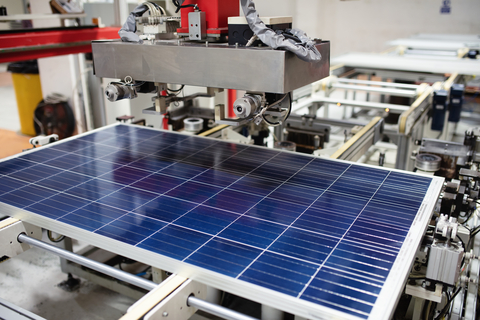
A potentially rocky 2025 never stopped the U.S. from bolstering its solar capacity for the future. In addition to those promising solar installation numbers from SEIA’s most recent Solar Market Insight report released Dec. 9, the U.S. has now put together its own solar manufacturing supply chain, built entirely on-shore with the completion of a new wafer facility in Michigan during Q3 2025.
These new facilities could help push the U.S. forward in the race for clean energy, according to Michelle Davis, head of solar research at Wood Mackenzie and lead author of the Solar Market Insight report.
“We expect 250 GW of solar to be installed from 2025 (to) 2030. But the U.S. solar industry has more potential,” says Davis. “Wood Mackenzie is tracking substantial increases in power demand across the nation. The solar industry would be well positioned to meet more of this new demand if existing constraints were alleviated, presenting upside to our forecast.”
Davis is cautiously optimistic for the short-term future of the U.S. solar industry, but the threat of President Trump’s energy policies will still loom large in 2026. SEIA research shows that more than 73 GW of solar projects are “vulnerable to politically-motivated delays or cancellations” in the near future.
SEIA president and CEO Abigail Ross Hopper echoed that sentiment in a recent report, noting that the solar market is continuing to meet demand, but could be frozen in political limbo under the second Trump administration.
“Remarkable growth in Texas, Indiana, Utah, and other states won by President Trump shows just how decisively the market is moving toward solar,” Hopper says. “But unless this administration reverses course, the future of clean, affordable, and reliable solar and storage will be frozen by uncertainty and Americans will continue to see their energy bills go up. America’s manufacturing surge, our global competitiveness, and billions of dollars in private investment are on the line.”
As the industry moves in 2026, Wiater says that he and the team at Standard Solar “remain optimistic,” despite policy changes and continued headwinds. In the wake of the OBBBA’s gutting of solar tax credits, the solar industry has the infrastructure and fundamentals to remain strong in 2026.
“The fundamentals of solar remain strong — our ability to deliver reliable, cost-effective clean energy continues to grow and public and private investment remain at record levels,” Wiater says. “The next phase isn’t just about weathering policy changes, but about innovating through them: strengthening domestic supply chains, accelerating interconnection reform and finding new ways to bring projects from planning to production. The industry has proven time and again that it can evolve faster than the challenges it faces — and 2026 will be no exception.”



Comments are closed here.