Report: U.S. adds 11.4 GW of solar capacity in Q2
The U.S. solar industry hit a new milestone in the second quarter of this year. With 11.4 GWdc of new capacity added, the country’s cumulative solar capacity is now enough to power one-third — or more than 50 million — households nationwide.
According to the latest U.S. Solar Market Insight report from the Solar Energy Industries Association (SEIA) and Wood Mackenzie, the solar industry’s 11.4 GWdc of new electricity generating capacity added in Q2 2026 represents a 45% year-over-year increase and a 43% increase from Q1.
“Solar and storage have grown to a scale most Americans have yet to fully realize, and we simply can’t meet America’s growing energy needs without these technologies,” says SEIA CEO Tim Pawlenty.
Utility-scale solar leads the way
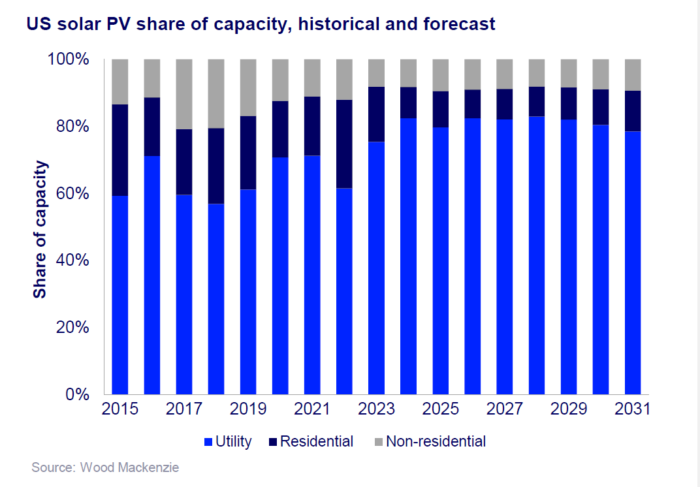
Utility-scale solar led the Q2 surge with 9.6 GWdc installed, up 61% year-over-year. The strong quarter reflects developers moving quickly to bring projects online ahead of the July 2026 safe harbor deadline for tax credit eligibility, while a substantial pipeline of projects will continue supporting solar growth in the years ahead.
Together, solar and storage account for 70% of all new capacity added to the grid in the first half of 2026.
The report’s forecasts show that the U.S. solar market will nearly double over the next five years, underscoring the industry’s ability to quickly deliver large amounts of new power as the country works to meet rising energy demand, strengthen grid reliability, and manage energy costs.
“Robust project pipelines and the build out of safe-harbored capacity will sustain roughly 44 GWdc of annual capacity through 2031,” says Caitlin Connelly, senior analyst at Wood Mackenzie. “However, permitting and the post-ITC transition remain significant headwinds.”
The residential market continues to face challenges following the expiration of the residential solar tax credit, but the outlook remains positive. Forecasts show the residential solar market will return to growth in 2027, as Americans choose solar to lower their electricity bills and improve resiliency.
Solar is booming in states across the country, particularly in those won by President Trump in 2024, which accounted for 71% of all solar capacity installed in the first half of 2026 and eight of the top 10 states for new solar installations.
Read the full report at www.seia.org/SMI.