
Noon Energy demonstrates ‘groundbreaking’ ultra-LDES battery
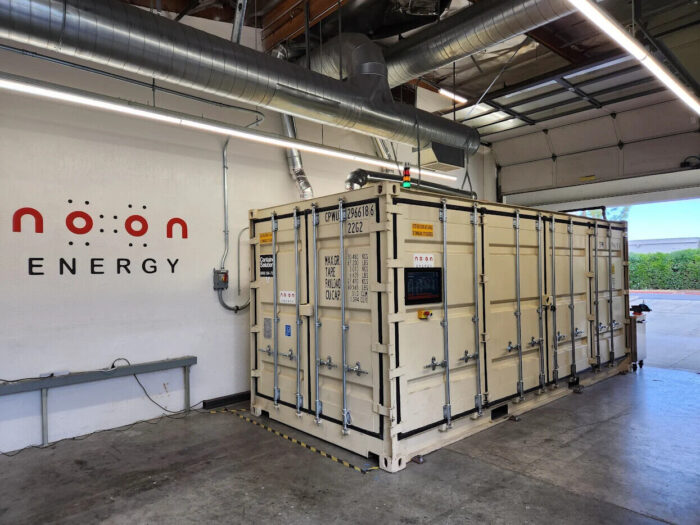
Noon Energy’s tests and demonstrations for its scaled-up ultra-long-duration energy storage (ultra-LDES) system proved successful, the Palo Alto, California-based company announced Jan. 21.
Touted as “the missing link” to 24/7 reliable renewable energy, the system is the world’s first containerized and modular ultra-LDES system sporting a reversible solid oxide fuel cell battery. The system has successfully operated for “thousands of hours,” the company says, and has an energy storage capacity of more than 200 hours.
“We are excited to have commissioned our multi-module demonstration system and demonstrated its lifetime, thanks to the excellent work of our incredible engineering team. This is a key milestone for our breakthrough technology’s scale-up,” says Chris Graves, co-founder and CEO of Noon Energy. “We have also built an even larger, commercial scale system, being commissioned soon with more details to come.
“Noon’s unique energy storage system enables low-cost, clean firm power for hyperscalers and other industrial load growth, which form an important part of our large customer pipeline.”
‘An incredible milestone’ for long-term storage
The ultra-LDES system is a “breakthrough” in low-cost long-term energy storage, the company says. The system’s storage capacity allows less expensive energy sources like intermittent renewables to become economically viable, delivering reliable power year-round and around the clock.
The system sports a discharge duration of more than 100 hours, allowing for a “constant, multi-day stream of power” and making the system useful in critical applications. Additionally, the system is anywhere between 20 and 200 times smaller than other storage systems like lithium-ion BESS systems and flow batteries.
Supported by the California Energy Commission, the demo of Noon Energy’s new battery is now live, the company says. The system only uses “around one percent of critical elements” in comparison to similar lithium-ion systems.

Comments are closed here.