Trina Storage completes fire test with Elementa 2 Pro system
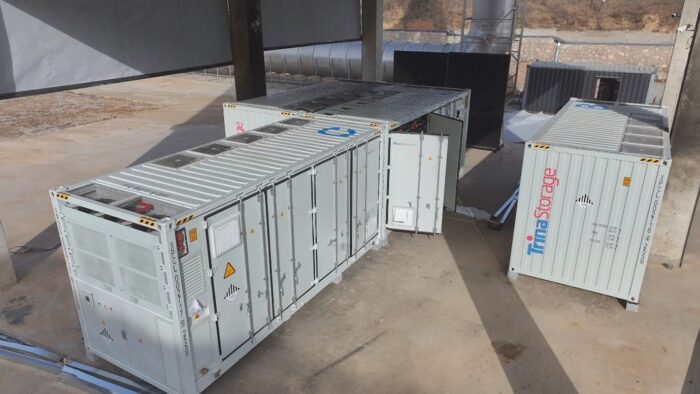
Energy storage firm Trina Storage, a business unit of Trina Solar U.S., has completed a full-container 5 MWh Large-Scale Fire Test (LSFT) for its Elementa 2 Pro system, the company announced Dec. 18.
Conducted under “extreme conditions” and with supervision from internationally-recognized third parties, the test confirms system-level safety performance features for the Elementa 2 Pro cell-to-AC product.
The Elementa 2 Pro integrates 314Ah high-performance battery cells, according to Trina Storage representatives. The system also includes “multi-layered safety architecture and systematic engineering design,” allowing the product to stand up to deliberately amplified heat during the test.
“With enhanced material upgrades from cell to cabinet level, (the Elementa 2 Pro) delivers comprehensive protection,” say Trina Storage officials. “Throughout the entire test process, the initiating cabinet maintained structural integrity without any collapse, while no thermal propagation occurred in adjacent cabinets. Its system-level thermal insulation and safety protection fully met expected requirements. Testing by the third-party authority Hiller confirmed that the internal cells showed no signs of abnormality.”
The Trina Storage testing model
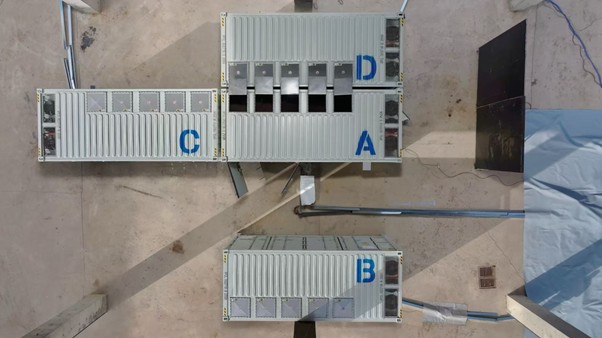
Trina officials performed the test on a full 1:1 site layout, officials said, with amplified testing conditions including high heat concentration, disabled fire suppression, open pressure-relief panels, and 100% state of change charging on all modules.
Each part of the test was amplified beyond normal measures and standard requirements, leaving less than four inches for cabinet spacing, and increasing thermal stress. Combustion strength and thermal load were also intensified thanks to the open pressure-relief panels and ventilation systems.
The team says that even in these conditions, the fire alarm system continuously issued alerts until its battery shut down.
“The uninterruptible power supply (UPS) within the initiating container remained functional, and the electrical cabinet was preserved intact, validating spatial layout, electrical isolation, and equipment protection strategy,” says the company. “Cell temperatures remained below 43.9°C in the back-to-back container and 23.9°C in the side-by-side container — both far beneath the cell venting point — the system showcased outstanding thermal propagation resistance, significantly surpassing typical safety expectations.”
The company now aims to keep pushing fire safety technology forward and “build a high-quality clean energy future.” The LSFT has helped Trina Storage deliver more than 12 GWh globally to date, with zero fire incidents across deployed systems.
Hiller validation
Fire protection, engineering, and safety institution Hiller’s Subject Matter Expert “fully witnessed and supervised the experiment on-site,” according to a Jan. 13 report by Trina Storage officials.
Recording critical data and maintaining stringent testing standards and conditions made the experiment with the Elementa 2 Pro not only transparent, but fully traceable, the company adds.
“Paul Hayes, vice president of energy infrastructure and senior fire protection engineer at Hiller, commented that Trina Storage’s stable and reliable system performance in this test reflects its professionalism in energy storage safety engineering,” Trina officials said Jan. 13. “Hiller will conduct a comprehensive and impartial analysis of all recorded data and produce an independent evaluation report, in addition to an NRTL report, providing valuable reference for the industry.”
Company representatives say that moving forward, the firm will continue this refining and testing process for its products, working with both global testing institutions and industrial partners to help usher in a safer, more reliable renewable energy industry.
Note: This story was edited on Jan. 13, 2026 to add more information about Hiller’s role in overseeing the experiment.