GameChange Solar holds industry-first seismic testing for solar trackers
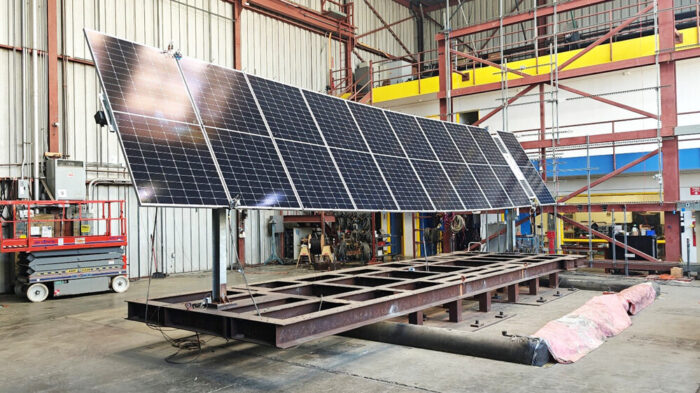
Solar tracker and fixed-tilt racking supplier GameChange Solar has successfully completed seismic testing for its Genius Tracker-brand products, company representatives announced March 30.
Touted as the solar industry’s first full-scale seismic shake table testing program, the tests were held at UC Berkeley’s Pacific Earthquake Engineering Research (PEER) Center in Berkeley, California. The product was tested at IEEE 693 seismic design standards, which GameChange says simulates “extreme earthquake conditions representative of high-risk regions such as the New Madrid Seismic Zone.”
Scott Van Pelt, the company’s chief engineer, says this testing — and technology that can pass it — is becoming exceptionally valuable as the solar industry expands across the globe.
“As solar expands into seismic-risk regions like California, Chile, and the New Madrid Fault Zone, the industry has had negligible real-world data on how modern utility scale trackers and modules perform in an earthquake,” says Scott Van Pelt, chief engineer of GameChange Solar. “This test changes that. We now have conclusive evidence that a solar tracking system, such as GameChange’s Genius Tracker, can be designed to withstand the forces associated with a meaningful earthquake.”
Seismic failure at a solar farm could mean not only widespread module damage and spiking repair costs, but potentially months of lost electricity, GameChange says. Fortunately for its Genius Tracker line of products, the company was able to report successful testing under rigorous standards.
Seismic testing results
The Genius Tracker held up well against the company’s testing standards, GameChange says. The tracking system “demonstrated strong performance across multiple configurations and test intensities,” according to officials, and posted no structural damage to any key components.
“Seismic design features, including GameChange’s proprietary Lateral Capture System, engaged as intended and effectively redistributed loads during testing,” the report says. “(The product experienced) no module microcracking or meaningful power loss, with degradation under 1% of the PV modules used during the testing. Full system functionality was maintained by the tracker motor after testing.”
The products tested in a number of different configurations and angles, as would be needed for useful racking technology. Despite the successful testing, the company recognizes that this is a “novel test campaign,” with several areas of improvement.
Future testing areas were discovered during the initial testing phase that could be implemented in a second round of testing for future products.
“Further work may be needed to characterize how different module types, such as thin film, respond to seismic loads,” the company’s research says, “as well as investigations into how different tilt angles, topographic slopes, and continuous span systems compare to the behavior of this specific test setup.”
Overall, however, the results “establish that single-axis solar trackers can operate reliably in high seismic threat environments,” according to Van Pelt.
GameChange Solar’s testing results, titled ‘Seismic Shake Table Testing of Single Axis Solar Trackers,’ are available on the company’s website.