Intersolar 2026 | Somewhat sunny skies, despite policy headwinds
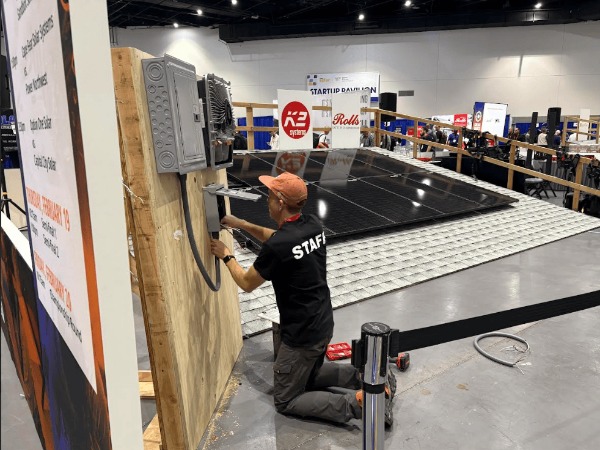
Last year’s Intersolar & Energy Storage North America (IESNA) flagship show took place in something of a limbo period. With President Trump having just retaken office a month prior — and promising to “drill, baby, drill,” largely doing away with the renewable energy policy advancements of the previous Biden administration — many feared the solar space, even as a mature market, was on unsteady ground going into 2025.
So far, 2026 has been largely more of the same, with good vibes abound, but that sinking feeling that the other shoe could always drop very much remaining. But there’s a difference now: the market has had time to correct. At the very least, the market has reacted to the changes made during the first year of the second Trump administration, perhaps most famously (or infamously), the One Big Beautiful Bill Act (OBBBA), which passed last summer.
Being able to read and react to the administration’s moves has allowed companies around the solar landscape to survive the changes, remaining mostly unscathed through the first 365 days and change of a second Trump presidency. But that doesn’t mean 2025 wasn’t hard.
Perhaps the strongest message this year was that all players in the solar market need to band together to continue weathering this policy-fueled storm in 2026.

Takeaway: No man — or company — is an island
The opening statement of Lynnae Willette, director of independent power producer EDF Power Solutions, could have served as a somewhat tongue-in-cheek slogan for the solar market in 2026.
“It’s been a rough year,” Willette says during the IESNA 2026 opening keynote.
The director would also say that her job “did a complete 180” in 2025. That is to say more specifically, that EDF shifted from enforcing the Biden-era Inflation Reduction Act’s renewable energy policies to simply trying to preserve what she could from the now four-year-old law in order to protect solar projects already in play.
“I don’t think I anticipated the amount of headwinds we would face, to the extent and to the significance,” she says. “Once the (OBBBA) was passed on July 4th, then it kind of switched over to the memos coming from the administration that impacted permitting on federal and private land.”
Other keynote speakers from the conference’s two-day schedule echoed Willette’s sentiment. Michael Judge, undersecretary of energy for the Massachusetts Executive Office of Energy and Environmental Affairs, pointed out that more than solar, offshore wind has been a particular challenge for companies in the northeast.
So with all this policy change, what can the industry actually do about it? Heather O’Neill, president and CEO of Advanced Energy United, says that collective action is key.
“When you’re trying to get policy outcomes in states, you’re working in coalition,” she says. “You’re working in coalition with your industry and your peers, but you’re also working with environmentalists and labor, and conservative groups. It just depends on the state and the politics of the moment.
“For us, collaboration is just part and parcel of what we do, and how we approach things.”

Takeaway: “VPP” is the acronymic buzzword of 2026
Speaking of collective action, virtual power plants (VPPs) have become perhaps the foremost rising star of the solar industry over the past year. Since their inception in Germany in the late 2000s, VPPs have always been a concept that sounds fantastic in a vacuum. However, practical implementation always seems to run into some sort of issue — lack of general electricity demand, high renewable energy costs, and lack of software to help link resources into a single VPP all jump to mind.
Those software issues are no longer a concern, according to Sam Wevers, director of product for Lunar Energy.
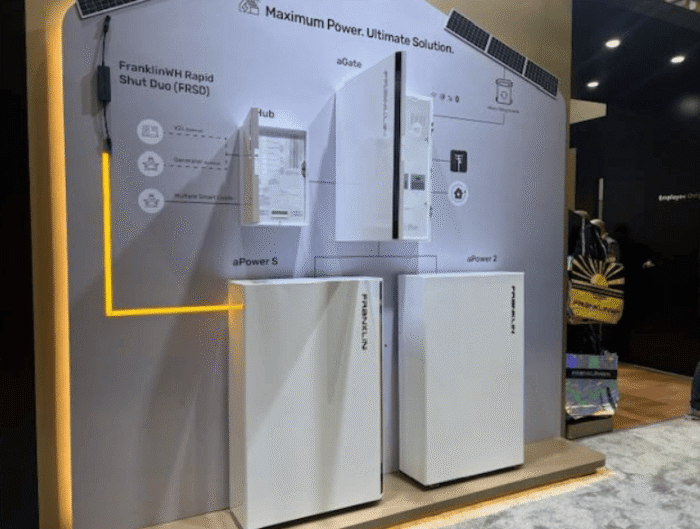
A product of Oxford University, Wevers is one of the leading minds behind Gridshare, Lunar’s half-AI, half-manual battery discharge platform that the firm calls the “digital backbone of the energy transition.” In short, the Mountain View, California-based company has used machine learning to teach Gridshare how to find eligible residential distributed energy resources (DERs), hook them into the grid as part of a VPP, and discharge their energy at just the right time to maximize efficiency.
“We’ve got 130,000 third-party devices connected (to Gridshare), which is about 650 MW, roughly 2 GWh,” Wevers says. “We’ve done 9 GWh of residential VPP dispatch, which I think is enough to power all of San Francisco for 29 hours. Our biggest dispatch in one push, so far, was 90 MW across 30,000 systems in one go.
“It’s not pilot, it’s not hypothetical. It’s actually contributing to the grid.”
Bobby Pierce, Lunar’s director of marketing, says the company is mostly tied to California right now, but the company will be making moves across the U.S. this year. Specifically, he highlighted known solar breeding grounds Texas and Illinois as two states on the proverbial short list, and off of American soil, Lunar is already seeing major usage in the BESS hub of Japan.
“Over in Japan, for instance, these batteries are also connected to our system — again, third-party batteries — and there about 30,000 batteries connected in Japan,” Wevers says. “For every one of these homes, we do a bespoke, behind-the-meter control plan each day. These homes have time-of-use rates and we essentially build, for each home, a machine learning prediction, personalized at massive scale.”
Takeaway: Affordability and reliability are key under a straining grid
Lunar’s machine learning model might be the most important aspect of the company as it looks toward the future. Knowing when to discharge energy across a VPP has become a key issue for operators, Wevers says, as energy grids continue to strain across the globe.
The problem with energy affordability, however, is that for as big of an issue as it is in 2026, the industry can “struggles to define what we’re even talking about,” according to Doreen Harris, president and CEO of the New York State Energy Research and Development Authority (NYSERDA).
“I think it’s important to note that many consumers don’t understand that energy is comprised of many costs to consumers, not just their utility bill, which is perhaps the most visible of those costs,” she says. “But in fact, in a state like New York, we have a large amount of customers on delivered fuels like propane and oil. We even have some kerosene that’s still used in New York and beyond.
“When we look at this collectively, it’s also the case that at least the northeastern states have some of the oldest infrastructure in the country as well.”
But the energy industry’s struggle to identify a core problem that can be easily pointed to doesn’t change the fact that utility affordability is a dire issue in the U.S. ABC News reported in late 2025 that energy bills rose an average of 13% across the country since the beginning of the second Trump administration, due in part to things like rising demand and the data center boom.
As Wevers says, batteries and VPPs are a part of the solution, but there are a slew of other factors at play that could cause prices to keep going up. But as the grid is filling up with distributed energy discharge options, Judge says, there still may be a bright spot in all of this.
“We’re actually seeing now with rooftop installation and residential, they’re not even participating in our incentive programs. The cost of electricity — and maybe this is a potential positive thing for solar — is so high, that it actually makes sense to just build this,” he says. “In the wake of changes to the IRA, we’re trying to cut red tape, make it easier, streamline permitting.
“How do we make it simpler to do this? I think grid issues is a central area where we’ve run into some major problems.”
Takeaway: Solar recycling is on the rise
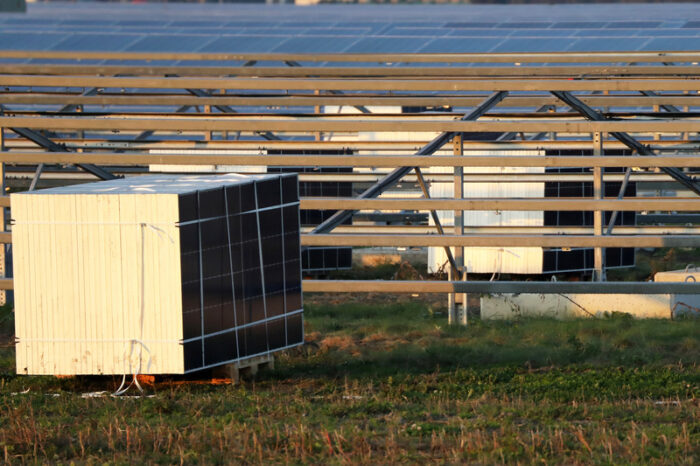
“(When I was with Sunshine Solar), I noticed a lot of waste,” says Emilie O’Leary, CEO and owner of Green Clean Solar & Wind. “You see a lot of trash in the mechanical installation part, and some trash through electrical installation, and cable and wiring. But when we were building these large sites, we didn’t know what to do with all that waste, and haul it to a landfill.
“I thought, this is so counterintuitive.”
O’Leary is far from alone, as solar recycling has become a hot-button issue across the industrial landscape.
Kate Collardson, co-founder and “technical operations wizard” at the Solar Service of Colorado, started SolarRecycle.org in 2021. A two-decade veteran of the solar industry, she has seen solar recycling go from a niche piece of the industry to a vital segment of the manufacturing ecosystem, she says.
“I’ve been giving presentations on this topic for many years, and the first presentations I gave, there were five dots on this map of (solar recycling sites),” Collardson says. “They were all spread out around the country. And I just love that every time I give a presentation on this topic, there are more dots on that map. It’s just really exciting to see this industry and this part of the industry grow as much as it has.”
Now, Collardson’s map is more than 30 sites strong, including 10 SEIA partnered processing sites.
Collardson and four other recycling-minded solar officials took the stage on Thursday for a panel that tackled the solar and storage decommissioning wave.
Among the panel’s speakers was Gaby Alvayay-Olson, director of sales and sourcing for North America at Sparks, Nevada-based Redwood Materials. She says JB Straubel, the company’s CEO (and the former CTO of Tesla), started brainstorming Redwood’s core ideas after a revelation came to him at Tesla.
“He said, ‘Hey, we’re going to have a battery problem in North America if we sell all these cars. What happens to these batteries when they come to end-of-life?’ What he found out, he was a little disturbed with: They were all going to have to go to Asia, because they own 92% of the world’s lithium battery supply chain,” says Alvayay-Olson. “That really bothered him, because we had to bring all these battery raw materials from all over the world to make these batteries, so this is really how the vision was born.
“We had to have a big problem in the lithium battery space to set up this much infrastructure. The EV is really what precipitated the building out of Redwood Materials.”
Sooner or later, the older generation of solar and ESS solutions is going to die off and need decommissioning, and the industry needs to be ready and have recycling plans in place when that happens, if it wants to be able to claim itself as a source of “clean” energy.
Takeaway: There is no silver bullet. But do we even need one?
Companies and consumers of solar and storage will do what they have to in order to weather the storm in 2026, whether the headwinds come from policy, shifting industrial practices, spiking energy demand, spiking energy bills, or any other in the wide number of sources. The reality is that there is not a one size fits all solution to these problems, so the only real solution is to keep going.
“There’s no silver bullet here,” Judge says. “When we were first talking with legislators and others, that’s a little unsatisfying to hear. They’re looking for quick fixes: how do we cut things and bring bills down? We really are tackling it from a lot of different angles, but clean energy is the solution. Clean energy is what’s going to make things affordable, and we really need to lean in on it.”
But truth be told, when I woke up for the first day of my first-ever Intersolar conference, I was worried that the rainclouds blocking out the rising San Diego sun might be a bad omen of things to come. As a newcomer to the solar space myself, I had imagined ghost stories: the Trump administration playing a Grim Reaper sort of character, haunting the American renewable energy industry and cutting all advancement from the past decade down where it stood.
I was pleased, and even more so relieved, to hear from a few separate sources that those fears — while still valid — had not yet come to pass.
“This diverse set of clean energy resources are very much those that we see only expanding into the future,” Harris says. “Order number one is just to build as much as we possibly can in the very near term, to really use up the pipeline to the expect that we can, to capture tax credits, to meet the demand.”
So yes, it has been a rough year, as Willette says. But while the solar industry may have taken a few hits, it has a much stronger chin than a newcomer like me had first thought.