VDE Americas touts hail risk model improvements
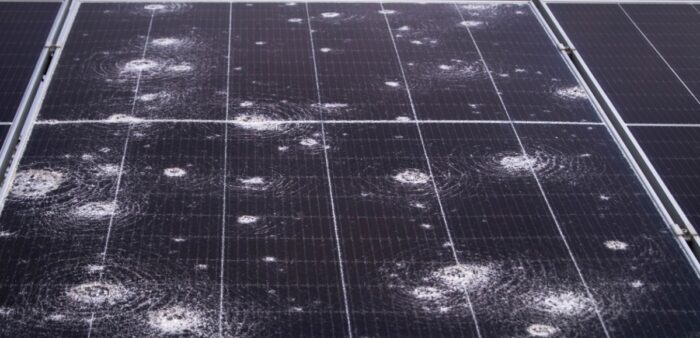
Nicole Thompson, senior data science manage for property insurance at kWh Analytics, says that hail accounts for just 6% of loss events among solar modules. It also manages to account for 73% of total solar losses.
Severe weather has always been a major risk factor for solar systems, simply by virtue of being located outside. But hail’s unique properties — namely, of course, its rock-like makeup — have made it a particularly formidable enemy for the average solar panel. VDE Americas is working to give solar owners and operators the tools they need to mitigate hail risk.
Pioneered by VDE’s in-house meteorologist and hail science specialist Dennis Weaver, the new hail risk assessment model is a “significant improvement” on its previous hail damage prediction model.
“The primary update is actually to do with how we understand hail falling through a wind field,” Weaver explains. “You can imagine that hail is not just being dropped vertically out of a cloud, it’s not just falling perfectly vertical. It’s falling through wind, and it’s being modified by wind.”
Helmed by president and CEO Brian Grenko, the San Jose-based company aims to give solar asset operators the tools they need to prepare and mitigate severe weather events. The updated hail model is one of several technologies offered by VDE for owners and operators, he says
“Every day, we’re learning more and more, and it’s kind of a continuous improvement process,” Grenko says. “You can kind of compare our hail model and our products to some peers in the industry that provide weather data. Their weather data is based on algorithms, and those algorithms are always being improved. The same is true for our hail risk models.”
Grenko says that modeling hail, and especially modeling the interactions it has with wind systems, is “complex.”
A relatively young science
Hail science, Weaver says, is actually a relatively young field, in comparison to the typical timescales of scientific investigations. In fact, humanity has only had the technology to estimate hail size from radars since 2000, making for a relatively small database.
It wasn’t until a recent study, led by a few private researchers and the National Weather Service, that new information came to light. That study was a major impetus for the model update, according to Weaver.
“We’re constantly learning new stuff,” he says. “This model update is just to keep in line with the best (data) we have, and constantly trying to improve the way that we come up with these estimates for hail damage.”
As previously mentioned, that update had a lot to do with trying to predict and mitigate the effects that wind would have on the falling hail. Weaver says that previous knowledge of the wind’s effects on nationwide hailfall has been “pretty minimal.”
“The big update here is, we actually took a whole bunch of weather data from across the country. We’re looking at ground observation stations,” Weaver says. “We crossed those against hailstorms that passed really near those stations.
“And then, analyzing the series of temperature data, of wind speed and direction data, we’re able to say, ‘Do we really think that the hailstorm passed over this station? And, do we really think that the winds that were measured here, are associated with the storm?'”
Refining the hail risk model using that updated wind data allows VDE to give solar operators a cleaner look at whether or not they’re going to get hit with a hailstorm. But that still doesn’t solve the main problem: what happens if your solar system is about to get hit by a hailstorm?
Mitigating disaster
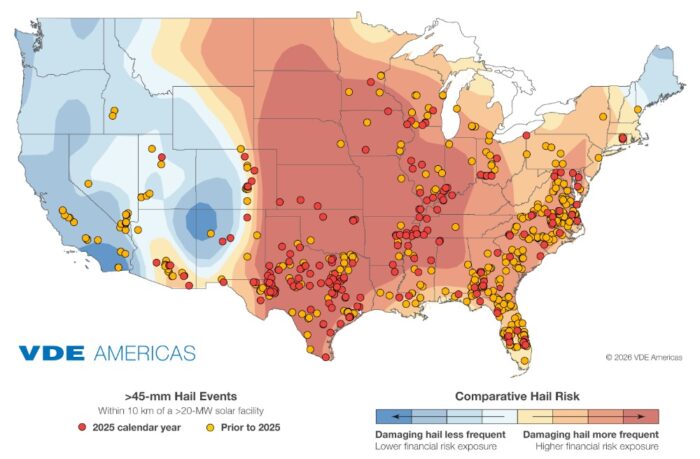
Hail isn’t all that common in the American weather system, but it’s becoming a stronger force in the forecast with each passing year. This could spell disaster for solar owners and operators without proper protection and mitigating, but VDE says the technology to deal with hail is becoming more advanced by the year.
“There’s two main pathways,” Weaver says. “One of the primary things that’s important when it comes to hail risk is the glass layer on the front of the panel, the overall resiliency of that construction at the very front. Those different constructions respond differently to hail impacts.
“The other is, imagine a large-scale solar facility tracking the sun throughout the day to maximize the energy it’s producing. If you put those panels into a higher tilt angle, what we call hail stow, you’re trying to minimize the energy that is imported into them from a hailstone.”
Either or both of these solutions can help turn hail events into “glancing blows” on solar systems across the country. In addition to system design elements, Grenko says that options are also open for operators to take matters into their own hands.
“As an operator of the plant, you can also set up severe weather alerts,” he adds. “You can design systems to automatically stow upon a certain type of weather alert, triggered by either the National Weather Service, or by private companies offering those types of services.”
Even so, Mother Nature can have a wicked sense of humor at times. Are solar owners and operators prepared for more severe weather events as the effects of climate change continue to take hold?
Planning for an uncertain future
In March 2026, Illinois saw a record-setting hailstorm, complete with a hail stone coming in at more than six inches in diameter. While that might be an outlier, potentially disastrous weather events are becoming more and more frequent across North America, and solar manufacturers are responding.
“I think one trend we’re going to start seeing over the next couple years is, you’re going to see solar panel manufacturers go back to designing products where there’s a variant more specifically designed for catastrophic risk mitigation,” Grenko says. “One of the general trends over the last 15 years is, module glass has decreased, frame thickness has decreased.
“Overall, the robust package of a solar panel has become less robust over time.”
That very literal “thinning out” of the general solar panel package has taken place because of a shift in supply and demand. As manufacturers try to cut costs, they simply decide to use less material, Grenko says. But as hailstorms and other weather events increase in both frequency and severity, the tide is turning back the other way.
So, how should solar asset operators weigh the cost of weather mitigation upgrades against potential damages? Grenko says that willingness to take risk will differ from owner to owner, but VDE wants to offer an objective look and let each solar owner choose for themselves.
“The reason why we’re doing this is because project developers, owners, are procuring project insurance to cover themselves for catastrophic risks,” Grenko says. “We’re a bunch of engineers. We’re driven by getting as close to the truth as we can. We want our models to be as accurate as possible.
“What we provide is a gut check, a reality check, and hopefully an independent view of hail risk.”