U.S. energy storage installations hit record numbers in 2025, report says
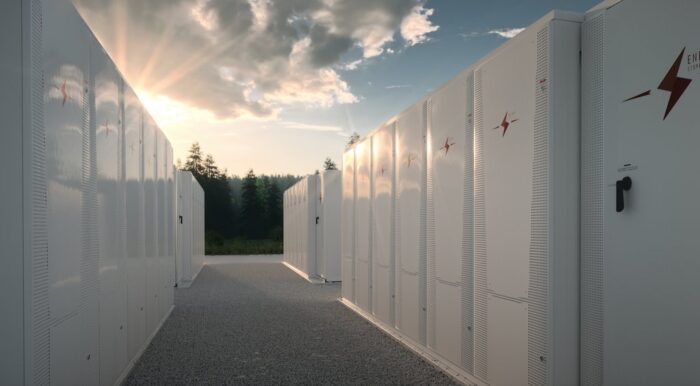
The American energy storage market set a record for new installations in 2025, according to Wood Mackenzie and the American Clean Power Association’s (ACP) new U.S. Energy Storage Monitor report.
Recording 18.9 GW of BESS installations last year, the industry posted a 52% increase over its 2024 number, the companies say. Q4 2025 closed with the strongest quarterly total on record with a total of 5.8 GW installed, and utility-scale installation accounted for 4.9 GW (about 84.5%) of that figure.
“The record-breaking energy storage growth seen in 2025 highlights how technology innovation is transforming America’s grid,” says John Hensley, SVP of markets and policy analysis at ACP. “This momentum, driven by supportive policy and expanding market opportunities, demonstrates that large-scale storage is now a cornerstone of delivering affordable, reliable, and American-made energy in communities nationwide.
“Continued collaboration across industry and government will be essential to building on this progress and meeting soaring energy demand.”
Breaking down market developments
2025 was a “banner year” for storage in America, according to Allison Feeney, a research analyst at Wood Mackenzie. Utility-scale storage saw installations across 22 states throughout the year and 13 states in Q3 alone, allowing some regional diversification in a market previously dominated by California and Texas.
“Declining system costs, supportive policies and growing revenue opportunities have all contributed to the impressive growth over the last six years,” Feeney says. “We expect this momentum to continue as the technology becomes even more proven and widely adopted.”
The residential storage segment saw the biggest spike in 2025, with installation figures marking a 92% increase over 2024. California led year over year growth with a 700-MW increase over last year thanks to high retail rates and net billing tariff implementation.
The CCI segment of the industry installed 95.6 MW of storage last year, good for a 16% increase over 2024. The report says the nation’s distributed energy segment grew in Q4, thanks in large part to bolstered policy measures at the state level.
“California led the market with record high Q4 installations of 45 MW,” the report states. “With the Net Billing Tariff (NBT) incentivizing storage, California is expected to sustain growth through 2026. New Mexico also delivered a record quarter with 5.9 MW installed, signaling a potential new market for C&I storage.”
Forecasting the future of storage
Storage is no longer a perk of some solar projects; it’s moving closer to being a basic necessity for the industry at large. The report states that the U.S. is set to install 500 GW of storage capacity from 2026 to 2031, making up two and a half times more than what was installed in the first half of the 2020s.
“The market trajectory is strongly upward,” says Allison Weis, global head of storage at Wood Mackenzie, “but large load buildout and federal policy will determine whether we reach the high case of 26 GW by 2031 or something more conservative.”
That base case does have room for even further upside for storage, however. The report says the high case results in 20% more storage capacity installed by 2031, than the base case’s 500 GW mark.
“The high scenario assumes that storage retains access to tax credits as written in the OBBBA and federal headwinds ease through workable FEOC guidance,” the report says. “This results in lower trade tensions and federal permitting relief and consequently higher utility-scale deployments at the end of the forecast.”
In the low case scenario, 24 GW less storage will be deployed by 2031. The case assumes that “restrictive FEOC guidance” makes tax credits difficult to earn for ESS and BESS projects. Weaker power demand — likely from the popping of a hypothetical AI bubble, among other factors — would also soften demand for storage in utility-scale projects.