
Global ESS likely to grow this year despite challenges, research says
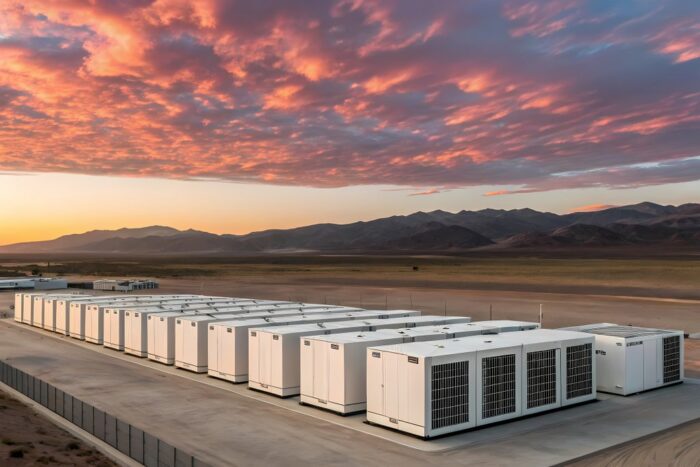
A new report from data analysis firm Wood Mackenzie says that the energy storage industry installed a record 106 GW last year. But even after such a smashing success in 2025, supply chain issues loom for the entire ESS supply chain in 2026.
Titled ‘Five trends to look for in global energy storage,’ the report says the global supply chain is due for restructuring as ESS continues to surge in the new year. Jiayue Zheng, an energy storage senior supply chain analyst at Wood Mackenzie, says that despite expected growth, solar developers face outsized execution risks in ESS installations this year.
“Margin pressure is particularly acute in China’s domestic market, while international markets offer a more favourable outlook characterised by stronger demand, better pricing discipline, and improved profitability,” says Zheng. “This market dynamic will drive Chinese manufacturers to aggressively expand overseas operations in 2026, prioritising market share gains over near-term profitability.”
Supply shortages that took hold across the ESS market during the tail end of 2025 are expected to persist this year, Wood Mackenzie says. Additionally, Chinese manufacturers are expected to change solar ownership structure options in 2026, in hopes to skirting around new FEOC restraints in the U.S. Regaining American market access could mean reducing ownership below 25%, the research report says.
Expected grid changes
As the global energy grid experiences further strain thanks to rising demand and the data center boom, 2026 will be a “pivotal year” for grid-forming energy storage solutions, Wood Mackenzie says.
“The global variable renewable energy (VRE) penetration of electricity capacity sits at around 36% as of 2025, and is expected to hit 56% by 2035, with many countries already experiencing VREs of 50% or higher today,” the firm says. “This decline of traditional synchronous generation is weakening the grid stability that power systems have relied upon for decades.”
This mass shift in renewable energy penetration leaves the metaphorical door wide open for energy storage and grid-forming inverters, researchers say. Europe has already published a technical report establishing the continent’s first “harmonized framework for grid-forming capability” with other renewable energy-heavy regions likely to follow suit.
Storage will also be critical for supporting large loads on the electrical grid, Wood Mackenzie officials say. As data centers and other large loads continue to strain the global grid—to the tune of 230 GW of projects in the U.S. alone—storage solutions will become exceptionally valuable.
“Storage will be deployed across a range of applications in 2026 to support data center growth, including interconnection support, load ramp management, resilience backup, and clean power integration,” researchers say. “While only 10% of all announced data centers currently tracked have associated onsite generation of any kind, that ratio is growing as load interconnection queues become increasingly jammed.”
Gas turbines are still the clubhouse leader when it comes to power large load projects on the grid for now, but the firm’s latest research report finds that storage is now the second most common onsite generator for such projects.
Hybrid ESS takes hold outside America
Allison Weis, Wood Mackenzie’s global head of energy storage, says the ESS market is currently “undergoing a fundamental transformation.” Hybrid and co-located BESS projects paired with renewable energy has become a popular option in the U.S., and the technology is expected to make the jump to mass adoption outside the 50 States this year.
“While supply chain challenges and policy shifts create near-term headwinds in some markets, the underlying drivers—falling costs, grid stability needs, and explosive data center growth—ensure that storage will play an increasingly critical role in the global energy transition,” Weis says.
Australia and India lead the hybrid trend in the Asia-Pacific region, Wood Mackenzie says, with more than 50% of storage projects announced across the two countries in 2025 containing solar, wind, or both.
“In Australia, hybrid and co-located projects accounted for 30% of storage capacity additions (GWh) in 2025,” Wood Mackenzie says. “For new solar-plus-storage projects, average battery capacity (in MW) is now larger than the solar generation capacity.”
Europe is also seeing storage co-location jumping to the mainstream, the firm says. Despite the fact that 80% of installed capacity remained in standalone ESS systems in 2025, the current state of the energy market is “driving rapid change” to co-location.
“Negative prices, once rare, now occur over 500 hours annually in some regions,” the report says of Europe’s ESS progress. “This reflects both the success of renewable deployment and structural weaknesses in grid flexibility. Offtakers demand PPA clauses that exclude negative price settlement, undermining bankability. Negotiations remain complex, pushing the industry toward hybrid PPA contracts that integrate batteries to mitigate volatility.”


Comments are closed here.