
Bifacial Panels + Dual Axis Tracker = 24% Winter Solar Boost
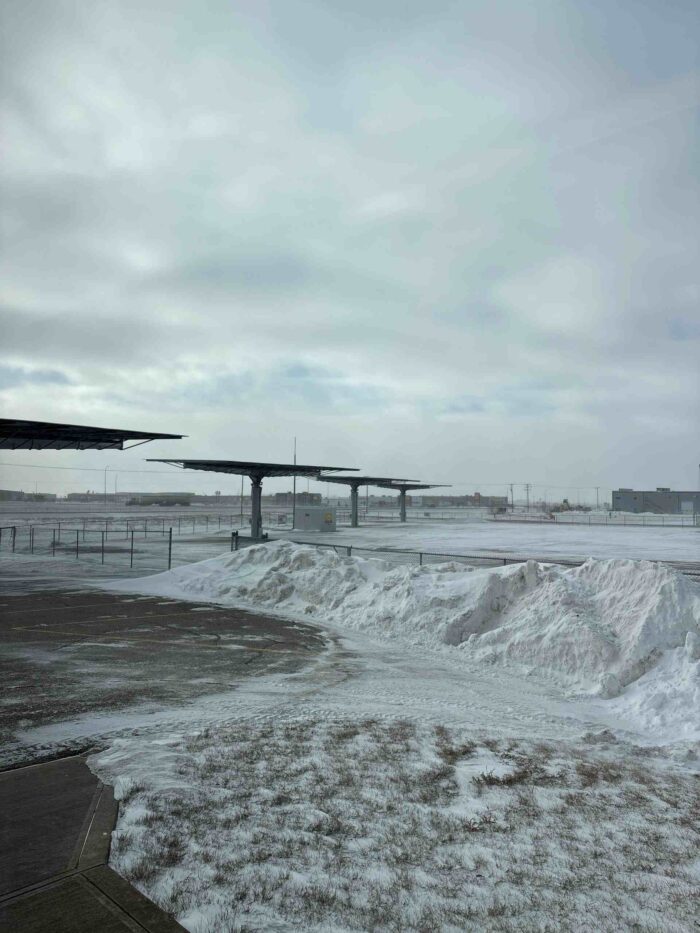
Balzer’s Canada Inc.’s (BCI) dual-axis tracker-plus-bifacial panel installation in Regina, Saskatchewan, has demonstrated an anticipated high bifacial electricity boost peaking at 24% over nameplate during a four-month winter test completed in January.
The bifacial array of four Mechatron M18KD trackers captured both reflected and diffused light, routinely reaching a double-digit percentage boost by 11 a.m. and routinely exceeding 20% thereafter, up to the daily winter 3 p.m. light curve decline.
Each of the four Mechatron M18KD trackers at the installation support 72 Thornova bifacial panels (Type 288), generating 580 Watts, with cumulative total power for the array at 167.04kW. The panels are linked by two 125kWac three-phase Solis inverters (Model 125K-EHV-5G-US-PLUS).
Bifacial panels capture low sun angles
The increased bifacial gain at Regina begins in the early morning hours with the low zenith angle of the sun at between 80-65 degrees, due to substantial deflective irradiance from the snow-covered ground around but not beneath the tracker.
The maximum mid-day 57-degree zenith position markedly increases diffused light, thanks in part to the extended height of the tracker panel table which ranges from 16 feet at the trailing edge to 35 feet at the top edge.
A much higher average bifacial boost is anticipated during the spring and summer seasons, when the sun’s zenith will reach 0 degrees directly overhead.
The hourly data for the test was collected by the Solis monitoring portal, including power (kW) and energy production (kWh) during the October 2025 to January 2026 period.
BCI builds and markets Mechatron trackers in Canada
BCI is a large supplier of oil and gas piping and manufacturing services in western Canada that represents Mechatron Trackers across the country. BCI also deployed two trackers at their satellite office in Calgary in mid-January.
“We’re setting a new standard for sustainable contracting in Canada,” states Ron Balzer, President and CEO of BCI.
The Regina array, commissioned in late October, is expected to produce approximately 750,000 kWh yearly, providing net-zero energy operations for the 23-acre company campus by the end of this year, according to Balzer.
With a LCOE at 0.02/kWh and an ROI at 22%, the Mechatron dual-axis tracker pays for itself within three to five years, depending on prevailing utility rates.
“We expect to build and install Mechatron trackers across the country as the best suited solar tracker technology for our Canadian climate, because of the gearless, low maintenance design,” says Josh Engen, the Solar project coordinator for BCI.
BCI manufactures steel products, and designs, builds and maintains large industrial projects in the oil and gas, utility, mining and wastewater industries, among others, utilizing company facilities in Alberta and Saskatchewan. Through a partnership network in Saskatchewan, BCI will be able to manufacture the vast majority of the components for Mechatron trackers sold in Canada, Engen notes.
Tapping the highest insolation in Canada
The initial geographic market focus for the new BCI Mechatron entity will be western Canada.
“We see a great potential for the Mechatron trackers to be utilized in the prairie provinces — Alberta, Saskatchewan and Manitoba — since these provinces have the highest levels of yearly sunlight hours in Canada,” Engen says.
“The elevated pedestal mount design is quite appealing to farmers due to the high demand for land space. Business owners also seem to appreciate the increased production with a smaller footprint when they have limited space. The footprint of the concrete pillar of the M18KD Mechatron tracker is a mere 7 square feet, minimizing the impact on land use.”
“As soon as we learned about Mechatron’s M18KD, with its unmatched accuracy, durability, and yield – including the great bifacial boost, we knew it was the right choice,” adds Balzer. “This system isn’t just about meeting our own net zero goals — it’s about leading the way for greener industrial construction across the prairies and beyond.”
Delivering the highest energy density in the industry
Dual-axis trackers present the highest energy density of all solar industry mounting designs, among which the Mechatron M18KD is the largest, supporting up to 90 panels. The trailing edge of the 35-foot high trackers is 15 feet, which permits full equipment operation under the canopy.
The unusually high-yield M18KD tracker generates 40% more energy than ground-mounted solar arrays and 20% more than single-axis arrays. With a single mast the tracker also has the smallest ground footprint in the global solar market, ideal for vineyards, carports and other terrain-constrained sites.
Each M18KD tracker supports 90 solar panels with 72-cut cells each, or 72 panels with 144-cut cells each, culminating in a yield of over 43 kW on a single mast. With a ground coverage ratio of up to 50%, the M18KD solution requires only 4 acres per MW of array.
Apart from providing the highest energy yield in the solar industry, Mechatron trackers are also extremely reliable, points out Michael Fakukakis, CEO of Mechatron Trackers. This best-of-the-industry performance is backed by a guaranteed uptime of 99.6% and a standard 20-year limited warrantee covering all the components of the tracker including electronics, hydraulics, mechanics and pneumatics.
About the M18KD Dual-Axis Tracker
The gearless, hydraulic design drives through 360 degrees of Azimuth rotation and 60 degrees of Zenith inclination. Highly weather-resistant, the M18KD tracker withstands wind gusts of up to 115 mph, with higher resistance available with the M18KD Heavy model, now operating in Idaho. The M18KD withstands snow loads of nearly 35 pounds per square foot (psf), although snow loads typically are shed using automated snow sensors and motion management software.
The unusually high-yield M18KD tracker generates 40% more energy than ground-mounted solar arrays and 20% more than single-axis arrays. With a single mast Each M18KD tracker supports 90 solar panels with 72-cut cells each, or 72 panels with 144-cut cells each, culminating in a yield of over 43 kW on a single mast. With a ground coverage ratio of up to 50%, the M18KD solution requires only 4 acres per MW of array.
The footprint of the three-foot diameter concrete pillar of the M18KD Mechatron tracker is a mere 7 square feet — the smallest ground footprint in the global solar market — minimizing the impact on land use and vehicle movement. The single-pillar architecture permits dual land use that allows unfettered business activities including agriculture, vineyards, carports and other terrain-constrained sites, with potential for EV charging.
Using bifacial solar panels, the Mechatron tracker has demonstrated an energy yield boost ranging from 21% in California to 24% in Saskatchewan. The dual-axis M18KD tracker captures more reflected light on the underside of the solar panels than lower fixed-mount and single-axis trackers, while it also captures more light than smaller dual-axis trackers that have lower tables.
Mechatron Trackers has completed a Black & Veatch Bankability Report, as well as UL 3703 certification standard evaluation by SolarPTL. The company’s expanded manufacturing facility now has an annual production capacity of 200 MW of trackers.



Comments are closed here.